

This research note is part of the Clockless Clock book project.
I’ve previously written about three Greek personifications of time, Chronos, Kairos, and Aion. The first two are relatively well known, and represent, roughly, objective (clock), and subjective (stream of consciousness) time. The third though, is neither well known, nor well understood, but is particularly relevant for making sense of the times we are living through now, so let’s do a little side quest.
From Aion, we get aeon or eon, the modern English word for long historic eras. But it is not so much the length of a period of time that makes an eon as its cyclical narrative completeness. An eon is a frame story with a beginning and end, and an all-subsuming quality to it, covering all humans in scope, not just the dramatis personae of a specific story (even if it is an epic story, though epic stories often mark boundaries between aeons). Eons represent the equivalent of seasonality in historical time.
Aion is often represented as an ouroboros (a snake biting its own tail) or as either a young or old man. These representations get at the cyclic aspect of time. Every ending is a new beginning. There is also an out-of-time liminal quality to the aionic aspect. To contemplate the significance of eons, you have to somehow situate yourself outside of time altogether, hence the liminality. You have to somehow pop out of a narrative mode and view the shape of the story in an extratemporal way. I think of this as aionic storytelling.
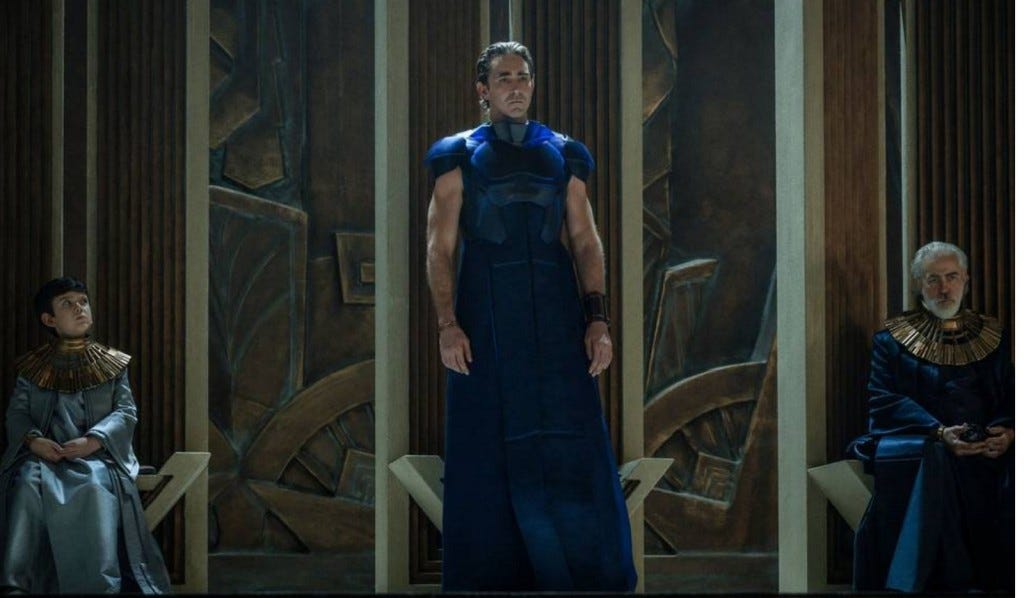
One of the best examples of aionic storytelling I’ve ever seen is in the new Foundation TV series. The show has a plot element (not in Asimov’s original books, but an excellent tweak) involving a line of cloned emperors. At any given time, there is a triumvirate of a child, adult, and elderly clones, who rule together, and are referred to as Brother Dawn, Brother Day, and Brother Dusk respectively, with Brother Day as first among equals.
As each Brother Dusk ages, a new baby clone is grown, to be the new Brother Dawn, and Brother Dusk becomes Brother Night and is euthanized. Brother Dawn becomes Brother Day, Brother Day becomes Brother Dusk, and a new eon begins. A new eon isn’t marked by everything being young, but by the youngest part being young. Brother Dawn is a baby at the start of a new cycle of Cleons, and a still-young man towards the end. It’s the presence of a newborn in the ruling tableau, the baby Brother Dawn cradled in Brother Day’s arms, that makes it a new eon. And it is the fact of the three being collectively the emperors of the empire that makes the eon about more than just the three individuals. The three Cleons are even formally addressed as empire. They literally embody the empire. There is no part of contemporary history they do not represent.
The first act of the second episode is entirely devoted to a meditative, liminal contemplation of the cycling of the Cleons (interesting that Cleon is an anagram of clone, and also includes eon). Nothing much of note happens in this bit. The plot doesn’t move forward. Yet, we see the whole story in a powerful way, from outside of time. A way grounded in stillness and eternal karmic cycling that’s a perfect complement to the eventful Chronos-Kairos psychohistory that drives the foreground plot.
It’s been my favorite part of what is already my favorite TV show in a long time.
There are other shows that do aionic storytelling well (Doctor Who for example, with the regeneration episodes between Doctors being particularly powerful), but this is one of the best I’ve seen, and really suits the present mood.
When I wrote Chapter 1 of The Clockless Clock, the pandemic was just starting, and the light at the end of the tunnel was not visible. Now we’re towards the end, and large parts of even the developing world have been vaccinated (India just crossed the 1 billion shots mark, and China crossed it a while ago) with the notable exception of Africa (still around 5%). Things are opening up again. It’s hard to remember or relive the early days of the pandemic.
We’ve changed. We’re now people who’ve always-already lived through a pandemic and cannot return to the state of mind we were in before.
In 2020, the end of the last eon was most starkly centered by the events of history. There was the unruly closing act of the Trump administration, and various other global threads of the Great Weirding, which all seemed to represent one or the other aspect of the end game of the Industrial Age (a proper eon). Dusk turning into Night for the Industrial Age.
In 2021 though, while several globally/universally salient threads (such as the Biden administration’s doings) seem to belong to the past, many more threads seem to belong to the future.
Whatever this new eon is, it has dawned. Brother Night has been euthanized, and the infant Brother Dawn is being cradled by Brother Day.
The supply chain crisis, the Web3 , AI, robotics, and metaverse conversations, COP26 coming up next week (amid leaks and mutual recriminations among nations over missed COP21 targets), and the suddenly warming China-Taiwan issue, all seem to be opening scenes from dramas that will take decades or even a century or more to play out.
In other words, whatever you choose to name it, and whatever aspect you choose to emphasize, it’s clear we’re in the infancy of a new eon.
I personally have been calling it the Permaweird. But the eon won’t acquire its proper name in history until after we’re all dead. The end of the eon that is being born right now lies beyond the horizon of our own mortality.
Grand narrative threads that are getting started now will probably not reach their natural denouements in our lifetimes. We’ve talked about many such stories in this newsletter recently: AI, robotics, terraforming. I have a series going about the possible end of the nation state (After Westphalia). There’s others, such as the new space race, and a potential US-China new Cold War, that I haven’t yet touched upon, but plan to.
All these stories share a common feature: you and I likely won’t live to see how most of them end. There’s a certain poignancy to thinking and writing about any of this, seeing as how we likely won’t live to see if we were right or wrong.
Sentiment aside, what are baby eons like?
Unsurprisingly, nobody seems to have a clear idea. Arguably humanity has not lived through a baby eon since at least the 1920s, and possibly since the early 1800s. Remember, an eon, in the sense I mean it, is not any old historical cycle. It is one whose grand narrative subsumes all other narratives for all of humanity, in a way that trying to step outside of it almost kicks you out of time altogether. An eon is a complete extended narrative universe.
Aionic babyhoods are not in human living memory. We’re going to have to figure it out, with some limited help from historical records.
The one that’s possibly shaped my own thinking the most is the one following the Black Death.
Events in Europe are best documented, and in many ways the Black Death marks the birth of Europe itself, as both a civilizational pattern distinct from those extant at the time in Asia, and as the vanguard of global modernity.
Many stories we now recognize as historic, such as the reformation of the Church, the development of modern printing, the age of exploration leading to the European settlement of the Americas, the decline of feudalism, the rise of strong monarchies, urbanization, and the beginnings of modern trade, all have roots traceable to the immediate aftermath of the Black Death.
The eon that began around 1348 only ended with the beginning of the eon that is ending now: industrial modernity around 1800. So it lasted about 450 years. It is usually called early modernity, and the beginning is typically dated to between 1453 to 1492, with the fall of Constantinople or the voyages of Columbus being the usual markers, so about 100-150 years counts as the unmarked babyhood (tempus nullus?) of Early Modernity.
Words like “renaissance” and “enlightenment” only partially get at the character of the eon that started with the tragedies and dislocations of 1350-1400.
When you review the history of the 1350s-1450s, what is striking is the inchoate nature of events, and the lack of clear narrative threads. Not just Europe, but the entire world was in transition. You see fragmentation of historic civilizations, unraveling of the patterns of the Middle Ages, reform movements gathering momentum in all major world religions, governance models undergoing serious churn, and so on.
It was an age where the slate had been brutally wiped cleaned, and a great many new beginnings were underway. There was a great deal of potential being unleashed, but it had yet to take on concrete forms. It did not yet have a character that could be named.
One way to put it is — there was a great deal more energy than structure to the events of history. Chaos was reigning, and would not be reined in for another century. Cleaner narrative movements begin to appear worldwide only in the middle of the 16th century.
History unfolds faster these days. There are good reasons to expect that the amount of historical development that took a century (counting from say the first wave of Black Death in 1348 to the fall of Constantinople in 1453) might only take half a century today. Eons seem to vary in length but normalizing loosely, you could say that a quarter-eon took 150 years in 1350, but might take 50 years now. In terms of our lifecycle metaphor, we might segment an eon as follows:
Babyhood: 25% — chaotic energy, undefined character
Rise: 25% — defined character, coherent narratives
Maturity: 25% — established history, character and narrative worth naming
Decline: 25% — unraveling, confused interaction with next eon being born
So you and I, we might begin to sense the true contours of the coming eon on our deathbeds, but much of the rest of our lives will be spent grappling with the babyhood of this new eon.
I don’t have or want any kids, but I’ve lately been spending a lot of time with some kittens we rescued, so the characteristics of babies are pretty fresh in my mind.
Babies have a boundless energy, a pure curiosity, and a sort of innocence attached even to what are obviously future vices. They are easily entertained, but also easily distracted. They also easily get themselves into trouble, but are surprisingly resilient. They have a curious mixture of fragility and antifragility. A careless move by an adult could easily crush them, but they also seem capable of shaking off awkward falls and twists that would lay adults low for weeks.
On the downside, while babies are charming and cuddly, they are kinda boring and exhausting too. They can get endlessly absorbed in repeating some trivial kind of play that cannot engage adult attention. They chase their own tails. They watch the same dumb animated movie repeatedly. They cannot see obvious endings coming. They lack a proper theory of other minds. They are easy to fool. They are entertained by tic-tac-toe. Their ignorance of almost everything is intimidating. You have to do everything for them and protect them from everything they don’t know. They wake you up at night.
I think many of these characteristics carry over to baby eons. After all, understood as the all-encompassing birth-to-death stories of coherently self-perpetuating global human superorganisms, an eon is less a kind of time than a kind of life.
A recently born eon, as it explores its life, and comes into its own, will act like a baby.
It is going to be energizing and boring, inchoate but full of momentum, ignorant, but open.
And in the background, the eon that was will continue to fade rapidly. In my own life there is also a 17-year old cat who probably only has a couple more years left at best. He has a fully developed and strongly ingrained personality, and a full complement of the infirmities of old age. There is a certain sadness to being with him that colors perceptions of kittens. They too will age and die. He too was once a baby (we rescued him when he was just past kittenhood, in 2004, and ran into my apartment on a cold night)
I’ve taken to thinking of the rescue kittens as Brother Dawns, and my aging cat as a Brother Dusk. That thought is at once genuinely sad and genuinely life-affirming.
As above, so below. From cats to civilizations. The aeonic cycle of life continues fractally at all levels in the background, even if momentous psychohistorical events unfold in the foreground.
For those of us living through this birth of a new eon, the only real question is which aspect to be a part of: dawn, day, or dusk.
Are we to be part of the undefined and new Dawn, full of a rude energy, but lacking in character and structure?
Are we to be part of the reigning Day, nurturing a Dawn whose Dusk we will be not live to see, and watching the retreat of a Dusk we will outlive, but whose Dawn we never shared?
Or are we to be part of the receding Dusk, learning to let go, turning into Night?
Interesting thought and perspective. Foundation has already moved away from the original stories significantly. Just finished reading all of them again. It’s actually quite good. The Marvel Universe is also experimenting. Time spans are small but the move to a Multiverse SMD multiple universes with What If and Loki and the upcoming shows and movies also marks the start of a new aeon, I think.