

Didn’t send out a newsletter last week since I was busy with the Protocol Symposium and then came down with a bad cold right after that left me unable to do anything except vibe-coding. That led to some very interesting results though, which I’ll write about in the future.1
I want to do an update on my world machines theory, based on recent readings in the book club. For those who came in late, the theme for the year has been what I call the Divergence Machine, my name for the world system that emerged between 1600-2000.
I didn’t get too far with The Education of Henry Adams, the September pick, since I was busy trying to finish Darwin’s Dangerous Idea from August and the side quest Revolutionary Spring from July (side-quest month) which is the one that has me really hooked, and is long and dense. So several reads in flight that will take a while to finish, but hey, that doesn’t mean we can’t start new reads, right?
I have 2 selections for October, and you can pick one. Unfortunately, Bayly is not available on Kindle and Appleby is expensive, so I recommend looking in your library and buying used copies if you can’t find them there.
Joyce Appleby’s Relentless Revolution
C. A. Bayly’s The Birth of the Modern World.
All book links and Discord discussion thread links (hosted on the Protocol Institute Discord) are on the book club page.
Now for the updates to world machines theory.
The 19th Century
The big learning for me from the last few months of book-clubbing is that the 19th century is where almost all the action is, for the Divergence Machine, and much of it was precipitated by the French Revolution and the Napoleonic wars, both of which are big events we’ve been reading around rather than through.
In the first few months of the year, we read several books that basically looked at how the foundations of the Divergence Machine got laid in the 17th and 18th centuries. This was a tumultuous and very eventful period in history, but I didn’t realize the extent to which the French Revolution was the precipitating event for divergence in our sense — unbridled plurality, epistemic and ontological divergence, and liberalism in the modern sense — really exploding all over the globe. Like any self-respecting exponential/network-effect type process, the back half of the growth curve was where the heavy lifting happened.
Speaking of eventfulness, a paper by William Sewell, Three Temporalities: Towards a sociology of the event, has been very influential for our book club and associated psychohistory discussions. Ht Nils Gilman since I found it in a book (Logics of History) he loaned me several years ago, specifically tagging this chapter. It provides a useful way to think about “singularity” type events embedded into the larger currents of history, such as the French Revolution or 1848. We’re doing a bunch of theorizing inspired by it.
Before/After 1789-1814
1789-1814 was something like an explosion, through which divergence took off with a vengeance. You could say divergence got prototyped and theorized as a mechanism in 1600-1800 but was deployed to production during 1789-1814.
The books we read earlier in the summer, all pre-1800, about Alexander von Humboldt, the Jena romantics, the history of the mechanical clock, Enlightenment publishing around Diderot’s Encyclopedie, and the philosophical ferment around Leibniz, Spinoza, Hume and Adam Smith, all converge on the French revolution and Napoleonic wars in one way or another.
I finally got why Hegel tagged the Battle of Jena-Aurstedt (1806) as the og candidate for the End of History. It is a breakpoint when a certain kind of historical process concluded and a distinctly different kind took off. I think Fukuyama was right to relocate the End of History to the end of the Cold War, but I can see why and how 1806 would have seemed compelling to Hegel. It was a similar kind of break boundary. I think the reason Hegel got it wrong is that history only ended for elites in 1806. The masses had yet to be even brought into history as meaningful actors (not counting pre-modern peasant revolutions, which in a certain sense were sub-historical background phenomena). The reason 1989-1992 is a much more compelling candidate is that that marked the end of history for everybody.
This makes me think history may be restarting (a conclusion I’ve long resisted more stubbornly than Fukuyama himself): AIs are a new class of political actors that have yet to enter history. Whatever your views on the sentience or consciousness or personhood of these actors, they are emerging as true actors in the same sense nations and corporations already have. And while nations and corporations are accounted for in Fukuyama’s end-of-history tag, AIs have emerged since then.
So yeah, history may be restarting.
1848 as the Inflection Point
After the end of Napoleon’s career, things really start to get going for divergence. Like many, I used to treat 1648 (Peace of Westphalia) as the notional starting point for political/nation-state modernity, but now I think 1848 is the right date. The two intervening centuries didn’t really establish the idea of the nation state. They didn’t even properly separate church and state, or systematically contain monarchial power. You want a real hinge year, look at 1848.
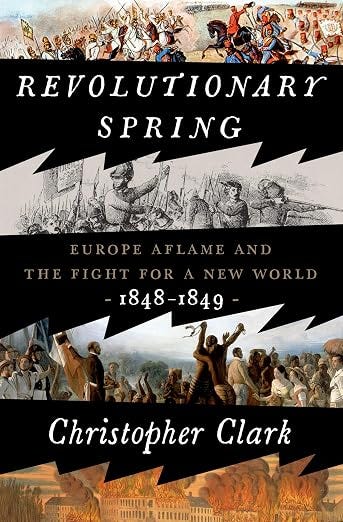
Christopher Clark’s Revolutionary Spring is the one book I’d highly recommend if you read just one book from our book club so far. It focuses on the build-up to, and aftermath of, the wave of revolutions across 1848 in Europe that created the modern nation-state, along with all the familiar political factions that persist to this day — progressive radicals, liberals, and conservatives. And the dominant actors who emerged in 1848 were the non-elites that didn’t really matter in 1806 when Hegel thought history ended.
The prehistory of Marxism in particular, is a particularly interesting thread, featuring such French thinkers/cult leaders as Saint-Simon and Michael Fourier (no relation to the mathematician) and decades-long political ferment around what was then called the “social question” — the new conditions of urban poverty and squalor being created by the early industrial age. Marx was just one among a great many reformist ideologues in the mix in the decades leading up to 1848. He came out ahead as the leading ideologue by way of synthesizing all the strands in a coherent, opinionated, and legible way, more than by originating them.
Many historical references now make more sense. The famous barricade scene in Les Miserables dates to this era and is situated in this history. The word putsch apparently derives from the zuriputsch, a Zurich instance of that type of political-revolutionary episode.
Anglosphere Exceptionalism
Equally important is history that didn’t happen. Britain largely escaped the Continental turmoil of the mid-19th century because it had already gone through a more primitive form of the transition in the 17th-18th centuries and had developed a kind of immune resistance to the influences originating in France.
A crucially important note here (which emerges in the Hume-Smith book) is that for Britain and the Anglosphere generally, the Scottish Enlightenment was far more consequential than the Continental one, and had a much stronger economic-technological character (think Adam Smith and James Watt). So instead of a revolutionary spring, it got the industrial revolution. The story of the West since then has been the continent trying to absorb the Anglosphere’s industrial-economic ethos and the Anglosphere trying to absorb the continent’s political-social ethos. Both have gone poorly, for the West itself, and the world. A battle of two immune systems fighting alien DNA.
One little subplot probably worth exploring here. The Royal Society and Academie Francaise emerged before the 1800s, along with (rather curiously) the Russian Academy (thanks in part to Leibniz) as major institutions (there were others, but less influential), with Latin, and later French, as the dominant languages. These were pre-nationalist scientific societies that were born of royal patronage. But in the mid 1800s, we see a burst of nationalist ones, in unexpected places like Hungary and Serbia, that aimed to not only reproduce the French or British model, but modernize their languages in order to make the suitable for doing science. This tendency of course, spread to the rest of the world. But on the whole, arguably, the British model won modernity, establishing English as the language of science and development. Revealingly, French remained the language of international politics and diplomacy much longer than it remained the language of science.
I have to look into Anglosphere-Continent dynamics more carefully. I think they were similar to the US-Soviet or US-China epochs that came later. Primal tensions that proved/disproved important things about history.
The 1830s-40s feature recognizably modern culture-war type discourses all over the place, though perhaps with more of a religious flavor.
Colonial Regions Reconsidered
One of the biggest surprises for me was the extent to which the national movements around the 1848 revolutions resemble the freedom struggles in the colonial parts of the world a few decades later. In fact, it seems pretty clear there’s not just inspiration, but direct causation and continuity, since there is barely any gap between the two. Many of the leaders of various colonial freedom movements were already alive and watching in 1848, and early events were already unfolding (the first war of Indian independence or “sepoy mutiny” was in 1857, less than a decade after the events of 1848; Perry forced Japan open in 1853; the Taiping rebellion started in 1850).
The colonial freedom and nationalism movements, arguably, were merely continuations of the 1848 European dynamics in non-European territories, with non-European idiomatic characteristics. I’d argue even the American Civil War was part of this global wave of emergence of modern nations, not a uniquely American event.
Oddly, this makes me more sympathetic to the colonial powers. The 1600-1800 period of colonialism was pure, brutal mercantilist expansion on the back of a small technological edge that had not yet compounded significantly. But 1800-1950 or so, world history was in fact already loosely synchronized. Japan for instance, emerged almost in lockstep with modern Europe, from a roughly similar condition. It did not mimic European development patterns after they’d stabilized. Other non-European societies followed. Some events in India (such as the Anglo-Sikh war) belong in this era, rather than in the previous era of colonial wars proper (such as the Mysore and Maratha wars of the 18th century).
It isn’t surprising that much of the transmission/continuation of European reform outside Europe was the work of Western educated lawyers (like Nehru and Gandhi in India). They imported not just ideas about constitutional machinery, but the softer ideas like the ideas of nationalism, socialism, conservatism, and most importantly, liberalism. The Indian independence movement, which is the one I know the most about, rhymes eerily with the European ones.
Econo-Globalism Triumphant?
One way to frame the history after 1848 is as a struggle for dominance between the political culture of the Continent and the econo-globalist culture of the Anglosphere, and arguably, the latter “won” to a large extent. It’s not that the events of 1848 weren’t consequential. They were hugely consequential around the world. But they got largely contained and tamed by the more powerful forces unleashed in the Anglosphere, and continental Europeans have been pissed off about it ever since. Possibly both World Wars can be seen as expressions of this tension.
That brings us to the final missing piece in this story.
The final missing piece in this big story, the econo-globalism piece. I think we will find the answers we’re looking for in our October reads. Appleby’s book in particular has long been on my radar, and seems very promising (ht Mick Costigan). The Bayly book, which I discovered via a ChatGPT brainstorm will, I suspect, substantiate the thesis I just outlined above — the ripple effects from the 19th century that transformed the world, creating the beginnings of globalization.
At the symposium, I gave a talk on Blygger, a kind of RSS 3.0ish AI-native future-of-blogging/social publishing protocol I’ve been developing in stealth for a few months with Claude. Just a week ago, all I had was a rudimentary spec and janky demo reference client. But the talk appeared to hit a chord and it looks like a lot of people were itching for something like this. A bunch of people immediately hopped on, made their own blygs despite the early and unstable nature of the spec and code, and started contributing significant amounts of code. There’s now a very active core group developing the protocol and multiple clients, and a dozen blygs already up and running. It’s not yet ready for prime-time or non-technical users, but if you think you can keep up with rapid and unstable pre-release development, and are comfortable working with coding agents, you’re welcome to jump in. There’s already a thriving little blygging scene going. Here’s my personal blyg.
> I finally got why Hegel tagged the Battle of Jena-Aurstedt (1806) as the og candidate for the End of History. It is a breakpoint when a certain kind of historical process concluded and a distinctly different kind took off. I think Fukuyama was right to relocate the End of History to the end of the Cold War, but I can see why and how 1806 would have seemed compelling to Hegel.
Sorry to be that guy, but you won't quite find this in Hegel. By my lights, it's Kojève's claim. (Who even himself conceded his reading of Hegel was idiosyncratic and even a sort of political propaganda.) Hegel famously claimed to see Napoleon arriving to Jena as world-soul on horseback, which I suppose was Kojève's justification. But it's a great leap.
It's challenging to find living scholars who think end of history existed for Hegel, to begin with, but this is at least possible to argue. The nays point to the Owl of Minerva in the preface to PR, yays answer with some quote on constitutional monarchy (after Jena), nays point to Hegel's remarks on America as a land of the future (and as such beyond philosophy, which is to him retrospective), which would align strangely with the yays' quote about how history world history starts in Asia and ends in Europe...
So far as there is an "end" in Hegel, it is better seen as telos than a finality. History can arrive to the completion of some totality, but it's like the end of a chapter: the future remains contingent. Such a telos may unfold deterministically, but only in hindsight. Maybe you're getting that this end is not the end which Fukuyama is often thought to posit, but that so far as they exist, there have been and will be many more ends of history.