

We’re heading into December and a wrap for our 2026 book club. Our final pick is Samuel Butler’s utopian satire, Erewhon (1872) rhyming with our final pick last December, Thomas More’s less obviously satirical Utopia (1516).
For those who came in late, let me reintroduce our book club and its underlying conceits. It’s all about what we call world machines theory, which aims to model history as overlapping millennium-long epochs marked by the rise and fall of planet-scale civilizational apparatuses with specific, peculiar, historical characteristics. Every year we study one world machine by reading a book a month about its rise, or dawn phase, of about 400 years. Last year we studied the Modernity Machine (dawn: 1200-1600). This year we’ve been studying the Divergence Machines (dawn: 1600-2000). In 2027 we will study the Liveness Machine (dawn: 2000-2400?). You can catch up on my previous world machines writings here.
This year, a few of us we leveled up the conceit beyond a book club, to try and develop a real-life version of Asimovian psychohistory through some gleefully abusive use of AI capabilities directed at historical analysis, using the books of our book club plus lots of other material.
Join us: Our psychohistory research group meets every other Thursday at 9 AM Pacific on our Discord. Our next two meetings, Dec 3 and Dec 17, will be the final ones for this year. We will discuss our 2026 book readings, brainstorm candidates for next year’s book club, and plan the Liveness Machine research agenda.
We even have the beginnings of a prime radiant, primarily designed by Aneesh Sathe with material support from Sean Stevenson, Florian Lohse, and others.
Just look at this vibecoded monster, it’s enough to give professional historians nightmares.
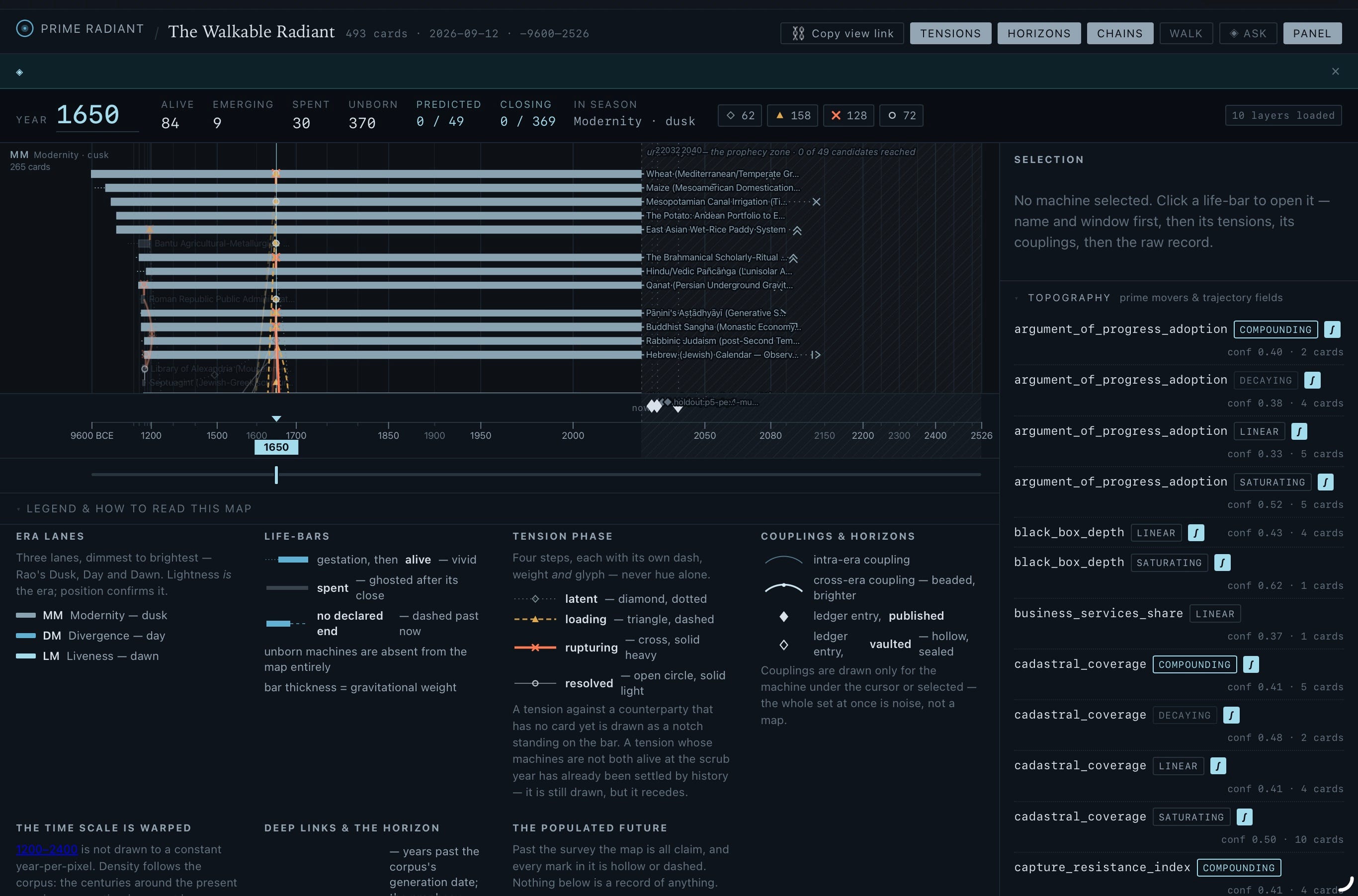
Soon we’ll be producing 150,0000-page Lean proofs proving that the Industrial Revolution didn’t happen and the moon landing was faked. And historians will be forming an Association for Human History like the mathematicians.
Kidding aside, it’s never been a more rewarding time to study history. It is one of the subjects the models already know very well, so you can go as deep as you like on any bunny trails the books get you interested in.
All of us in the research groups write essays that feed the model. My own role is primarily picking the book club readings and working on the foundations of WMT. You can just read along with the book club part, or if you want to go deeper, you can join our research meetings where we alternate between reading history modeling papers and the discussing the technical problems of building out the world machines oracle and the prime radiant engine.
I don’t want to try and survey or summarize the enormous breadth and depth of history we covered this year (attend the two upcoming meetings for a sense of that), but the big takeaway for me from studying the phenomenology of divergence at Big History scale is that increasing material plenty over the last 400 years, provisioned by technology and market economics, has allowed us to retreat into increasingly solipsistic and divergent personal realities. What I call solipsistic reality tunnels. AI is merely the cherry on the top.
What we call “AI psychosis,” induced by AIs validating and steel-manning whatever we want to believe, is merely the final stage of a 400-year-long larger dynamic.
The Divergence Machine has made it increasingly possible to inhabit our preferred escaped realities safely and sustainably. Idiosyncratic epistemologies and ontologies are just two pieces of the puzzle. A great many other pieces had to come together for the machine to mature and reach its current stable operating condition. Material plenty. Workable plurality in polities. Ways of metabolizing revolutionary energies. The invention of “nature” itself and a more sophisticated relationship with it. The ideas of Adam Smith and Darwin. The invention of those amazing simulated imagined communities, nation-states. Encyclopedias. Global travel. The integration of the Americas into the world system, and the rise of the US into an underground empire. We read about all this in 2026.
And the old Modernity Machine had to continue to operate stably beneath this space of ever-ramifying and diverging solipsistic reality tunnels. Organizing trade and book-keeping, moving commodities, keeping the barbarian nomad periphery in check.
By our theories, the Modernity Machine has entered its dusk phase. It will increasingly fail to function. The Divergence Machine will have to grow new AI-native foundations in a fraught hot-swap operation involving renewable energy, oozy AI infrastructures, and hard cryptographic supports. What I call New Nature.
There’s a lot more than AI going on with our planet when you zoom out to the 400-1000 year scale.
Which brings me to the theme for next year’s book club and research. Liveness.
I’ve written a few things on the topic already, but I don’t yet have a firm handle on how to approach it through a reading program. We are hypothesizing that the Liveness Machine is just starting to take shape, so history is going to be less helpful for our explorations. We’re going to have to get into more speculative genres of inquiry. Of course, given that the “future is already here, just unevenly distributed,” we can probably find some food for thought in history and contemporary events, but it won’t be enough.
What I do have so far is a sort of central dogma — intelligence is already history. The emergence of AI will powerfully shape the future of course, but in an essential way it is more part of the end of the Dawn phase of the Divergence Machine. A marker of its maturation into the Day phase. It’s already priced in to WMT to a significant degree.
Liveness is not intelligence. You can have one without the other. We humans just happen to possess both. AI possesses intelligence but not yet liveness. Plants and primitive animals arguably possess no intelligence in the conventional sense, but certainly embody liveness.
New Nature though, is going to embody artificial liveness somehow, and that’s not quite the same notion as artificial life. Artificial life is biomimicry. Artificial liveness is an embodiment of an emerging world-scale process metaphysics; a kind of diffuse infrastructural haunting, a technological elan vital starting to circulate across the planet.
That much is already clear from very early signs. There are signs ranging from micro to macro. The contours of the Liveness Machine are already forming. Our challenge is to learn to see them.
At the same time, the Divergence Machine is entering its heyday, and is going to absolutely dominate attention, particularly through AI, its mark of arrival as a mature world machine. That fact is going to frame everything else, including the fragile birth of liveness and the accelerating dismantling of modernity.
If all this interests you, join us this Thursday, Dec 3, for the first of our two-parter review/preparation session.
Join us: Our psychohistory research group meets every other Thursday at 9 AM Pacific on our Discord. Our next two meetings, Dec 3 and Dec 17, will be the final ones for this year. We will discuss our 2026 book readings, brainstorm candidates for next year’s book club, and plan the Liveness Machine research agenda.