

This is part of the Graph Minds Notebook series
One of the nice things about keeping a big curiosity active over a long time is you get sensitized to interesting provocations in the wild (aka Twitter) that move the thinking along with low effort. This is why I like to marinate my thinking in the Twitter scene by sharing bits and pieces of what I’m reading and thinking about.
An interesting recent provocation of this kind was a tweet to which I responded with a shitpost, which immediately struck me as a significant clue for our graph mind investigations:
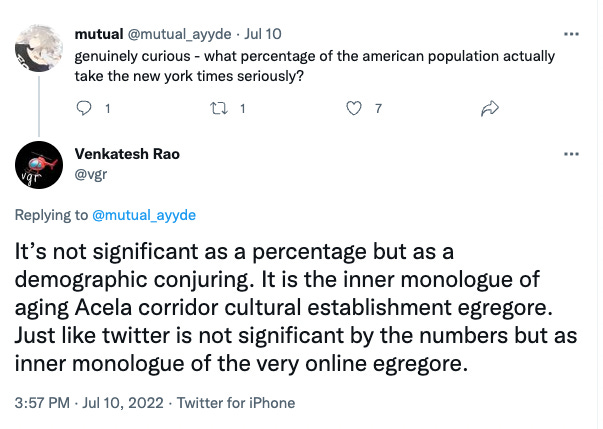
The notion of the New York Times being the inner monologue of the Acela corridor is a good illustration of the concept I want to explore today — inner monologues for graph minds, or inner graph monologues. I am using that ordering, rather than graph inner monologue, because it isn’t just a graph mind’s inner monologue, but one that happens in the interior of the graph mind, in the “inner graph.”
You have to be immersed in the interior to “hear” it. You can’t hear it from the outside.
The Acela corridor is an example of one such interior. Another is the reply zones of Twitter scenes. The exchange above is obviously itself an example of the latter: an outtake from the inner graph monologue of a twitter scene (anarchist twitter in this case, which I am sort of on the fringes of). But to avoid getting too meta, and also because the Acela corridor exhibits richer features, let’s talk about that, rather than Twitter.
For those not familiar with the cultural geography of the United States, Acela corridor refers to the Northeastern megalopolis spanning Boston, New York, Philadelphia, and Washington, DC, connected by a dense network of local and regional train systems, including the only kinda-high-speed rail line in the country, the Amtrak Acela. Rides between the major cities take between 3 and 6 hours, and especially for the shorter distances, the Acela is more convenient and comfortable than flying.
The term is normally just used as synecdoche for the regional nexus of global political, economic, and cultural power, but in the context of the idea we want to poke at, the train from which the region draws its popular name is literally important as an inner graph monologue locus.
***
The Northeast is big on reading, and the long, regular train rides (both local commutes and the longer Acela rides) make for a lot of quality reading time. Even post broadband and iPhones, trains in the region feature a lot of print reading: books, magazines, and of course, newspapers. And before the shift to digital media, reading printed long form was the dominant activity. Even in the non-quiet cars, you’d find more people reading general content than working, chatting, or listening only to audio content through headphones.
The multi-dimensional power of the region, arguably, rests in part on the fact that it is one of the few parts of the United States where people read a lot on a regular basis, and do so on trains.
Of course, it matters too that the people also tend to be highly educated, and work for powerful institutions with control over everything from nuclear arsenals to global interest rates, but the regular reading in a convivial setting is, I think, a big factor. Compared to weaker train-connected regions, such as the Bay Area with the BART/Caltrain system, a larger, and more complete fraction of the population in the northeast uses the system (in the Bay Area, people work in more dispersed ways, and driving is much easier, so more people drive or take corporate buses as well).
It’s not just that the Acela corridor reads, but that it reads a lot of the same things — The New York Times, The Wall Street Journal, The Washington Post, and the bestseller books recommended by them. Among magazines, The New Yorker, and The Atlantic Monthly are part of the club. Together, these form the literary-industrial complex of the Acela corridor, with the NYT at the top of the pecking order.
For reasons we will get to, the assemblage produces weakly harmonized, mutually reinforcing, convergent content, with a consistent overall tone historically set by the NYT (though the WaPo has occasionally stolen the lead for brief periods). The deep coherence of Acela corridor “mainstream media” output triggers both fear and envy among weaker competing assemblages, such as Red America and Silicon Valley media complexes.
The power of the Acela corridor literary-industrial complex has weakened with the gradual displacement of print by digital media, but is still quite considerable.
Among the subtler affordances of print-on-trains is that not only do you read, you are seen to read, and see others reading. Covers, mastheads, and headlines are visible for hours at a time, no tweets necessary. When a particular book hits the bestseller lists, it is spotted in the wild on trains for weeks.
This has a powerful effect: it creates what is known as common knowledge.
***
Common knowledge exists when not only do you know X, but you know others know, and they know you know, and you know they know you know, and so on ad infinitum. It is a critical part of an inner graph monologue, because common knowledge is how a graph mind goes from knowing stuff to knowing that it knows stuff.
If something particularly provocative hits the zeitgeist, you’ll feel it in the buzz of conversation. You not only have common knowledge, but you have common knowledge about the state of mind of the broader public, via a relatively random sampling of strangers.
Even better, this common knowledge of what strangers are thinking about does not preclude more intimate knowledge of what friends, family members, and coworkers are thinking about.
You might meet a coworker on the train, chat about what he’s reading, and let that intimate common knowledge inform how you work together. Your spouse and kids are likely to know which newspaper you read on the train, even if they don’t get which part of Twitter you hang out in.
The social graph underlying the Acela corridor is strong and active on the trains. Individual subcultural graphs interpenetrate and bump into each other, driving information diffusion, and forming the larger regional graph mind. The strangers whose book covers or newspapers you notice, or whose conversations you overhear, aren’t complete strangers. You can guess how they fit into the larger society through their appearance, dress, and patterns of interactions with others. If you work on Madison Avenue, you’ll still get a sense of what the Wall Street crowd is upset or excited about through what you notice on your morning commute.
The commuter context makes the monologue particularly potent, since it courses through minds in a liminal state (between home and work headspaces for example) when they are particularly sensitive and vulnerable to public information flows and diffuse moods and sentiments.
This effect is, of course, much less powerful in physical spaces when people are primarily consuming digital media. Kindles have no visible covers. Podcasts streaming through headphones can’t be overheard. Nobody knows which newspaper you’re reading on your phone.
Other comparable media, such free-to-air broadcast television, and talk radio, have far less powerful effects, because their consumption contexts aren’t as convivial.
Talk radio is primarily consumed in relative privacy, while driving. At most family members or a friend riding with you knows what you listened to, and how you responded to it.
Television is somewhat more powerful, since airports and other public spaces often have monitors tuned to CNN or Fox News, depending on where you are in the US.
Sports bars have big games playing. University campuses feature people walking around carrying books or studying together.
But none of these media consumption contexts features the potent mix of 7 critical features print-on-trains does:
Weakly harmonized, mutually reinforcing, convergent content sources
Individual consumption choices
Visible public consumption in large groups of strangers
Deep material consumed over longer periods
Co-extensivity with patterns of life and work
Co-extensivity with dense social networks
Synchronized presence in a liminal state
Together, these catalyze what I am calling the inner graph monologue. From outside the region, or without participating in the convivial consumption, you can read the source material, but you won’t be able to hear the monologue.
The monologue isn’t the raw material itself, but immersive presence in the collective processing of it into common knowledge.
Social media streams reproduce these 7 features to varying degrees, and in some cases add kinds of depth and richness that is not possible with print-on-trains (such as sharing screenshots and links, and broadcasting reactions, complete with gifs and emoji), but arguably, as inner-monologue media, they are weaker than the Acela corridor train spaces. Even the most powerful, such as Twitter and Reddit, are more warren-like than plaza like.
Know thyself is good advice for graph minds, just as it is for individuals. It would not be much of an exaggeration to say that the historic power of the Acela corridor can be attributed to its strong self-knowledge. Its ongoing inner graph monologue creates much stronger self-knowledge than that of any other region.
So even in the age of digital social media, the Acela corridor still has the most powerful inner graph monologue in the world.
Consensus by Monologue
The common knowledge state that is created and maintained by the Acela corridor inner monologue is necessary, but not sufficient, for that monologue to represent some sort of consensus thought stream in the graph mind.
Of course, inner monologues need not feature consensus. They can feature inner disharmony and conflict, and the sense of being torn apart. But what makes inner monologues so powerful is that their default state is by default one of harmony and consensus, allowing the agent to act coherently, narrating and authoring the self even as it acts. If this weren’t the case, the graph mind wouldn’t really exist.
The additional condition for the monologue to be a consensus is this: you must know that your consumption both harmonizes with, and is holographically representative of,1 how the graph mind as a whole is processing information.
For example, imagine a big scandal breaks one morning. You read about it on your commute, but not only do you form your own reactions, you get a chance to gauge how much mindshare it has with the rest of the commuters, and how they’re reacting to it. You can pick up on patterns of alignment and lines of argument. You can calibrate and modify your own reactions appropriately. You can sense the cost of going with the developing consensus, or bucking it as a contrarian.
Do this for a couple of hours day after day, every day for decades, and the inner monologue of the Acela corridor graph mind starts flowing through your brain. And it rhymes with the thread of it going through other brains.
And all this without a lot of energetic and high bit-rate broadcasting. Convivial presence does most of the work. Very little actual information need be exchanged.
This process explains the first item in our list of 7 features: Weakly harmonized, mutually reinforcing, convergent content sources.
The literary industrial complex doesn’t just feed the media appetite of the Acela corridor, it reflects the feeding process. The content of “news” isn’t just the raw details of events around the news, progressively digested by newspapers, magazines, and books, but the sensibilities of consumption reflected back to the consuming process itself.
Concretely, it is important not to forget that the journalists, editors, and graphic designers staffing the literary industrial complex aren’t abstractions living in a separate realm. They themselves inhabit the infrastructure of the Acela corridor, including the trains that form the convivial content consumption contexts. The feedback loops that we associate with “clickbaity” online media existed first in the meatspace production/consumption loops. Long before “bluechecks” trawled Twitter for cheap story ideas, they rode trains and picked up on currents of thought in meatspace worth amplifying. They reported on the inner graph monologue they were themselves part of.
This kind of production-consumption ouroboros is a very powerful mechanism for long-term, large-scale, deep, stable consensus.
Other old media have to work much harder to achieve a similar effect. For example, podcast, talk radio and TV talk show hosts have to not just convey information, they have to guess, and model, appropriate reactions to it, via live performance. Instead of immersing yourself in an evolving inner graph monologue consensus through a convivial commute, you do so in isolation, taking your cues from a single person. Instead of watching a group of bankers arguing about the latest market crash on the train, you have to decide how to feel based on Tucker Carlson’s artful performances of shock, concern, and mockery, consumed alone or with a small group. Or a talk-radio broadcast consumed alone in your pickup truck. (As an aside, I’m not surprised these media are not textual — when you consume in relative isolation, you need more contextual cues to guide the consumption).
What’s more, to the extent the individual reactions have a chance to shape each other, the patterns of influence are much more restricted. When in Red America, you get out of your pickup truck after listening to some talk radio by yourself for an hour, and go chat with a friend or two, you might slowly create a two-node graph-mind convergence. A session at the bar in the evening might expand that to a dozen. Though the thing spans a continent, it does so in a weakly connected, relatively slow way. I suspect individualism as a celebrated value is more consequence than cause — the graph mind can’t converge as strongly to a consensus.
At a strictly structural level, the whole thing is far more fragile compared to the corresponding process in Blue America’s Acela corridor.
As a result, the inner graph monologue is much stronger in the latter. The presence of charismatic talkers is in fact a sign of weakness in the former — Paul Krugman looms much less powerfully over the Acela corridor inner graph monologue than Tucker Carlson does over the Red America inner graph monologue. Because there’s much less he can do, and much less he needs to do. In the Acela corridor, the inner graph monologue has much more elan vital. Much more of a life of its own that is greater than the sum of its parts.
The breakthrough political moment of 2016, when Talk Radio and Fox Nation managed to breach the strongholds of Acela Corridor Nation, was so newsworthy precisely because it was so surprising, a case of a David graph mind taking down a Goliath graph mind. There are of course many reasons for that, but one might be that the Acela corridor ouroboros got too insular and echo-chambery, recirculating too little real information and getting detached from larger realities.
Online media are also weaker in many ways. At its best, Twitter fragments into small islands of conversation in the mentions of clusters of friends. And most people don’t even get that level of limited online convivial “commuting” — they simply follow their favorite bluechecks from old media (unlike in their Acela corridor “home” inner graph monologue, on social media, bluechecks are far weaker since our inner monologue process doesn’t need them as much to complete the feedback loops — they’re still important though, which is why we love-hate them).
Most subtly, the last feature in my list — synchronized presence in a liminal state — is somewhere between weak to absent in social media. Yes, people often use social media during breaks, when switching between work and personal modes for example, but it’s not as strong a context feature as it is in commuting. You are “commuting” virtually between focused mind states, but it’s not a strongly liminal context the way physical commuting is. It is a sort of continuous partial liminality.
There is a reason, despite the obvious and growing problems in the Acela corridor literary industrial complex, that it is still so utterly dominant not just in shaping national discourses in the United States, but global discourses on global matters. Despite a decade of weakening commuter-conviviality culture. And despite its innermost fortresses falling to invasions by alien graph minds (quite literally in the case of the January 6th insurrection).
Of course, I don’t want to suggest that convivial content consumption is the only, or even biggest reason for the power of the Acela corridor. There are many other regions in the world with equal or superior inner graph monologues. But the Acela corridor commands vastly more financial, military, political, and cultural power than most of those regions combined.
By harboring one of the strongest inner graph monologues on the planet, the region manages to exercise its power with a coherence and reach unmatched by any other graph mind on the planet.
This is why a question like “who takes the New York Times seriously?” is in some sense irrelevant. Those of us outside the Acela corridor inner monologue are mere spectators. We merely “read” the NYT; we don’t participate in the inner graph monologue ouroboros it anchors. Even if nobody outside the Acela corridor paid attention to it, it would still matter a great deal.
***
There’s more to be said about the inner monologue metaphor for graph minds, but I’ll stop here for the week with the following thought.
If media are properly understood in the context of the convivial consumption loci that close their ouroboros-like production loops, rather than as standing apart “broadcasting” content sourced from the outside at “audiences,” what exactly is their status within the subjectivities they help cohere?
“Trusted and authoritative source of information” seems not even wrong. It’s like calling a mirror a source of information. It sort of is, but not that’s not really what a mirror is about. You bring information to a mirror to have it reflected back at you. The Acela corridor, arguably brings its inner graph monologue to the NYT to have it reflected back at it.
What do you call this sort of thing?
I offer “voice in the head.”
The only question is, is the voice experienced as part of the subjectivity of a graph mind, or as “command hallucinations” distinct from the mute agency that hears and obeys?
This is a graph mind version of Julian Jaynes’ question of unicameral versus bicameral minds. I have a hypothesis (which of course I already tweeted) that old media are unicameral (so evolutionarily more mature), while new media are bicameral (so evolutionarily less mature). I might unpack that more in a future installment.
Loosely speaking, by “holographically representative” I mean you could in principle recover a decent approximation of “what New York is thinking” by extracting the state of one of the more representative individual minds, the way you can extract the DNA of an entire organism from a single cell. Of course, the metaphor is not perfect, since individual media consumption varies a lot more. Still, the “headlines” in people’s minds are probably similar.