

I introduced the idea of New Nature in my recent Protocolized post, Theorizing Protocolization I: New Nature, which I defined as “A planetary condition powerfully determined by the laws of the artificial, which can increasingly be engineered to be nearly as immutable and indefinitely persistent as those of nature itself.”
I’ve now been thoroughly nerdsniped by the idea, and have a cleaner definition:
New Nature is regimes of reality governed by technologically mediated laws that are nearly as inviolable, immutable, and persistent as those of nature.
With apologies to Philip K. Dick, New Nature is technology that doesn’t go away when you stop believing in it.
New Nature is only new relative to old nature, but is as old as technology itself. What’s changed is the strength of the “nearly as” part. The first roads created laws of movement that self-enforced through the allure of lower effort, which was as attractive to animals as humans. Modern highways make it really, really expensive to move other than according to their logic, through a mix of danger (high-speed vehicles) and physical barriers. They constitute lawful regimes of what Deleuze and Guattari call striated space.
But arguably the first truly strong piece of New Nature was public-key cryptography (PKC). There no known way to break today’s strongest encryption schemes, and it seems likely they will evolve to be quantum-resistant too. For many, this was the Genesis event of New Nature.
PKC has another feature. As many have pointed out, it is the first major technology to feature something of an asymmetry that favors the weak rather than the strong. This leads to the increasingly popular idea of “can’t be evil” technology (a reference to Google’s abandoned “don’t be evil” posturing a lifetime ago), a proposition that has 4 assumptions underlying it:
Technology is not neutral but has an asymmetric bias favoring one kind of actor or another
The favored actor is usually the one who is already more powerful
The worst evil generally emerges from the corruption of power
There are ways to make that hard or impossible through rare technologies with the opposite bias
It’s not that the weak are incapable of evil. The steelman proposition here is that the worst kinds of evil are due to a particular mechanism that can create unbounded concentrations of power: capture.
The mechanism of “evil” here is vulnerability to capture. If there’s a gun on the ground and a stronger and weaker guy fight to claim it, the stronger guy will likely end up with it, making him even stronger. Eventually all the guns are in the hands of the already powerful, with the most powerful having the biggest guns, and no opposed forces restraining them. That’s the sort of “evil” that “can’t be evil” tries to restrain. The kind pointed to by the proverb, power corrupts, absolute power corrupts absolutely.
Most technologies are like guns. They tend to get aggregated and captured by those who already have a lot. Technology, in other words, generally exhibits preferential attachment to power.
Most capture and enclosure phenomena are way more complex but the basic principle is the same. The powerful get more powerful. Most efforts to mitigate that rely on accepting or even enshrining the capture outcome as a given (such as “monopoly on violence” as a doctrinal basis of statehood), and trying to persuade the powerful to also be good through moral exhortations.
PKC is one of the few technologies where at least under some conditions, the weak get stronger. And not through flattering narratives for the clueless like “empowerment” and “democratization” but through mathematical guarantees. This is why states and their spy agencies have historically fought hard and whipped up various moral panics to prevent broad access to encryption technology. There’s real devolution of power there, not incumbent powers granting easily revocable freedoms at their own pleasure, so long as it suits them to perform morality.
It has limits though. There’s a reason why the “$5 wrench attack” xkcd became a meme:
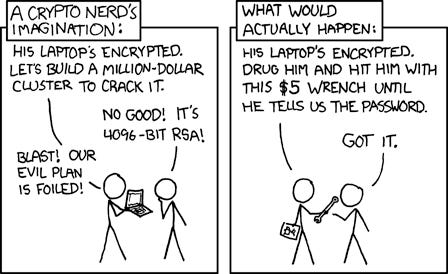
The point to note here is that encryption offers ways for the weak to keep fighting even when there are $5 wrenches in the picture. For instance, this attack fails against a multisig wallet controlled by 7 people scattered around the globe. Now you probably need the full resources of a powerful government to break through, and even then it wouldn’t be easy (there’s a thriller waiting to be written here about evil government operatives chasing 4/7 people around the world, or maybe a supervillain taking a bunch of people hostage and threatening to shoot them all one by one unless 4/7 people reveal themselves and give up their private keys). Beyond this, there are schemes that add anonymity and other kinds of obfuscation, Cryptography is so appealing — and so alarming to the already powerful — because it offers ways for the weak to keep escalating their end of the arms race.
And unlike more primitive “weapons of the weak,” it is a technology that does not require a retreat to a primitive, impoverished existence in the mountains.
So can’t be evil is, to first order, the same thing as capture-resistant, the first manifestation of which is unbreakable encryption schemes.
But there is more to New Nature than PKC. I see at least 3 classes of New Nature laws, all of which exhibit some flavor of capture resistance:
Encryption based technological laws: Including, but not limited to, E2EE communication technologies and blockchains
Complex emergence laws: This is primarily AI at the moment, but could extend to domains like synthetic biology. Lawfulness in phenomena like hallucinations, unexplainability, and incorrigibility that are the result of the fundamental mechanisms of a technology, and can’t just be legislated out of existence.
Too-fast-to-regulate laws: Here I’m thinking of the laws governing technologies that operate too fast, in too-tight, too-local feedback loops, for humans to directly regulate without slowing them down to uselessness. Robotics is the big class here, starting with self-driving cars. We’re almost ready to start trying out Asimovian robotics laws for real.
All these classes of technological phenomena exhibit lawful and highly valuable behaviors that satisfy the definition of New Nature fairly strongly, and much more strongly than any technology from 50 years ago. Not coincidentally, they’re all powered by computers. New Nature is computation-based.
This means the slogan code is law, which used to be interpreted in a narrow way with reference to blockchains, ought to be broadened in scope. Code is law can be true of many kinds of code, with the inviolability/immutability/persistence secured by factors besides unbreakable encryption. Illegible emergence and high-speed dynamics can also underwrite new nature. So long as some significant subset of humans want the benefits of the technology badly enough, it will emerge, and obey its own code-based New Nature laws.
I’m becoming a hardliner on the value of this, and increasingly have no patience for arguments that technology must always be subject to human regulation, overrides, etc.
Quite the opposite.
It is imperative that we make a lot more New Nature of many varieties, because it is becoming quite clear that those who believe in the power of human wisdom as a regulatory force systematically fail to recognize a fundamental law, perhaps the central dogma of New Nature:
Central Dogma of New Nature: There is no way to create mechanisms for wise and enlightened human regulation of a technology without also creating attack surfaces for capture and enclosure in service of the worst abuses of that technology.
And to the extent most technologies preferentially attach to power, lofty don’t be evil sentiments shaping laws with too much room for human discretion invariably yield to the reality of power corrupts, and absolute power corrupts absolutely.
I’d rather have a bunch of can’t-be-evil capture-resistant technologies running amok, in the hands of lots of uncoordinated average humans with average morality, than a bunch of captured death stars that began as lofty ideals and ended up weaponized by and for the worst of humanity.
Very insightful. I'll be cogitating on this for awhile.
Code is law. So let's say rules for self driving cars, now written by tech companies, should have a "constitution" of laws created (by humans, for humans?) then encrypted and instantiated on a blockchain, that then acts as a control on a class of technologies, agents, or devices? Thus being, or becoming highly resistant to capture (given the right blockchain)?
I hope you flesh this out.
Familiarity rather than hardness, but I feel compelled to share Virginia Postrel, in _The Fabric of Civilization: How Textiles Made The World_
"Any sufficiently familiar technology is indistinguishable from nature."