

Steve Jobs was wrong. A traditional computer was never a bicycle for the brain. It was never a coherent enough machine to require, or enable, the holistic mode of dynamically stabilized control that is “riding a bike” after learning to “balance” it. At best, a traditional computer is like a set of power tools. If it’s an Apple, it’s a coherently branded set of power tools in a nice toolbox, but not an integrated machine. At least not at the level of human user experience. You do not use a traditional computer the way you ride a bicycle.
AI has revealed this by revealing itself to be something that does require bicycle-riding type skills: a motorcycle for the brain. And just as learning to ride a motorcycle is about extending a previously acquired ability to ride a bicycle, learning to ride AI is about extending a previously acquired ability to ride your own brain.
The experience of using a regular computer is a largely unrelated set of skills. A giant red herring.
AI literacy is not an extension of computer literacy.
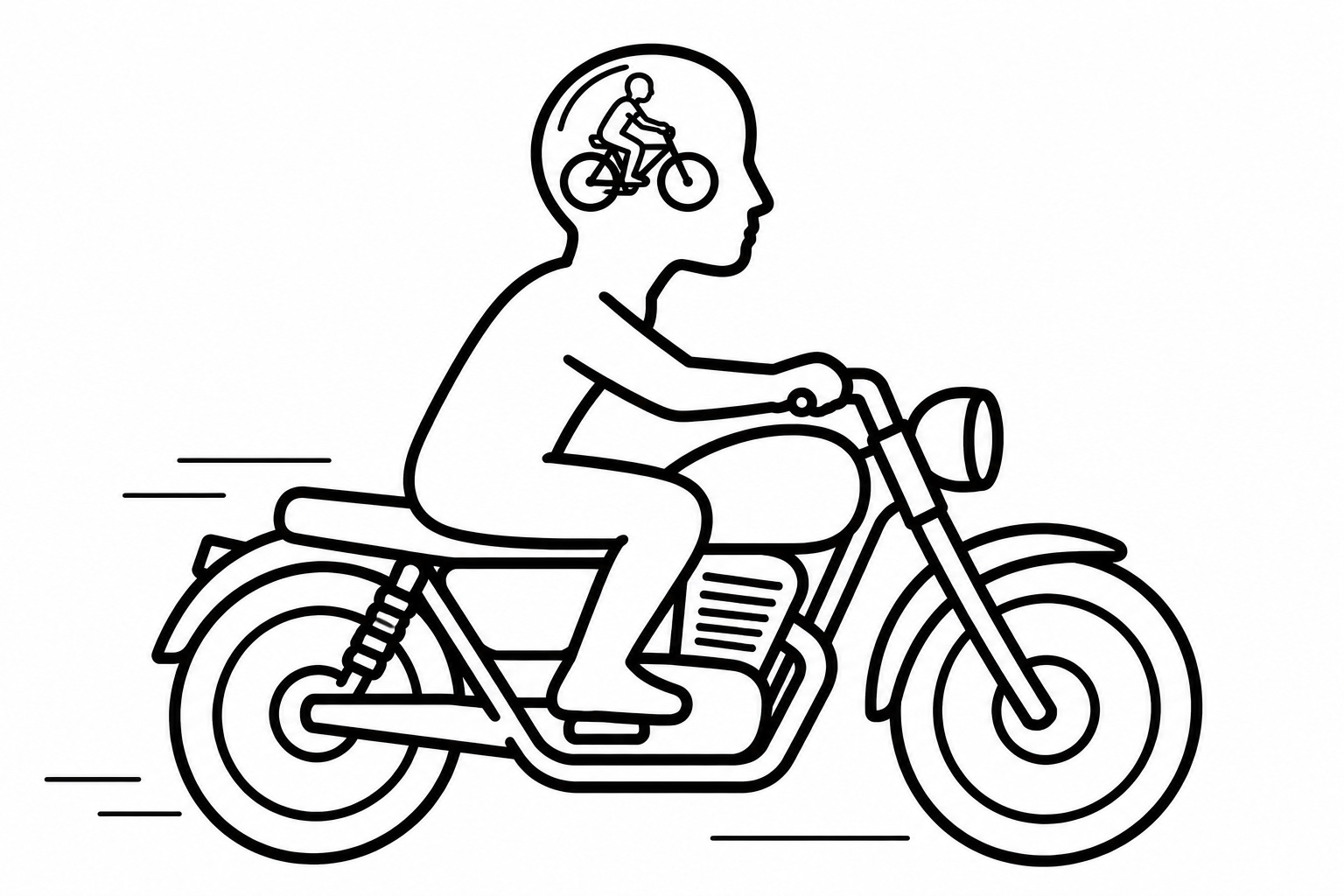
The thing is, the human brain itself is already a combination rider-and-bicycle type entity; one which not all humans know how to ride.
The “bicycle” part is loosely what we call intelligence, and is largely a cultivable set of native aptitudes, while the “rider” part is the part that has learned to manage attention. And that process is strikingly similar to learning to ride a bike. And as with riding a bike, not all humans learn it.
To understand how this works, we have to dig into the sociology of how “smart” is constructed, recognized, and socialized in human society. Because what we conventionally recognize as intelligence, which I’ll call smarts, is not quite the same thing as being able to ride your brain. This means it is dangerous to mistake “smart” as “competent to ride AIs.”
To appreciate this, you first have to appreciate what smarts are actually for socially, and why smarts can function without necessarily being accompanied by the trait required to ride AI well — cognitive balance. In fact that can be a liability if your societal role is to perform smarts.
Licensed to Smart
Unless you’re active in one of the relatively few domains where savant performance is meaningful and legible, like chess, music, or number theory, “smart” tends to be highly socially constructed as some mix of academic performance, extracurricular depth, and social presentation.
Good grades, evidence of depth outside textbooks, and most importantly, a capacity for lively social interaction that subtly dominates conversation by topping others’ arguments, citing deeper knowledge sources, and referencing the right hooks into relevant authoritative discourses. That’s “smart” in conventional terms.
Generally, acquiring a “license to smart” amounts to demonstrating early and often to peers that almost any subject is deeper and more complex than the casual dilettante appreciates.
The “smart” person has a particular social role: Serving as ready proof of the shallowness of the mental life of the median person on the median topic, who is revealed to be, not stupid per se, but simply atrociously unaware of the meta of most topics they weigh in on, to the point that they cannot be taken seriously. This is primarily a social governance function, not a directly useful thinking function. The smart person is a useful instrument for the exercise of power. Sometimes the power is even their own, but more often it is the power of particular political, cultural, or social institutions.
Curiously, logic and reason play almost no role in this sort of performance of smartness, since smartness typically operates by subverting the interlocutor’s lazy presumption that they are competent to reason about something in the first place. The characteristic move of the smart person is to reveal to you that you haven’t yet earned the right to begin reasoning because you don’t understand the terrain. And to do so in a way that you cannot easily resist.
Smartness operates by vividly demonstrating the conversational incompetence of the interlocutor, with varying degrees of grace and kindness, to the interlocutor’s own satisfaction, even if they are too chagrined to admit it. This means cowing them into suitable deference, an awkward face-saving retreat, or visible absurdity. The effect is demonstrating to others that they are either cowards, frauds, or clueless. In all cases, they are revealed to be governable without force, which is why smarts are useful for power. This also explains why getting physically assaulted is the main risk of performing smartness, which is also a useful outcome to power, because it legitimates the use of violence to govern those who resist browbeating by smarts.
This model of smarts is what’s performed by Matt Damon in the Good Will Hunting bar scene (not the less interesting math-savant scenes). He doesn’t win by doing a harder calculation. He wins by revealing that his opponent’s apparent intellectual authority is borrowed, shallow, and unearned. And he does so within the opponent’s own preferred terms of reference, leaving him unable to defend himself on home turf. And he does so as a social outsider, adding insult to injury.
Real-life examples are less dramatically intense, but this is how people are “normally” judged to be smart. That’s why interviews are such a ubiquitous gatekeeping mechanism. They are stylized versions of a normal social process of establishing who deserves to be taken seriously.
There are several pathological smartness cultures that derive from this basic culture through degeneracy, but fail to function in quite the same way.
Virtuoso IQ performances on inadequately prepared or persuasive ontological ground. These separate the audience into uncritical future acolytes and skeptics who tag you as a solipsistic egghead with an unconvincing halo; someone who doesn’t realize they’re prematurely trying to “reason” without establishing persuasive common grounds and motives for doing so. You cannot persuade a non-English speaker of their own stupidity in English. You have to do so in their native language. Cults start this way.
Overdeveloped debate skill or wit that dazzles without persuading. Any wins fail to sustainably occupy nominally captured ground because later reflection by witnesses or opponents/victims typically reverses the gains, unless they’re locked in immediately by other means. Political and legal theaters operate this way precisely because such locking-in mechanisms exist.
Demonstrations of deep erudition that turn conversations into tedious lectures, presuming the authority of a tradition rather than establishing it. Ivory towers start this way, as do taste subcultures, fandoms, and various sorts of glass-bead games. A fan of rock music cannot establish that someone with no interest in rock music is uncool. A historian cannot demonstrate that someone with no interest in history is stupid.
All three modes create escaped realities that are only persuasive if you’re already inside them. They create diverging dissensus realities. By contrast, “normal” smartness performances are generally persuasive across such social boundaries. They create converging consensus realities.
Which mode dominates determines whether zeitgeist narratives are, overall, convergent or divergent. Whether we inhabit a consensus reality or a web of contending alt-realities.
But none of this is actually that interesting. It just demonstrates that functional and socially useful smarts, both normal and degenerate, do not obviously need cognitive balance in order to serve as governance mechanisms.
Performative smartness behaviors, both normal and degenerate, constitute a kind of consensus social-proof process layer of society. A form of sociological intelligence that underwrites societal governance, but has a very vague relationship with truth at best. Important as praxis, but peripheral to the pursuit of truth in any significant sense.
Performative smartness is what we are socialized into. Like getting a driving license for a four-wheeler, a vehicle that does not require a learned sense of balance to operate, at least at a basic level.
I recall when I was first tagged “smart” beyond my immediate family, sometime in fifth grade, with firm membership achieved by eighth grade. There was real signal there, but not in the visible signals.
Learning to Balance
The real signal was that between fifth and eighth grades, I learned to actually manage my attention and direct it where I wanted. Something that many of my peers, who were also tagged smart, did not learn.
“This is thinkable, and I can think about it by just paying steady attention, which I can do,” became a basic move for me. A move that moved the challenge frontier from how to think to what to think about. This does not mean I got equally good at thinking about everything. It means I got good enough at thinking about enough things, that the bottleneck moved to choice of attention targets.
I started coming across as “generally smart” to others as a side effect, and started to easily get good grades with barely any effort, and banter impressively at parties when in the mood. Control over attention was much more consequential than raw thinking ability. I was officially licensed to smart by age 14, with all the attendant privileges and vulnerabilities.
The underlying developmental event was not really the acquisition of knowledge, or even an increase in intelligence in any simple sense. It was the acquisition of a new kind of control over an intelligence that was already there.
This felt much more like learning to ride a bike, which revealingly does not have or require a licensing regime, unlike car driving.
When learning to ride a bike, your balancing circuits visibly cross a fairly sharp threshold, with just a narrow transient phase of wobbling. You’re suddenly able to operate as a dynamically stabilized human-plus-bicycle system.
Before that threshold, every little correction is a deliberate and effortful struggle. You wobble, overcorrect, lose the thread, and fall off. Afterward, the corrections happen largely beneath conscious awareness. You can steer, accelerate, slow down, and pay attention to where you’re going rather than merely trying to remain upright.
This is the key: learning cognitive balance does not mean learning a large collection of explicit rules for staying upright. It does not mean acquiring a lot of theoretical knowledge or even any theoretical knowledge. After all, monkeys can learn to ride bikes. It means acquiring an integrated regulatory capacity that makes an entire new class of behaviors possible.
You may still need to learn some safe riding behaviors for traffic, but nobody demands to see your biking license once you demonstrate you can ride. By contrast, it’s possible to fake being able to drive a car safely well enough to be dangerous, which is why licenses are needed.
In a similar sense, when learning to ride your brain, you’re suddenly able to operate as a dynamically stabilized generative-and-reasoning-brain-plus-attention-regulation system. It’s just not as visible. So we end up noticing and certifying varied epiphenomena that serve as unreliable proxies for being able to ride your brain. That’s smartness licensing. A fragile certification that you can avoid falling off in some situations.
The bike-riding quality of attention management becomes clearer in adulthood, when you start noticing people you thought were “stupid” suddenly turning “on” (usually because they landed in more suitable environments than school) and becoming seriously impressive in some way that does not present as conventional smarts.
They’ve learned to balance on their brain bikes. Their attention is controlled, directable, coherent, and steady. At least some of the time.
Sometimes this presents as “intelligence,” and other times it presents as other traits: drive, imagination, betting acumen, foresight, resourcefulness, diligence, attunement, relentlessness, agility.
What these manifestations share is not necessarily an exceptional ability to solve abstract benchmark problems, but an ability to keep a coherent cognitive process going long enough, and steer it effectively enough, for something interesting to happen. Thats cognitive balance.
A person who can sustain an imaginative inquiry for hours, maintain a complicated practical intention over months, or hold a difficult social situation in attention without flinching, is demonstrating something closely related to what the conventionally smart person demonstrates while solving a mathematical problem.
Different terrains, different riding styles, different manifestations of the same underlying regulatory achievement.
Absence of this capacity becomes equally noticeable. Sometimes it can even lead to brackets around previous assessments of “licensed to smart.” Some notations on your license to smart, like ADHD or OCD, may limit expectations about your capacity for attention regulation to particular conditions.
Others come across as some sort of undiagnosed tragic failure: a great deal of apparent intellectual potential that never quite becomes a steerable, sustained capacity for action.
Of course, attention regulation is not a single scalar ability, and clinical labels are not simple measures of competence. People can exhibit extraordinary control in one setting and struggle in another. The important point is that the ability to direct attention is neither identical to intelligence nor reliably inferred from the social performance of smartness.
It’s only when you’ve come to terms with this phenomenology that you realize that “smart” is just one unreliable indicator of attention regulation capacity among many. Or more generally, capacity to regulate emotions and overall psyche. Societal systems are designed to detect it because smarts usually manifest earlier than other markers.
Even when the indicators are correct, we are not talking perfect mastery. Knowing how to ride a bike doesn’t mean you’ll never fall off, or be able to stay in control under all conditions.
But there’s a clear and sharp observable point where someone visibly masters balance. They’ve driven a balancing protocol into the unconscious layers of their nervous system. This is trivially visible with bike-riding, but takes some practice to notice with attention-governing.
I think I’m fairly skilled at correctly assessing whether someone has learned to ride their brain, and the limits of their ability to retain balance under various circumstances. But I make mistakes on occasion, overestimating or underestimating how much balance someone has. It is especially easy to make such mistakes in the US, which probably has the most refined smartness-licensing culture on the planet, and really polished smartness performance cultural modes. In other countries, it is typically much easier to detect when someone can or cannot ride their brains.
With both bicycles and brains, there are people who somehow seem never to get there.
With bicycles, at least there’s a clear reason why: you need a bike, some concentrated learning effort, and a culture that makes that a routine part of growing up, to the point that we’re surprised when an adult admits they never learned to ride a bike.
We’re surprised, but don’t think the worse of anyone for not knowing how to ride a bike, because we correctly presume that these are things almost anyone can learn, modulo some neurological and physical conditions.
But learning to “ride your brain” is not really a thing society solves for directly, because until recently there has been no need for it.
We teach subjects, test knowledge, reward cleverness, and sort people into status hierarchies based on visible performances of smartness. We sometimes teach study skills, concentration techniques, or emotional regulation, but these are usually treated as auxiliary skills rather than the central developmental achievement.
We largely leave the acquisition of cognitive balance to chance, and then retrospectively and unreliably recognize it as “smarts” or one of several other traits that reveal the presence of balance. Some more reliably than others.
It’s a bit like organizing an elaborate system of bicycle races, awarding prizes for bicycle maintenance knowledge, and conducting interviews about cycling theory, while leaving children to figure out how to balance on their own.
Some do. Some don’t. Some learn late. Some acquire remarkable specialized abilities that never translate into cognitive balance. And we mistake the resulting distribution of performances for a distribution of something called intelligence.
The Motorcycle for the Brain
Why am I going on about this?
Because consequential “intelligence” in practice is not the social performance and governance processes associated with the license to smart, but the unreliably detectable capability to ride your brain in a balanced way.
And this brings us to AI.
Using AI is like riding a powered two-wheeler, like a motorcycle or scooter.
Some people who learn to ride a bike never go on to learn to ride powered two-wheelers. And while it is possible to learn to ride powered two-wheelers without first learning to ride a bike, that’s a seriously dangerous thing to attempt.
You need excess regulatory capacity to manage the greater mass and velocity. This is harder than either riding a bike or driving a car, at least in the particular sense of maintaining dynamically stabilized control. And no amount of theory will help you.
The motor introduces a qualitatively different problem. On a bicycle, your own effort largely determines the power entering the system. On a motorcycle, the machine supplies far more power than you could generate yourself. Small control inputs can have large consequences. You can get into situations faster than your regulatory capacities can handle.
The fundamental skill is still balancing and steering, but the operating envelope has changed.
Something similar is happening with AI.
A traditional computer offers tools that extend particular capabilities.
An AI system, by contrast, generates cognitive activity of its own. It proposes, elaborates, infers, improvises, and sometimes takes action. It can sustain a line of inquiry, produce an argument, or pursue a task with a momentum that is not simply an extension of your own moment-to-moment thinking.
The result is a coupled cognitive system with its own dynamics.
To use it well, you have to do more than issue instructions and evaluate outputs. You have to maintain orientation while the system generates possibilities faster than you can individually inspect them. You have to recognize when it is going somewhere interesting, when it is wandering, when it is confidently wrong, and when it is pulling you into a frame of reference you never intended to adopt.
You have to steer without micromanaging, supervise without becoming a bottleneck, and remain capable of independent judgment even while relying on the machine for much of the cognitive work. Your cognitive muscles have to be relaxed enough that the ride is smooth. As with learning to ride a bike, relaxing enough that you begin trusting the machine’s gyroscopic stability to do most of the work is a key moment. Realizing you have to be going fast enough for that effect to kick in is another. The mark of the learner bike-rider is tight muscles that correct too quickly and too hard, while going too slow, which triggers wobbling and instability.
A lot of failure to use AI effectively looks to me like bicycle riders struggling with powered two-wheelers because they have acquired licenses to drive four-wheelers and assume they know everything there is to know about controlling statically unstable powered machines too. They go too slow, and correct too hard, too fast, too often.
They have learned to perform four-wheeler smartness in a social environment, participate in governance, and perhaps to operate conventional intellectual tools competently. They may or may not have learned to ride their own brains. And even if they have learned, they may not necessarily have developed the surplus attention-regulatory capacity needed to manage an AI.
The relevant competence is an overdeveloped capacity to ride your own brain, with sufficient surplus supervisory capacity to balance the motorcycle.
And the surplus is important. If all your attention is consumed by keeping your own thinking coherent, you have little left to supervise an additional powered generative process. If, on the other hand, you’ve internalized enough of the balancing protocol that your own cognition remains stable with relatively little conscious effort, you can devote more of your attention to steering the larger system.
This also helps explain why conventional credentials and visible performances of smartness are imperfect predictors of AI competence. The AI motorcycle doesn’t care whether you have a license to smart. It cares whether you can balance.
Learning to Ride Faster
To extend the metaphor, the motorcycle can eventually become self-balancing.
We’re already there, at least in limited ways, with experimental robotic motorcycles. But we’re not yet there with brain motorcycles.
Current AI systems have some capacity to regulate their own behavior, detect errors, and recover from mistakes. But these capacities are uneven, and their apparent coherence can be deceptive. The human rider still supplies much of the supervisory intelligence that makes the coupled system reliable.
This suggests a useful way to think about AI safety.
A great many safety failures and risks amount to an insufficiently skilled bicycle rider getting thrown off the motorcycle (which they’re perhaps treating like a car), which then proceeds to become unbalanced and crash in some way.
Sometimes the rider loses track of what the machine is doing. Sometimes they overcorrect. Sometimes they mistake speed for progress. Sometimes they trust an apparent stability that is only temporary. And sometimes the machine is simply too powerful, unstable, or poorly designed for the available human control capacity.
Not every failure is a rider failure. Machines can be defective, roads can be dangerous, and no amount of skill can compensate for arbitrarily bad engineering. But the stability of the coupled system cannot be understood by studying the machine alone.
A motorcycle’s engine power, a rider’s regulatory capacity, and the stability of the rider-motorcycle system, are three different things.
Likewise, an AI’s intelligence, a human’s cognitive regulatory skill, and the effective intelligence of the coupled human-AI system are three different things.
The third is the one that increasingly matters in practice.
There is also an intriguing possibility here. As AI systems acquire better self-regulation, they may become easier to ride even as they become more powerful. A self-balancing motorcycle can compensate for a rider’s regulatory skill limitations rather than amplifying them. But this is not the same as eliminating the need for a rider. Balance is not direction. A system can remain perfectly upright while taking you somewhere you have no desire to go.
And a machine that can regulate itself may create entirely new demands on the human rider: less effort spent maintaining immediate stability, more effort spent maintaining orientation, intention, and judgment over longer horizons.
This brings us back to the developmental problem.
We have spent centuries building institutions for teaching knowledge, certifying expertise, and licensing performances of four-wheeler smartness. We have paid much less systematic attention to teaching people to ride their own brains.
Now we are handing them motorcycles.
Perhaps the most important educational challenge of the AI era is not teaching people to code, prompt, or even critically evaluate machine-generated information. Those are useful skills, but they are downstream of something more basic: learning to maintain dynamically stabilized control over your own cognitive activity, and then extending that control to a coupled system with a powerful generative machine.
The interesting thing about bicycles is that balance, once acquired, opens up a world that was previously inaccessible. You don’t have to think about balancing all the time. You can simply go places. And with motorcycle, you can get places faster.