

In a WSJ piece about Neom, the weird Saudi Arabian smart city project, Mohammad bin Salman was quoted as saying, "I want to build my pyramids."
Reading that quote made me think of 3 things.
First, it made me think of the Futurama episode where Bender becomes a brutal Pharoah of an Egyptian-type planet and forces his enslaved people to build a giant statue of him that shoots fire out of its eyes and thunders “Remember Me!”
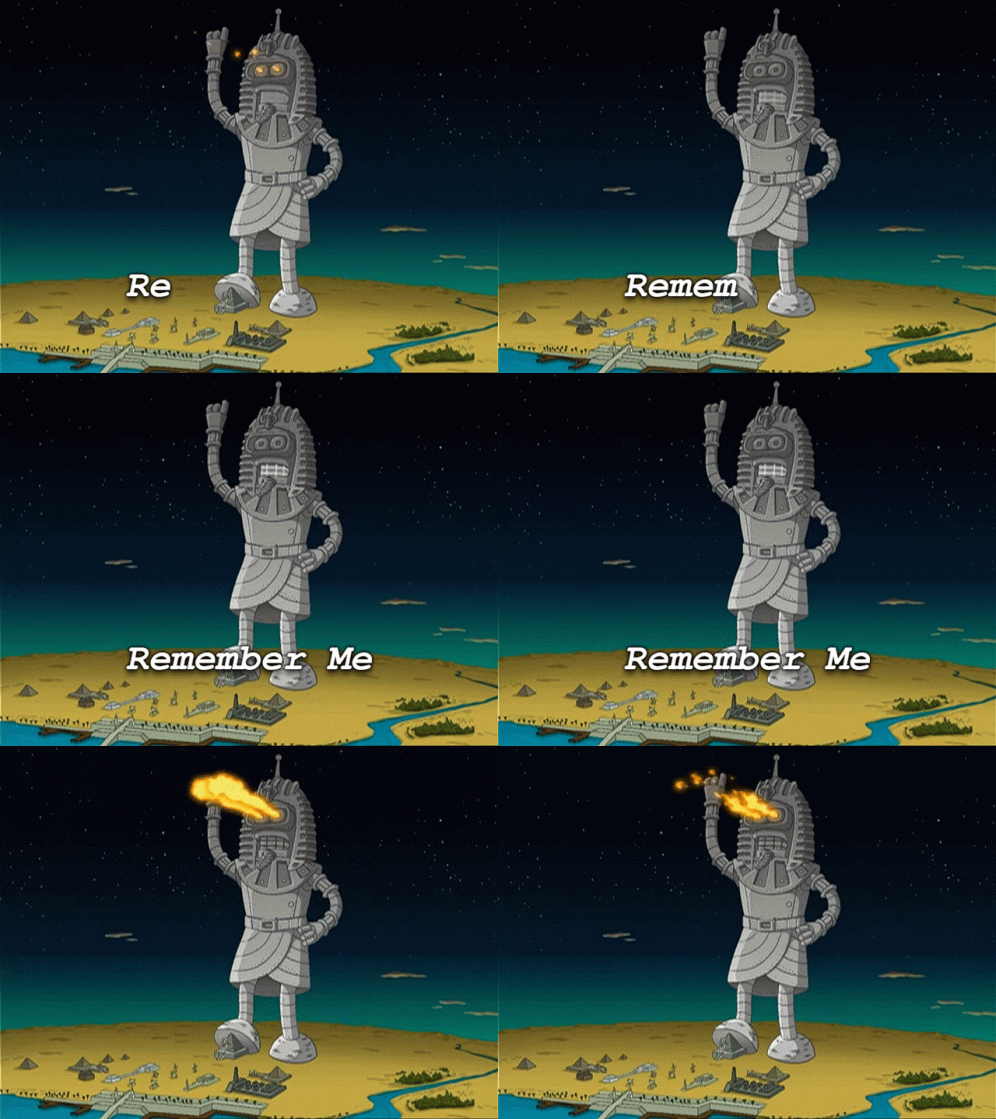
Second, it made me think of Shelley’s Ozymandias:
And on the pedestal, these words appear:
My name is Ozymandias, King of Kings;
Look on my Works, ye Mighty, and despair!
Nothing beside remains. Round the decay
Of that colossal Wreck, boundless and bare
The lone and level sands stretch far away.”
And third, it got me thinking about the question: what makes for a good legacy?
Well, the easy answer is — having the mix of luck and talent needed to do something like posing or proving a major theorem, making a major invention that steers the course of civilization, composing a major literary work, or the all-time favorite, coming up with a philosophical idea that can be misunderstood in interesting ways that inspire genocides.
Now those are real legacies.
But unfortunately, those are not the kind you can just formulaically craft, no matter how much money you have.
So let’s set that sort of sublime legacy aside.
Let’s also set aside the kind of penny-ante legacy you and I might be able to put together without much talent or luck. The average nonentity might toss a couple of brats into the gene pool, or a few modest ideas into the meme pool. That’s not what I’m talking about.
What kind of legacy might you be able to ponder crafting if you had millions or billions in surplus wealth to play with? Acquired either as an outsize return on your lifetime projects (like building a business, which might itself prove to be part of a legacy), or through a curse of resources (such as being an heir to an oil-based sheikhdom).
We’re talking Ozymandias problems here. The kind the worlds 0.1% is nobly struggling with right now.
The most obvious kind of legacy is a monumental legacy, like Neom.
Monumental Legacies
I’ve been seeing a lot of ads for this Neom thing on Twitter (it is multiple weird projects in one).
The ads feature stale, premium-mediocre, unironically authoritarian-high-modernist architecture with 2015 vibes. They showcase lifestyles that look like they were inspired by Peloton ads, TED talks, Instagram, and Davos. They make claims about the project being being futuristically renewably powered. All the promotional imagery and 3d renderings have an airbrushed, greenwashed, stock-photo tiredness to them, despite the money that has clearly been spent on them.
The ads are extremely depressing.
The project is apparently in trouble for the usual sorts of reasons, but given the amount of money behind it, Salman will probably get his pyramids, give or take a few dead Khashoggis along the way. Par for the course for such things. Neom might even survive and thrive. Perhaps it will turn into a sort of Middle Eastern Los Angeles by 2075. Perhaps it will be a great ancient city by 4022, in a terraformed green Middle East.
There’s another way to approach the question of monumental legacies.
The spirit of this approach is captured by the Greek proverb “A society grows great when old men plant trees in whose shade they shall never sit.”
I honestly don’t like this sort of thing either. It’s just Neom-thinking with better aesthetics and PR.
There is a certain self-satisfied piety and false humility to the kind of sentimental disposition that favors “natural” monuments for legacies.
At some level, planting trees and planning futuristic green-and-smart cities are not really that different. Tree-planting merely appeals to our lazy tendency to prefer appeal-to-nature arguments over appeal-to-technology arguments.
Nor are MbS’s obvious self-aggrandizing tendencies a reason to treat the technocratic Neom project as somehow fundamentally inferior to (say) an anonymous aging billionaire quietly funding reforestation programs or a nature preserve to save some charismatic species. After all, at Ozymandian scales, forestry and nature preservation programs suffer exactly the same kinds of high-modernist flaws as de novo urban development projects. There’s a reason James Scott had examples of both in Seeing Like a State.
Humility and limelight-avoidance are perhaps fine personal qualities, and tree-plantings are perhaps harder to get wrong than cities, but it seems to me that good and bad legacies ought to be separable by some deeper quality than the personal deportments of the people crafting them, or the cosmetic attributes and optics of the substance.
And the fact that you can’t be seen crafting your legacy doesn’t stop you from seeing like a state in crafting it. There is perhaps even a certain patronizing arrogance to the anonymity of stealthy legacies.
Which is not to say monumental legacies can’t succeed.
So what makes for a good monumental legacy?
For starters, even though there is something cartoonish and literal-minded about wanting an actual physical monument — be it a forest or a city — as your legacy in 2022, there’s something there.
It is easy to see why those with the wealth to create enduring legacies are attracted to sheer material scale. The bigger a thing, the harder it is to destroy, and the longer it takes to destroy. Perhaps good legacies should be weighed in gigatons rather than words.
Both cities and forests, done right, can endure for millennia, growing and changing in organic ways. If you try to found a small village, or get a university building named after yourself, chances are your legacy will be erased in the next cycle of development. If you plant a single tree, there’s a good chance it won’t last more than a generation.
But a city or forest? Those take more work to destroy. And the longer they last, the harder they are to destroy.
So cartoonish though it may be, there is sound reasoning behind wanting an Ozymandian legacy to be physically embodied. Much as you might want to leave behind a rarefied philosophical thought, or perhaps a set of commandments, a physical thing is likely more reliable.
And perhaps the dumber it is, the better, at least in the sense of enduring longer? A smart city might be bricked by the next Android update, but the Great Pyramid is already just a pile of bricks (well, stone blocks).
I’m going to bet the Great Pyramids will outlast the Ten Commandments. They’ve been running pretty much neck-to-neck so far, so it’s an interesting Lindy effect race.
On the other hand, a city or forest are more complex, and arguably, more worthwhile form factors for a monumental legacy to take. If you leave behind a pyramid, tourists 2000 years in the future might be impressed for five minutes. If you leave behind a great city or forest, people 2000 years in the future might find their entire lives enriched by your legacy.
But then again, those who ponder a pyramid will know who you were, at least in the form of a historical caricature presented in a tourist brochure. A city or forest might erase all signs of being a product of your mind.
Monumental legacies present a stark tradeoff between evolutionary generativity and the persistence of memory. They are not good at simultaneously being living legacies and remembering legacies.
This line of thought, of course, leads to the suspicion that perhaps the best form factor for a legacy is people. People are pretty good at simultaneously living and remembering, right? And reproducing and passing on what they remember.
And it says something that most people intuitively seek out this form factor.
Whether you make your own babies to pass on genes, (either at a modest 1-2 kids scale, or a Genghis Khan “show up in the genomes of 10% of humanity scale), or teach/mentor to pass on memes, your legacy can be people-shaped.
People-Shaped Legacies
The descendants of the wealthy seem to reliably turn into trustafarian failchildren by the third generation. Maintaining bloodlines through systems of hereditary nobility with carefully controlled reproduction doesn’t seem to fare much better — between inbred fragility and loss of purity through exogamy, genetic legacies have a bad habit of dissipating into the gene pool rapidly. What doesn’t dissipate turns into a caricature of its own past.
And there’s something unsatisfying about identifying with your selfish genes anyway, when it comes to legacies — you belong to the little molecules more than they belong to you. Legacies, arguably ought to be Lamarckian, not Darwinian. Otherwise you’re just passing on some genetic gunk that were passed to you. Your contribution to the transmission is that you were a unique permutation trial that was probably an error.
History, arguably, exists because people recognize this, and try to craft memetic legacies through people, instead of, or in addition to, mere genetic legacies. Those are much friendlier to being programmed by the circumstances of your life than your genes. Memetics is easier than epigenetics.
This is one reason media and education are such attractive targets for legacy-builders. Both are primarily technologies of memetic reproduction.
Let’s do universities first.
When you level up from having a building named after yourself to founding an entire university, you kinda level up from the monumental legacy level to the people legacy level through brute force. Own enough of the buildings, and you can kinda own the ideas they contain.
The Robber Barons loved founding universities. Rockefeller had the University of Chicago, Carnegie, Stanford, and Vanderbilt had the universities named after them.
Universities, of course, are not ideas, but they can shape them. Arguably, the school of economics associated with the University of Chicago has at least something to do with the capitalistic sensibilities of its founding patron.
But at some point you do have to transcend this level of indirection. There is perhaps no better illustration of this than North Korea.
I was reading the Wikipedia pages on North Korea yesterday, and the entire country is a monumental legacy aimed at turning the entire population into a people-shaped legacy bearing Kim Il-Sung’s thoroughly uninspired Juche ideology into the future like zombies. It’s the biggest, saddest, ongoing waste of brains unfolding on the planet today.
Apparently all the universities in the country are named for the ruling dynasty. And the entire university system put together doesn’t seem to have produced an original thought in 50 years. I am pretty sure the only mark North Korea and the Kim dynasty will leave on history will be through whatever nihilistic war or revolution rudely terminates both.
Media?
William Randolph Hearst famously managed to trigger a war with Spain.
I suspect though, that control of media is not a particularly meaningful mechanism for crafting a legacy beyond fomenting wars. Owning the WaPo or Twitter might perhaps provide strategic leverage in machinations at rarified levels within your lifetime, but they seem to lack the substance to do more. They don’t help when you’re thinking centuries rather than weeks.
No. Universities and media can at best play a supporting role. To forge a legacy through people, you have to turn yourself into an idea.
And not just any idea, but an interesting idea. Kim Il-Sung was not an interesting idea. With the entire machinery of a weird state behind it, it is struggling to perpetuate itself.
The best illustration of turning yourself into an idea that can live on in people-shaped legacies is perhaps ancestor worship, as in China. If your descendants revere you, generation after generation, retaining symbols of you in shrines that turn into heirlooms, you’re kinda living in their heads, (though not rent-free).
There’s something deadening about that though — and here I’m wandering into ideological territory. To me, creating an ancestor-revering line of descendants is a way to live on by deadening the future. It’s just a somewhat more sustainable version of North Korea.
When the gods are dead people, the living must die a little to serve as their legacies.
Which brings us back to square one, kinda.
People don’t actually solve the tradeoff we landed on with monumental legacies: between evolutionary generativity and the persistence of memories.
Maybe the trick to good legacies is not to attempt to fight the tradeoff at all, but to ensure you’re forgotten at the right rate?
Erasure Legacies
There is a null hypothesis here: there is no way to create an enduring legacy that does not have a deadening effect on the future.
So what if the best way to create a legacy is to not try at all? Maybe the trick is not to try and preserve a memory of yourself, but erase it. And do so as fast as the scale of concentrated Ozymandian wealth permits.
Could there be such a thing as an erasure legacy? A historical scale equivalent to “leave only footprints, take only photographs.”
It’s not as far-out an idea as it seems.
Think about stock buybacks. You have a maturing corporation that is running out of ideas faster than it is running out of wealth. It gradually buys back stock, returning wealth to the market, where it is instantly anonymized and redeployed in (we hope) maximally efficient ways. But what remains is intensified. Those who want to stick with the stock do so, even as the company itself fades. A stock being bought back and gradually retired is a stock that is being memorialized in the minds of those with the most reasons to remember it. When the last of the stock is retired and the company itself dissolved, there is a kind of transcendence. It has created as much wealth as it could have, in part by unwinding itself as fast as it could once it ran out of ideas.
This is a people-shaped legacy, but an opt-in one. The heat signature is an intense, maximal-rate release of surplus wealth into the general economy, and a committed, voluntary memorialization by an opt-in group of people-shaped memorials. The legacy is a spike of raw economic energy injected into the market. A boost to the life force of the body politic.
Ozymandian legacies, after all, are a kind of bid for immortality driven by mortality anxieties. Perhaps the most interesting legacy to leave behind is an energy signature that marks your transcendence of that anxiety, and a maximization of the life force you leave behind. Your legacy is not the information you embody, but the energy you embody.
A version of this kind of thinking is already taking root. The Gates Foundation is chartered to spend all its assets within 50 years of Bill and Melinda both dying. That’s actually a pretty rapid rate for unwinding that much wealth concentration, and a break from the past of such institutions as the Rockefeller Foundation.
Mackenzie Scott has developed a reputation for really high-velocity philanthropy.
The logic of erasure legacies is already recognized. Which is not to say that the people who create them will be forgotten — they will be remembered not because they wanted to be remembered, but because others thought they were worth remembering.
For a while.