

This is part of the Graph Minds Notebook series
The very first time I sat down to brainstorm graph minds, within minutes, it struck me that a key feature, perhaps the key feature, is that a collective intelligence, like a cult, is something you surrender to. The Borg catchphrases on Star Trek cut to the chase efficiently:
Resistance is futile, you will be assimilated
Lower your shields and surrender your ships
We are the Borg. Existence, as you know it, is over. We will add your biological and technological distinctiveness to our own.
Though in later seasons of Voyager we encounter a Borg queen, that feels like a narrative mis-step. The Borg are a true graph mind. The “graph” gestured at there is high-modernist and platonic rather than organic — a rectilinear grid (or a polar grid for the less common Borg spheres), but all the key features are present: surrender, resistance, assimilation.
We can see these phenomena in real-world examples too. Twitter, for example, is a weak sort of community of graph minds with fuzzy, overlapping boundaries. People resist being drawn into those minds at least a little. Resistance is often futile. Something about the nature of the assimilation is deeply threatening to our sense of individuality. Promises of “biological and technological distinctiveness” being added, rather than eliminated, are not enough.
I do think induced resistance is a key marker. Graph minds want individuals who are smart enough and egoistic enough to resist assimilation at first. A non-resisting mind is not particularly useful or interesting to assimilate.
So let’s approach graph minds from the perspective of surrender dynamics. And as promised, I will try to “show my work” and make my thought process as legible as I can, and make it a sort of stylized notebook.
Back when I used to do academic research, my first step after the “discovery” stage of just out dumping all my thoughts on a topic (which I did last week) was usually to go do a literature survey and talk to any key people in the field who would talk to me. The idea was to learn the lay of the land, orient around landmark bits of existing thinking, and find a bit of unoccupied whitespace to claim.
But ever since I became a blogger, I follow the far more fun path of finding an intriguing starting point, and simply diving in anyhow. I don’t really mind reinventing wheels since nobody is paying me for originality. And going in depth-first from a random angle has a small chance of a big upside: discovering a novel gestalt frame that nobody else has really been paying attention to. It’s what I call “refactored perception” and I get a big kick out of that.
Of course, on some topics, I have the benefit of having already done the academic style exploration too. This is actually one of them: both my PhD and postdoc were on multiagent systems, and the latter was specifically on mixed systems of humans and machines. But the tack I want to take here is very different from the ones I took back then.
Here, my “intriguing starting point” is the idea of surrender. We’ve taken a pass through 2 examples, one fictional (Borg), and one real (Twitter). Let’s try and add some structure. My favorite tool for structure, as you might know, is the 2x2. It forces you out of lazy dichotomies on one end, and stops you from being sucked into complicated high-dimensional nerdware epicycles too early on the other.
One of my dimensions is clearly surrender. You can rank graph minds from low surrender (eg a particular corner of Twitter) to high surrender (eg a very intense WhatsApp group). A good second dimension is not immediately apparent to me, which often happens when I try to do a 2x2 early (which I usually do). So I usually go back to my big brain-dump notes for ideas. Here are 4 candidates that jumped out at me. Usually, from a brain dump with say a few dozen potential dimensions, 3-7 tend to jump out at me and form a natural shortlist.
Adversarial/Cooperative
Reversibility of assimilation
Computational sophistication
Subjectivity
Adversarial/cooperative was actually one of my false starts on the topic — my first, lazy thought was that graph minds probably have to be highly aligned and non-adversarial. But a little thought showed that this is not true. Even the brain is a graph mind where parts of the brain try to steal neurons from other parts. And there are Hobbesian graph minds like the stock market. In fact, I don’t think there are any good examples of graph minds that are not at least slightly adversarial on the inside. Internal adversarial dynamics seem central to how a graph mind thinks. It’s how you govern the adversarial dynamics that is important. So let’s cross that out.
Reversibility is a sophisticated dimension, but it’s hard to think of an interesting graph mind with perfect or near-perfect symmetry of joining/leaving costs. All interesting graph minds seem to be at least a little bit like Hotel California — easy to join, hard to leave. So costly exit (organic solidarity) seems like a weak necessary condition for a graph mind. Once you’re in, voice is cheaper than exit. Staying is easier than leaving, and leaving might actually be painful in the sense of withdrawal symptoms or external coercion kicking in.
Subjectivity is a fascinating dimension too, but it’s not immediately apparent how to turn that into into a linear spectrum with “individual mind” at one end and “collective mind” at the other, and the highly collectivized subjectivity of science fiction (as in brain-to-brain interfaces, not merely salsa dancing or brainstorming) isn’t here yet anyway. So the intensely collectivized end of the subjectivity spectrum seems rather empty at the moment. Plus, it doesn’t seem quite orthogonal to surrender.
While these three are intriguing, I think computation is fundamental enough to minds that at this very basic level of analysis, it feels like the best second axis. Another reason I like it is that it’s close to physics. For a first pass on any topic, I like to stay as close to physics as possible. We may come back to the other three, or others from the brain-dump, later though.
So we have our basic 2x2: surrender level vs. computational sophistication.
Next, we need to add a kind of measure of each.
Computational sophistication is easier because there’s an obvious candidate: Turing completeness.
But wait! That’s not actually as useful as it seems. Almost anything can be Turing complete. In fact, it’s hard to think of a scaffolding for a graph mind that’s not Turing complete. A rare example is Bitcoin. Unlike Ethereum, the scripting layer of Bitcoin is not Turing complete, so I suspect you can’t build a good, expressive graph mind on Bitcoin. Which makes sense since they’re uniquely individualistic libertarians who hate the very idea of being part of sheep-like collectives.1
Turing-completeness is table stakes for any kind of mind. And it’s not enough for the individuals to be Turing complete. The scaffolding by which they come together has to be Turing complete. So Magic the Gathering, Minecraft, and Ethereum might work as graph mind scaffolds, but chess, Go, and Bitcoin will not.
So if we take it as an article of faith that the scaffolding is going to be Turing complete (or extensible into Turing-completeness, like Excel with VBA), what’s a second-order aspect of computational sophistication that can serve as a useful discriminatory measure for a 2x2 axis?
I think opinionatedness is it. On the one extreme, you have what are known as Turing tarpits where “everything is possible, but nothing is easy.” A graph mind in the form of a Turing tarpit would be formally equivalent to a computer, but almost every kind of computation would be very painful. On the other hand, a highly opinionated computer is one that can process certain classes of problems very well, but others basically not at all.
The “market” for example, could be considered a graph mind that can compute equilibria and prices very efficiently, but would be very hard to use to compute something like a filtered version of a photograph.
Another way of putting it is that an opinionated computer is one that has opinions about what problems are important to solve well. It has a missionary bias.
Understood that way, perhaps the most opinionated computers today involve deep learning language models in some way. “Dalle-2 Twitter” is a graph mind that puts a network of human “prompt engineers” together with whatever the innards of the model are, to produce a stream of weird images for our entertainment. Now that’s a very opinionated graph mind. Along its preferred directions of thinking, it flows very fluidly. But in other directions, it barely flows at all — it’s worse than a tarpit. It is anisotropic, to borrow a term from physics — different properties in different directions. In fact, the degree of anisotropy is a decent measure of departure from tarpit conditions.
So our computational sophistication axis is measured in terms of anisotropy and goes from “Turing tarpit” at the bottom to a polar opposite in terms of opinionatedness. Something like “Opinionated Turing superfluid.”
What about surrender? This one is harder to impose a measure on. How do you measure degree of surrender even notionally? What exactly do you surrender when you join a graph mind? Answers like “autonomy” are not useful since they’re too abstract.
The simpler case of cults helps us think it through, at least for human individuals within a graph mind. I don’t think cults are graph minds because they tend to fall apart if you remove the charismatic leader (I’m kinda inclined to make “presence of a queen bee/ant or charismatic leader” a disqualifying condition — I think you get computationally hamstrung sub-graph-mind things with that feature). But I think cults do tend to demand surrender in similar ways. You might surrender:
Your name (cult gives you a new name)
Existing family/friend relationships (they cut you off)
Your money (you’re encouraged to give your money to the cult)
Your visual signaling identity (shave your head and wear these robes)
Your time (spend all your time in the compound)
Your social behaviors (greetings, speech ways)
Your conflict models (“We do not raise our voices here, Brother Neo”)
Your relationship to authority (of individuals, established norms, etc)
Your epistemic posture (“please state your Bayesian priors, Brother Spock”)
Your world-historical view (“the world is corrupt and aliens will save us”)
There’s a lot of surrender phenomenology going on there, but without doing any kind of systematic analysis, my immediate suspicion is that the most important part is time. Cults are immersion machines. You’re a brain in a collectivized vat. The more time you spend in it, the more you think in the ways it prefers you to think. Learning to assimilate into a graph mind is like learning a language through immersion in a foreign country. All the other dimensions of surrender I’ve listed, and more, are functions of time spent. If you only spend 5% of your time in a cult, learning a weird greeting like “Greetings, brother!” is not particularly surrender-y. You’ll still use normal greetings like “Hi!” when outside.
The nice thing about time as a measure of surrender, besides the fact that it is close to the physics level, is that it extends easily to computers and robots and even dumb things like houses. If a computer is part of a graph mind, its permission and authentication barriers are down for trusted peers in the graph mind, and it is devoting a big chunk of its weakly secured attention to you, measured in CPU time/thread fractions. Ideally 100%. A house can be part of a graph mind if only members have exclusive use of it. A hotel is harder to make part of a graph mind (though not impossible — the Hotel Rosewood on Sand Hill Road is arguably part of the Silicon Valley graph mind).
So we measure surrender by share of time. For example, I spend 3-6 hours of mostly undivided attention doing activities with the Yak Collective per week, so out of 126 (7*18) waking hours in a week, I’m 2-4% committed in a median week, but some weeks it spikes up to 10-20%. I spend vastly more time on Twitter, but it’s not undivided attention (I’m usually watching TV and doing other things at the same time), and it’s not dominated by any particular corner of Twitter. So despite my heavy use, I’d say I’m not part of any Twitter particular graph mind (Twitter itself is not a graph mind, it’s a substrate for many graph minds).
My participation level in YC is probably the minimum level at which you can claim you’re a legit part of a graph mind. Below that, you’re only weakly attached. Let’s call that limit point minimum-viable surrender.
The final step in constructing a starter 2x2 is to populate each of the quadrants with evocative archetypal representatives, and good category labels. Here we go:
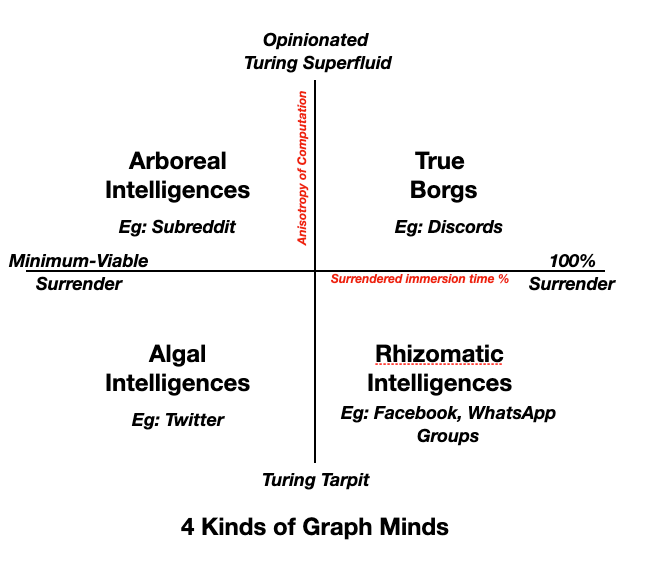
I won’t work through my reasoning in detail, since it’s mostly just intuitive leaps, not step-by-step, but a few points:
The first label that occurred to me was “algal” as in algae, which immediately suggested arboreal (tree-like) and rhizomatic (like a ginger root) as similar organic things with characteristic graph-like morphologies. The latter 2 are stolen from the Deleuze and Guattari arborescent vs. rhizomatic distinction in knowledge.
The high anisotropy, high surrender quadrant didn’t immediately suggest a natural archetype, but that makes sense, since true graph minds in the Borg-like sense we are talking about would be evolutionarily new beasts, and it would be reductive to map them to trees or anthills or bee swarms or whatever.
Finally, in terms of examples, I put in a bunch of social media platforms with the characteristic types of graph minds that seem to form on them. It’s hard to get away from this space of examples, since it’s really hard to put together comparably sophisticated assemblages of human and machine minds any other way.
I’m pretty happy with this 2x2 as a starting point for thinking about the design space of hive minds. It’s not the only possible one of course, but it does capture what feels important to me about surrender, assimilation, and resistance, and maps well to the “mind” aspect. And it seems to cover the most interesting subspace (digitally mediated graph minds) in a usefully MECE (mutually exclusive, collectively exhaustive) way.
Can you think of another interesting 2x2 with which to slice through the complexity and phenomenology? If so, post it as a comment using the following template:
x-axis limits
x-axis measure
y-axis limits
y-axis measure
Labels for each quadrant
Examples in each quadrant
Next week, I’ll probably take a stab at another of my favorite ways to analyze a topic early on: map it carefully to a governing metaphor. In this case the governing metaphor is obviously the human brain.
How is a graph mind like/unlike an actual biological human brain? Is it simply a larger version with individual brains being “neurons” of the graph mind? Or is the mapping more complex?
Insert joke about moving to New Hampshire to live on beef, guns, and unique individualism together.
When I was doing my PhD, the idea of “connectomics” was getting pretty big in human brain imaging. (eg https://www.pnas.org/doi/10.1073/pnas.1220826110) One of the big ideas was “modularity” - how we could identify meaningful subgraphs and interactions between these subgraphs, and to what extent they enabled cognition. So my mind goes there as one axis.
I also see differences in the level of external agency the graph mind has -- the difference between being a node in the matrix, which is actually just a giant battery, vs a node in a race that is trying to accomplish global domination for example.
So,
X-axis: modularity of the graph mind (nodes have no meaningful substructure vs Nodes being a part of a subgraphs that serves a specific purpose)
Y-Axis: Mind Agency (graph mind is purely reflective/self-absorbed vs graph mind is active agent in the world)
Quadrants:
- bottom left: unstructured / low agency -- Compute Machine -- examples, the Matrix battery (not, the AIs themselves I think), Twitter (has emergent substructure, but is fluid)
- top left: unstructured / high agency -- Hive Mind -- examples, StarCraft’s Zerg race (esp the Overmind), Ultron ,
- bottom right: structured / low agency -- collective - Scientific Community (experts contributing knowledge), Reddit
- top right: structured / high agency -- examples, StarCraft’s Protoss race (tribal/stratified but connected), human brain