

This the third and concluding part of my series with notes on the learnings from the 2025 Contraptions book club. Part I and Part II traced the construction of the Modernity Machine between roughly 1200 and 1600: a civilization-scale contraption that converted medieval heterogeneity into legible, interoperable order. By 1600, the machine was complete in all essential respects. This concluding part addresses what such completion actually meant, what the machine optimized for once built, the contradictions it necessarily produced, and why those contradictions could not be repaired from within.
The aim is not to declare the “end of modernity,” but to close out a rough analysis of the machine that took 400 years to build and turn on, making modernity possible, and sustained it for another 400 years, being patched in increasingly fragilizing ways along the way. And also to explore why its very success post-1600 began forcing a slow phase transition to a different kind of civilizational machinery which began to get constructed around 1600, right when the Modernity Machine got turned on. This machine, which I refer to as the Divergence Machine, is being completed and turned on as we speak, even as the Modernity Machine is starting to get decommissioned in bits and pieces worldwide. Here is a teaser picture for the overarching thesis we’re developing here.
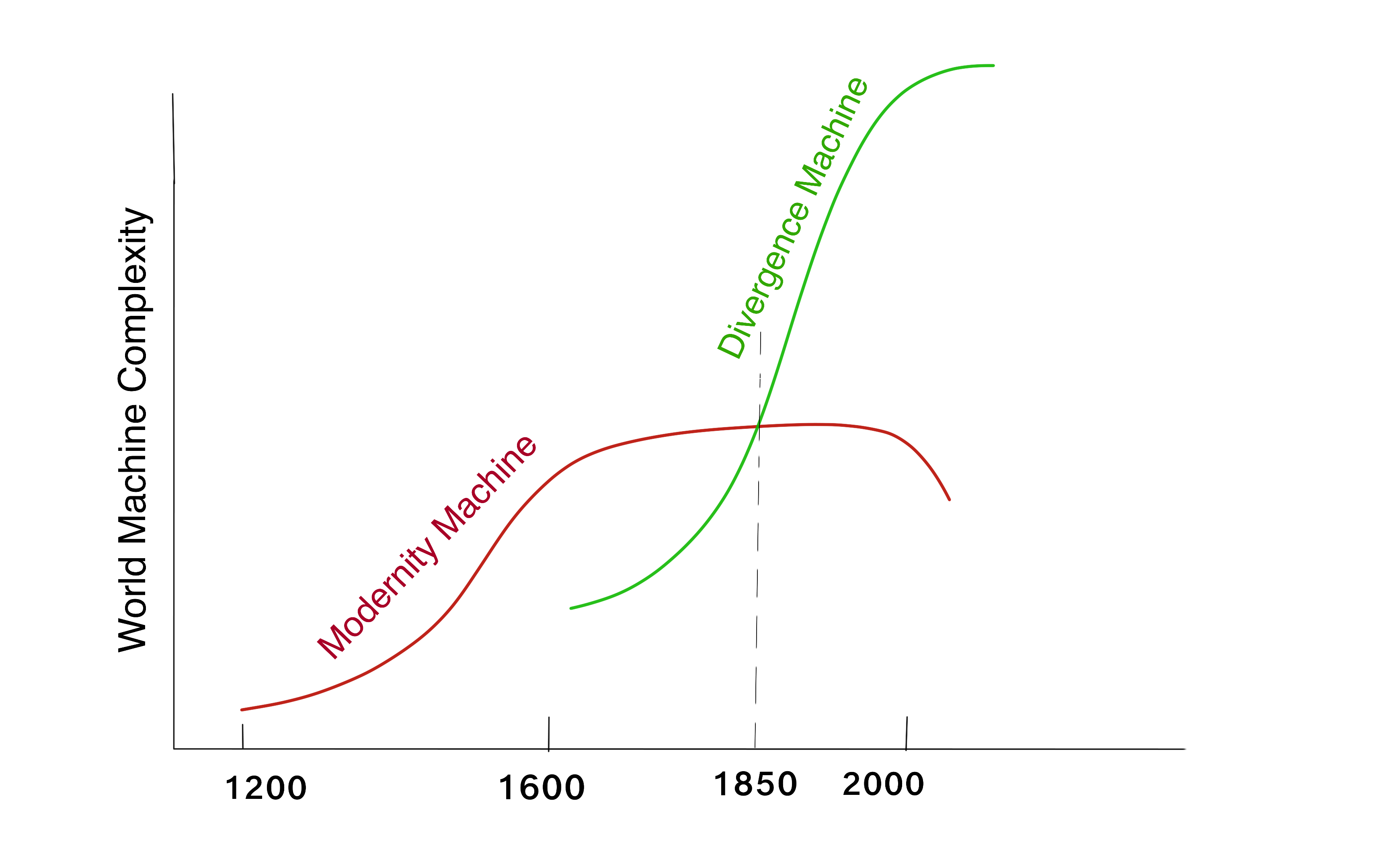
The 1600-2000 period and the Divergence Machine that emerged in that period will be the subject of the 2026 book club.
But let’s wrap up 2025 first.
You can catch up on the closing 2025 group discussion in this transcript. What follows is my personal wrap-up.
Sloptraptions is an AI-assisted opt-in section of the Contraptions Newsletter. If you only want my hand-crafted writing, you can unsubscribe from this section.
This one is special, since I wrote the first two parts myself, then asked ChatGPT to write part 3 based on the previous parts and a brainstorm on next year’s book club. It stuck the landing probably better than I could have.
What the Machine Optimized
The Modernity Machine did not optimize for truth, justice, progress, or freedom—those were its legitimating narratives. What it optimized for, relentlessly and across domains, was legibility: the ability to render people, land, goods, time, belief, and violence enumerable, narratable, and interoperable at scale.
Venice, in City of Fortune, is not interesting because it was rich or republican, but because it functioned as an early, tightly integrated legibility engine: maritime logistics, double-entry bookkeeping, legal abstraction, diplomacy, and intelligence-gathering fused into a self-reinforcing apparatus. Venice: A New History fills in the same picture from another angle: stability emerges not from ideology but from procedural compression.
The horse, in Raiders, Rulers, and Traders, plays a parallel role across Eurasia: a biological technology that collapses distance, standardizes military force, and forces political units to scale or perish. The horse is legibility made kinetic.
Printing, in The Printing Revolution in Early Modern Europe, completes the transition. Knowledge becomes reproducible independent of context. Interpretation decouples from replication. Information density explodes while shared meaning lags behind. The machine acquires a memory that grows faster than any coordinating narrative.
1493 shows the planetary version of the same dynamic. The Columbian exchange is not merely ecological or economic; it is a global synchronization event. Previously isolated systems are forced into a single ledger. The machine’s jurisdiction becomes planetary even as its capacity for meaning remains local.
Seen this way, the Modernity Machine is best understood as a civilization-scale compression algorithm. For several centuries, the gains are extraordinary.
Medieval Baselines
To understand what the machine displaced, it helps to look at relatively pristine end-of-medieval snapshots.
Majapahit offers such a snapshot outside Europe: a highly developed but still recognizably medieval empire, organized around courtly ritual, tributary relations, and localized legitimacy, poised at the cusp of collapse before modernity arrives in force. It represents a world not yet reorganized by legibility, still governed by face-to-face sovereignty and cosmological order.
Within Europe, The Age of Chivalry performs a similar function. Chivalry appears not as romance but as a fully articulated medieval coordination system—ethical, military, and social—already straining under pressures it cannot metabolize. This is medievalism at its most coherent, just before it becomes an anachronism.
These snapshots matter because they show what modernity did not inherit: localized legitimacy, narrative sufficiency, and bounded scale.
The Hidden Outputs
Once the Modernity Machine works, it produces three unavoidable byproducts.
First, excess agency. Feudal bonds dissolve, religious monopolies weaken, markets and cities proliferate. The Canterbury Tales and The Decameron are early catalogs of proliferating voices and moral standpoints. Social life becomes polyphonic. Coordination becomes harder because more people can act.
Second, excess information. Printing destabilizes epistemic hierarchy. By Montaigne’s time, the educated individual is already drowning in books. The Complete Essays read as field notes from the first generation to experience epistemic overload. Skepticism is both a philosophical stance and a coping mechanism.
Third, excess scale. Before European Hegemony and When Asia Was the World make clear that global integration predates European dominance, but modernity hardens integration into permanent structure. Local meaning cannot survive planetary circulation intact.
The machine creates more actors than it can integrate, more information than it can interpret, and more scale than it can narrate.
The Last Gasp of the Medieval
The lesson of Giordano Bruno and the Hermetic Tradition is not that Bruno foresaw modern pluralism. It is almost the opposite. Bruno represents the last exuberant escape of medieval imagination—a crackpot magician and memory-maven operating within an anachronistic misunderstanding of Hermeticism as ancient Egyptian wisdom to hallucinate a worldview of bullshit — indifferent to truth or falsity in any modern empirical sense. His cosmological conclusions happened to resonate sympathetically with Copernican implications, but for fundamentally wrong reasons.
Bruno does not anticipate modernity; he misunderstands it. His fate marks not the birth of a new worldview, but the extinguishing of a freewheeling medieval mode incompatible with both emerging authoritarian modernism, especially ecclesiastical, and scientific empiricism. What survives of his tradition—Rosicrucianism, Masonic esotericism—persists as fringe subculture: culturally influential at times, intellectually irrelevant to the main currents of modern thought.
Bruno is thus not an early modern prophet, but a terminal medieval outlier.
Similarly, Ibn Khaldun: An Intellectual Biography should not be read as the story of a proto-sociologist ahead of his time. That role is largely retrofitted by modern interpreters. In his own context, Ibn Khaldun appears more plausibly as a kind of depressed Arab Petrarch: a brilliant chronicler of decline and defender of tradition, lamenting the absence of an Islamic renaissance rather than inaugurating one.
His cyclical theory of dynasties does not launch a new science of society; it records the exhaustion of an old civilizational form. The importance of Ibn Khaldun here is diagnostic, not genealogical. He documents a world failing to enter the Modernity Machine at all, despite being in possession of many of the necessary components.
Narrative Exhaustion
By the early modern period, narrative itself begins to fail as a unifying technology. Don Quixote stands as the European bookend to The Age of Chivalry. Quixote behaves impeccably within a dead symbolic system, and chaos results. The novel demonstrates that inherited narratives no longer synchronize action with reality.
Journey to the West stages the same problem mythically. The Monkey King embodies pure agency without moral center. Order is restored only through endless improvisation, not closure. This is not premodern innocence but recognition that containment now requires perpetual patching, a condition whose outer story is told in 1493.
Utopia remains the last sincere architectural drawing of the Modernity Machine. It assumes total legibility, benevolent coordination, stable universals, and obedient subjects. Even at publication, it is already obsolete. The social, informational, and political conditions required for utopia to function are precisely those modernity has destroyed in creating itself.
Everything after Utopia is retrofit to a completed civilizational machine, to patch problems that began appearing almost immediately after it was turned on in 1600.
Why Repair is Impossible
By 1600, the machine has crossed a complexity threshold. More law increases rigidity without legitimacy. More reason fragments into disciplines. More planning amplifies unintended consequences. More morality polarizes rather than integrates.
This is not moral failure or intellectual laziness. It is structural. The Modernity Machine generates more differentiation than any universal framework can absorb.
The Modernity Machine does not collapse, but a new logic begins cohering at its periphery. Coordination shifts from top-down design to nudging from the margins — and increasingly, everybody is in the margins. Some just recognize it in 1600, while others are only realizing it now in 2025. Legitimacy fragments. Meaning localizes. Systems adapt without consensus. Civilization continues to function—often remarkably well—while agreeing less and less about what it is doing or why.
This is the phase transition. The machine that made convergence possible gives way to a machine that produces divergence as a default condition.
The Modernity Machine has done its job. What follows is not its negation, but the emergence of a Divergence Machine destined to replace it—a different contraption, hot-swapped piecemeal for its predecessor over 400 years, between 1600 and 2000. Optimized not for legibility and convergence, but for proliferation, adaptation, and coexistence without closure. For divergence.
That is the story of 1600–2000, which we will tackle in 2026.
The picks for the first three months have been posted on the book club page if you want to get a head start. I’ll lay out the thesis in a January kickoff post.
The legibility as optimization framing is especially clarifying here. Once scale, agency, and information outran narrative capacity, repair was structurally impossible rather than morally deficient. Seeing the present as a phase transition toward divergence rather than breakdown feels exactly right.
Venkat proves yet again in this trilogy that he's practically the only one awake. I absolutely love his thinking, his thesis, and his approach here. That said, I have two critiques.
First is that The Modernity Machine is not an especially machinic project; to the contrary, this is an overridingly humanist effort (possibly because Venkat is a philosophe in a technologist's body). To wit, a machinic approach to explaining modernity might have a Vaclav Smil gloss, with the hermeneutic center of gravity being energy flows, and the explanatory mechanism being the forces modulating and ramifying these flows. Or a Blaise Aguera y Arcas approach, with information processing as the driving force, and functions transforming information (whether instantiated as bits or atoms) the explanatory mechanism. Either way, a legitimately machinic lens will provide quantifiability and legibility.
Explaining history as the product of a modernity machine or a divergence machine locates the explanatory mechanism in the realm of ideas, however. I have no objection to this - I rather prefer it - although I admit it makes Venkat's analysis perhaps less quantifiable, less falsifiable, and ultimately less machinic.
The problem with locating the motive force of modernity in a conceptual contraption is that you then have to contend with your fellow travelers. For example, while Venkat mentions postmodernism in part II, he seems to be defining it in his own terms rather than negotiating the adequate (if inscrutable) world of definitions that have already accrued to it. If we're gonna walk down this road, it's only fair to engage with those who walked down it before, particularly Habermas and Lyotard. Heck, even Thomas Berry wrote (in 1988) "The old story that sustained us no longer functions; the new story has not yet emerged."
My second critique is that the sloptraption approach did not 'stick the landing' better than Venkat could have, at least in the case of part III. I admit that the AI-assist yielded a phenomenal synthesis which moreover transmuted the group's takeaways into a pleasingly linear narrative. Indeed, it reads easier than most of Venkat's Venkat-authored work. But - the drivers of deep value got lost. If, like Venkat does, we were to depict the ideas in this text as an image, it would look more like a washed-out jpeg than a lossless tiff. In other words, good human-authored text has a fractal character that admits of great richness: innuendo, allusion, metaphor, anecdote, etc. - techniques that say a lot with a little, or as Venkat might say, have high implicit information density. These amplifiers of meaning are not present here.