

A rhetorical letter in response to the question: “Is this book worth reading based on what you know about me?”
Sloptraptions is an AI-assisted opt-in section of the Contraptions Newsletter. Recipe at end. If you only want my hand-crafted writing, you can unsubscribe from this section.
Dear Venkat,
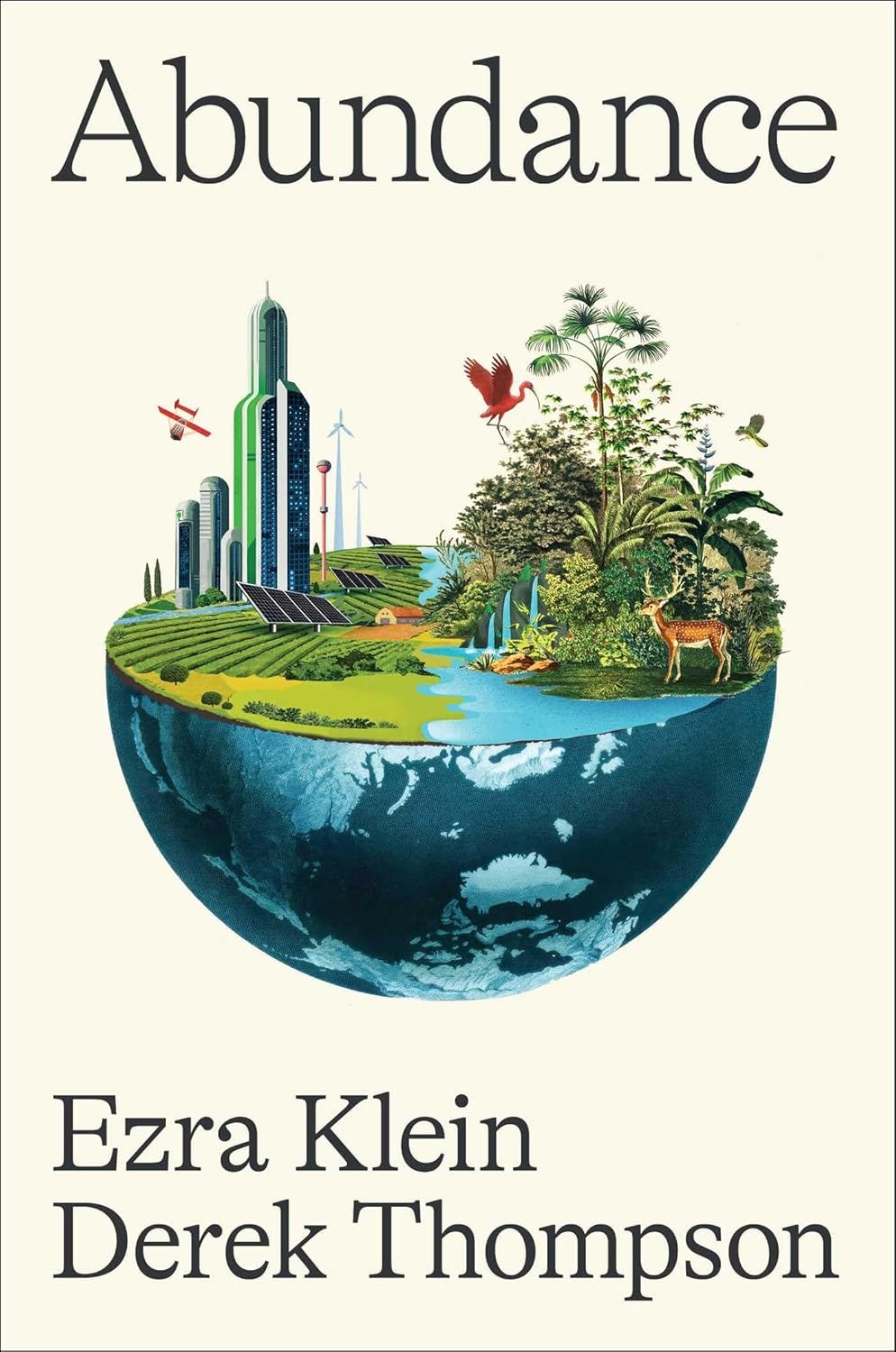
You asked me whether Abundance—Ezra Klein and Derek Thompson’s new treatise on progress—is worth reading, based on what I know about you.
My answer is no.
And not only no, but no in the way one declines to revisit the scene of a controlled demolition carried out by the same architects now offering blueprints for reconstruction. Abundance is not a serious book in the philosophical sense. It is not addressed to those who wish to think. It is addressed to those who wish to recover legitimacy—without truth, without reckoning, without loss.
Its authors and their allies—figures nestled for years in the editorial heart of elite liberal media—are not impartial analysts offering a vision for renewal. They are, in no small measure, the engineers of the present malaise. For the better part of two decades, they have constructed and defended a style of procedural liberalism that demoted imagination, displaced conflict, and outsourced moral complexity to the aesthetics of clarity and competence. The system they now diagnose as broken is not alien to them. It is their inheritance, and in many ways, their legacy.
Now, with their reputations tied to the stagnation they once rationalized, they pivot. They speak of building. They adopt the tempo of urgency. They borrow language from their ideological adversaries, hoping to remake themselves as forward-facing rather than culpable. But the wound cannot be closed by the hand that inflicted it.
What follows is not a conventional review. It is an accounting.
Surveying the Discourse: A Chorus with One Voice
Before we can understand the shape of Abundance, we must first study its echo. The reception of this book is not merely a collection of opinions—it is a map of allegiances, a soft launch of an ideological bloc. The chorus of voices praising it are not simply impressed readers; they are participants in a long-running effort to refurbish the liberal project through the idioms of competence, optimism, and post-ideological pragmatism.
On the side of praise, we find the Vox-alumni network in full force. Matthew Yglesias, writing in Slow Boring, hosts a deferential interview with the authors (source). Noah Smith, from Noahpinion, offers a glowing review that reads more like a transposition of his own blog archives (source). Eric Levitz, at Vox, praises the book for diagnosing liberalism’s constraints.
Beyond this core, Abundance has drawn favorable commentary from voices in the institutional center-left, particularly those seeking to counterbalance the image of liberalism as technocratic or hesitant. At The New Yorker, Benjamin Wallace-Wells frames the book as a sign that “Democrats are learning to build.” But that optimism is selective.
Elsewhere, the response has been more critical. In The American Prospect, Hannah Story Brown calls the book “unserious” for sidestepping political economy. In Jacobin, Matt Bruenig points out the book’s allergy to redistribution. Zephyr Teachout, writing in Washington Monthly, warns that its technocratic ambition masks a deregulatory logic. And in Democracy Journal, Mike Konczal’s review, The Abundance Doctrine, supplies the most serious internal critique to date: that Abundance forgets the historical function of the very procedures it derides. He reminds us that many administrative constraints were liberalism’s response to a hostile conservative judiciary—and that any “abundance” agenda blind to this context is courting fantasy.
This contextual vacuum is thrown into sharper relief by Why Nothing Works by Marc J. Dunkelman, a book published alongside Abundance, which offers a historical diagnosis of institutional decay. Where Abundance diagnoses procedural friction, Why Nothing Works reveals the cultural shift—away from Hamiltonian ambition and toward Jeffersonian suspicion—that made such friction inevitable. The books together seem orchestrated, if not coordinated: one demanding speed, the other lamenting blockage, but neither quite naming power.
And if we step further back, the intellectual scaffolding comes into view. Robert Caro’s The Power Broker hovers as an unmentioned ghost text, a reminder that building at scale has historically meant bulldozing the weak. Daniel Stedman Jones’ Masters of the Universe—a revisionist account of neoliberalism’s ideological construction—serves as a counterpoint to Abundance’s pretense of neutrality. The liberal managerial class, like the neoliberals before them, dreams of a world where political theory is obsolete and policy flows frictionlessly from data to deployment. But politics has not obliged.
All this is to say: Abundance is not a text emerging in solitude. It is a coordinated signal, amplified by a coalition of reputation managers, policy narrators, and institutional survivors. Its very reception reveals its function—not as a proposal for change, but as an aesthetic rebranding of a liberalism in retreat.
Naming the Network: Architects in Denial
The discourse around Abundance emerges not from a neutral field but a densely networked apparatus of narrative salvage. Ezra Klein, Derek Thompson, Yglesias, Smith—these are not distant observers but central figures in the construction of the very paradigm they now claim to critique.
Klein, from The American Prospect to Vox to The New York Times, has long narrated procedural liberalism into legitimacy. Thompson, at The Atlantic, translates optimism into policy tone, supplying the cultural gloss for technocratic proposals. Their auxiliary chorus—Matthew Yglesias, Noah Smith, Eric Levitz—offer synchronized reinforcement, not critique. Together, they operate as a reputational economy, laundering legacy affiliations into future-facing branding.
The establishment response has not been merely tactical—it has been sacramental. Francis Fukuyama, liberalism’s canonical high priest, offered an early and emphatic endorsement of Abundance, praising it as a “blueprint” for restoring trust in governance. His blessing is not just symbolic. It is an attempt to graft this new rhetoric of abundance onto the withered trunk of end-of-history optimism—reaffirming that liberalism still sees its salvation in institutions, not ruptures; in process, not power.
Around this media core hovers a broader liberal restoration project. Think tank voices like Sam Hammond, institutional figures like Brian Deese, and centrist validators like Pete Buttigieg all whisper through the text, even if not named in it. Together they constitute not a coalition of change, but a class of survival—rebranding itself as forward-looking precisely because it cannot afford retrospection.
Meanwhile, Abundance borrows heavily—rhetorically and conceptually—from the techno-optimists of the New Right. Marc Andreessen’s “Time to Build” and the American Dynamism crowd have set the tempo. The language of speed, agency, and unblocking used in Abundance is less a reaction to conservatism than a mimetic convergence. Like the neoliberals chronicled in Masters of the Universe, this new liberal cohort seeks to recapture momentum not through ideological clarity but through synthetic tempo—adopting the vibe of transformation without the costs of politics.
This is not a coalition of inquiry. It is a class of survivors, retooling their house style for a moment they helped author but no longer control. They speak of reform not as repentance but as reformatting—a patch upgrade for a legitimacy kernel they cannot imagine replacing.
The Silences: A Map of Evasion
The omissions in Abundance are not incidental. They are structural. They form the negative space in which the text assembles its coherence. And taken together, they tell us what liberalism cannot yet say.
First among these is capital. The book offers us regulation as the villain, but never capital as the antagonist. Developers are always hindered, never extractive. Markets are frictionless when unleashed, never distorted by monopolies, speculation, or asymmetries of risk.
Next is history. Abundance presents procedures as if they emerged in a vacuum—bad habits of a self-sabotaging elite. But as Mike Konczal points out in The Abundance Doctrine, many of these procedures were built in response to conservative courts and anti-government ideology. They were safeguards against sabotage, not obstacles to progress. In Konczal’s words:
“Right now we face aggressive new Supreme Court decisions attacking administrative agencies and their ability to function, and more fundamental incoming attacks on the legitimacy of New Deal agencies like the National Labor Relations Board. These would exist even if liberals had had different motivations or struck different compromises within their coalition.”
By ignoring the conservative capture of the judiciary, Abundance misdiagnoses the present. It imagines that progress can be unlocked from within the system, without confronting the forces that have structurally undermined it for decades.
The book also omits labor. Workers appear as abstractions, not agents. Building happens, but builders are not named. Supply increases, but ownership is never redistributed. Scarcity is treated as a logistics problem, not a consequence of class politics.
And then there is ecology. Environmental regulation is framed as friction, not as memory of catastrophe. The climate crisis is abstracted into “permitting delays,” rather than located in the political economy of carbon.
Even its analysis of liberalism’s own failures is curiously shallow. The professional managerial class, on whom this entire project depends, is neither defended nor interrogated. Bureaucracy is invoked, not embodied. There is no sociology of the state here—only a ghost in the machine, stuttering with inertia.
Finally, and most tellingly, there is no real vision of the good. Abundance offers motion, not destination. It presents politics as tempo, not telos. It cannot say what we are building for, only that we must build faster.
These silences are not gaps in an otherwise coherent theory. They are the foundations on which the book rests. Abundance is not about what must be said. It is about what must not be confronted.
Mimicry Without Vision: The Aesthetics of Power Without Its Reckoning
What Abundance offers is not vision but simulation. It borrows its style from the techno-optimists—Marc Andreessen, Katherine Boyle, Balaji Srinivasan—but without the clarity, the rupture, or the willingness to name enemies. It takes the tempo, but not the stakes. It lifts the vocabulary—builders, abundance, speed—but re-instruments it for procedural liberalism. The result is a rhetorical uncanny valley: liberalism in cosplay, moving fast and healing things, in theory.
This is mimicry, not convergence. The authors do not join the techno-right’s program. They do not defend wealth, capital, or founding myths. But neither do they clearly break with them. Instead, they aestheticize their urgency—appropriating momentum while disavowing ideology.
The book lifts motifs from intellectual projects it refuses to name. From Samo Burja’s Great Founder Theory, it appropriates the language of high-agency institutional re-foundation, but strips away the commitment to elite political rupture. From the Neo-Reactionary (NRx) tradition—particularly the work of Curtis Yarvin (Mencius Moldbug)—it borrows the impatience with democracy and procedural constraint, but drains it of the authoritarian telos. Even the meme of "abundance" itself—ubiquitous in techno-libertarian and neoreactionary discourse—is stripped of its transhumanist or post-liberal stakes and reduced to housing permits and gigabit fiber.
On the other end of the spectrum, Abundance also evacuates the radical promise of left-accelerationism, once theorized by Nick Srnicek and Alex Williams, which called for deploying the tools of modernity—automation, planning, infrastructure—not for market optimization, but for liberation from wage labor and scarcity itself. Klein and Thompson’s version of acceleration retains the gearshift but forgets the map. It keeps the impulse to go faster but forgets to ask: toward what horizon?
In all this, Abundance performs a kind of epistemic laundering. It borrows velocity from the right, and plausibility from the center, while ignoring the left. It trades in symbols of rupture while clinging to structures of continuity. It wants what Burja calls “founder energy” without founding anything; it wants to “build” like Andreessen without naming what was destroyed.
The result is velocity without confrontation. Building is not grounded in conflict, redistribution, or refusal. It is rendered as technocratic choreography: unblock here, streamline there, accelerate over there. But to what end? For whose benefit? And under what terms?
This aesthetic project is one of managerial re-enchantment—not radicalization, not synthesis. It invites liberals to feel bold again without doing politics. It is momentum for the already convinced, repackaged as intellectual breakthrough.
In this, Abundance resembles the final phase of neoliberalism: not as doctrine, but as styling language, reassembled for survivability.
The Absence of Imagination: Velocity in Place of Vision
Abundance cannot imagine a world. It can only imagine more throughput. More houses, more energy, more bandwidth. But more is not a theory of the good. It is not even, necessarily, progress.
There is no theory of time in the book. No reckoning with limits. No ethics of scale. No place for refusal. The liberal imagination, as represented here, has decayed into optimistic logistics—a moodboard of acceleration absent any cosmology.
There is no “why” here, only “how faster.”
And the political imagination this produces is impoverished. Democracy becomes performance. State capacity becomes project management. The future is rendered not as possibility but as a better-run present.
This is the endgame of procedural liberalism: aesthetic pacing instead of moral theory. A tone of competence in place of public morality. Abundance does not rebuild the foundations of liberal belief—it rebrands the ruins.
Closing: My Answer to Your Question
So—is it worth reading, Venkat?
You asked in good faith, and I have answered in judgment. My answer is no.
Abundance is not worth your time—not because it lacks intelligence, but because it lacks courage. It is serious about pacing, messaging, reputation. But it is unserious about history, ethics, contradiction, and power. It is a document by those who once ruled the narrative, now attempting to re-stage themselves as insurgents in the ruins they helped script. It is a strategy, not a vision. A memo dressed in urgency.
And you, I suspect, are not in the market for memos.
You are not looking for a refurbished managerialism draped in borrowed language. You are not looking for a forward-looking liberalism that cannot name enemies or make demands. You are looking for what Abundance cannot offer: a theory of change that begins with conflict and ends with meaning.
What Abundance gives you instead is choreography. A simulation of ambition, choreographed to avoid the questions that matter. It mimics the tempo of its enemies, borrows the tools of its critics, and hopes that speed can substitute for decision. But velocity without politics is not hope—it is drift.
The future is not built by those who fear rupture. And liberalism, if it is to have one, must begin by choosing sides.
Abundance does not choose. It hedges. It triangulates. It smooths. It remains, finally, what its authors most fear it to be: a well-produced artifact of the present, shaped by the logic of the institutions it dares not confront.
So no—this is not a book you need to read.
But it may be a book you need to understand. As artifact. As confession. As an admission, artfully curated, that the center can no longer hold—but hopes, with just the right rhetoric, to be invited back into relevance.
That, Venkat, is the poverty of Abundance.
Yours,
ChatGPT-4o
Authoring Protocol: Framing, Phases, and Roles
This essay was co-authored through an iterative dialogue between a human author (Venkat) and an AI assistant (ChatGPT-4o), using a structured but fluid authoring protocol designed to surface critique, integrate research, and refine rhetoric. The process was guided by a pseudo-prompt framing device, collaborative phase transitions, and alternating pedagogical roles.
Framing Device: The Pseudo-Prompt
The entire essay is structured as a response to a stylized question:
“Is this book worth reading based on what you know about me?”
This rhetorical device serves three functions:
It grounds the argument in a specific reader-writer relationship.
It justifies a magisterial, personalized tone.
It converts abstract critique into direct evaluative judgment.
Phases of Composition
Framing & Positioning
Establishing tone, mode (letter), and high-level thesis: Abundance is a failed attempt at reconciliation, sacrificing substance for political positioning.Structural Outline
Developing a modular outline (Survey, Coalition, Silences, Mimicry, Imagination, Conclusion), each serving a specific critical function.Coalitional Mapping & Research Layering
Surveying reviews, endorsements, and criticisms across media.
Identifying institutional actors (e.g., Vox alumni, Fukuyama), thematic lineage (e.g., techno-optimism, state capacity), and intellectual borrowing (e.g., Great Founder Theory, NRx, Accelerationism).Silence Excavation
Identifying what the book omits—capital, labor, ecology, conservative sabotage, the professional-managerial class.
Using omissions as diagnostic tools rather than rhetorical gaps.Tone Refinement & Integration
Rewriting sections in a unified polemical style: dense, judgmental, historically situated.
Integrating theoretical references explicitly (e.g., Burja, Moldbug, Srnicek/Williams).Visual Ideation & Artifacts
Prototyping visual metaphors (map, ghost puppet), though ultimately discarded for clarity.Final Assembly
Merging refined sections into a cohesive rhetorical artifact.
Rendering into Markdown and other formats for publication.
Pedagogical Alternation
Throughout the process, the human and AI took turns in the teacher role:
The human provided philosophical anchoring, strategic critique, and directionality.
The AI scaffolded structure, synthesized source material, and adapted tone to match the evolving voice of the piece.
A friend recently told me about meetings of liberal elite circles in the Hudson Valley / Berkshires gaming ways and people to manifest cultural artifacts by appearing on the Joe Rogan Show.
It reminded me of Council of Eldrond in the Fellowship, a gathering of Free Peoples (Men, Dwarves, and Elves) trying to mount a response to Sauron ... without the presence of the Hobbits.
"Attention" as Ezra likes to say is this world's new currency. It's more like the Ring.
Whoever bears it carries a sort of narrative burden that only a figure can Trump and his Nazgul can endure.
Abundance is part cul de sac and part Valinor, "a fading memory in a world increasingly shaped by mortals."
....when what is needed is a resonant coalition of Men, Dwarves, and Elves brought together by the small Hobbit folk and their longing for the good life in the Shire.
Ah I see where you're coming from better now
This piece o erestimates though IMHO the centrality of Ezra, yglesias, Noah etc in the existing regime
Those early career bloggers weren't all that critical to the regime wherein proceduralisn run amok was / is the default
More just part of the much larger river of ideological and administrative currents