

A deft bit of stage direction in Shaw’s Pygmalion, introducing the character of Mrs. Higgins, has been stuck in my head since I first read it in high school:
There is a portrait of Mrs. Higgins as she was when she defied fashion in her youth in one of the beautiful Rossettian costumes... In the corner... Mrs. Higgins, now over sixty and long past taking the trouble to dress out of the fashion, sits writing...
You have to do a double-take to appreciate the insight in this thumbnail sketch, and it is worth unpacking. Normally, we assume that it is keeping up with, and conforming to, current fashion that takes effort. As this sketch suggests, this view is mistaken, and things are rather more complicated.
We make this mistake because we often lazily conflate genuine indifference to fashion (which takes no effort) with being unfashionable (which takes as much effort as being fashionable). To be indifferent to fashion is to make essentially random sartorial choices while being oblivious to the consequences. But to be unfashionable is to earnestly misdirect effort to conform to the wrong fashion culture, such as one that’s identifiably a season or two older than the prevailing one, or one that fails subtle signaling tests while passing easier ones.
The difference between the indifferent and the unfashionable is the difference between the outlaw and the unwitting criminal. The former is simply outside the jurisdiction of a taste culture, and therefore largely invulnerable to any social sanctions it might capable of imposing. Not being invited to parties does not matter if you do not care to go to parties. The indifferent make utilitarian decisions ignoring considerations of taste. The unfashionable person though, transgresses the prevailing culture of taste, while sincerely intending and trying to conform to it, and as such, represents a policing problem for the fashionable. The choices of such individuals are what are generally labeled crimes of fashion.
Crimes of fashion that manifest through unfashionable choices are of two sorts, only one of which can be properly attributed to tastelessness, and judged and punished accordingly, with greater harshness.
The first sort is the result of simple ignorance and disconnection from the social core of a culture of taste, rather than lack of discernment or aptitude. Those who are unfashionable simply because they lack access and mentorship can acquire tasteful comportment, as was the case with Eliza Doolittle.
The second sort of crime of fashion though, is more serious: Attributable to an inability to acquire the appropriate sort of discernment and literacy despite being sufficiently immersed in the culture and materially equipped to participate in it. It is this second sort of fashion criminal who is usually charged with tastelessness, and policed and punished through particularly aggressive acts of contempt, exclusion, and humiliation.
The fashionable, the unfashionable, and the indifferent, then, are the basic types one encounters in and around a taste culture. We will refine our models of these and give them better names in a moment.
Mrs. Higgins though, belongs to none of these types.
***
In Pygmalion, the introductory thumbnail sketch reveals Mrs. Higgins to have been, in her youth, guilty of high treason — someone who committed transgressions against a prevailing culture of taste while being a literate insider of it.
For someone like this, conforming to prevailing fashion is an entirely effortless matter. High effort for her was associated with conscious transgression. I know nothing of women’s fashion, but fortunately ChatGPT does:
Mrs. Higgins would have come of age roughly in the 1860s and 1870s, when respectable upper-middle-class British women were expected to dress according to the highly structured fashions of the day: crinolines giving way to bustles, tightly corseted waists, elaborate trimming, and an emphasis on displaying wealth and propriety. Fashion was ornate, highly codified, and closely tied to social respectability.
The “Rossettian costume” refers to the aesthetic associated with Dante Gabriel Rossetti and the broader Pre-Raphaelite Brotherhood and Aesthetic Movement. Women in Rossetti’s paintings typically wore:
loose, flowing medieval- or Renaissance-inspired gowns,
uncorseted or lightly corseted silhouettes,
rich but subdued fabrics,
long, naturally arranged hair,
little emphasis on the latest Paris fashions.
To adopt that style in everyday life was not simply to wear different clothes; it was to signal allegiance to an artistic and intellectual subculture. It rejected mainstream Victorian ideals of propriety and commercial fashion in favor of beauty, craftsmanship, medievalism, and artistic individuality. Figures associated with the movement—including William Morris and Oscar Wilde a generation later—encouraged “artistic dress” as a critique of conventional taste.
Mrs. Higgins, who once helped pioneer a new taste culture by subverting prevailing ones, is now old enough to require neither the validation of her individual tastes that transgression can supply, nor driven by the sort of youthful sensibility that is capable of being entertained by the thrilling bloodsport of it.
Equally, her conforming to the contemporary culture of fashion in later years is not a mark of anxious attachment to it, but enlightened transcendence of it.
This is not an incidental bit of color in the characterization of Mrs. Higgins. It is integral to her role in the play, as someone who can see through her son’s theatrics and is unimpressed by them. She is more deeply fluent in the culture Henry Higgins is attempting to hack at a superficial level, and correctly predicts the outcome of the experiment he sets in motion. Most importantly, she is consistently kind and considerate towards Eliza, and acts to ease her journey as a human being rather than as an ill-conceived experiment.
Mrs. Higgins used to be a taste pioneer. Someone who helps establish new cultures of taste to challenge existing ones. But when we meet her, she has transcended the ebb and tide of taste cultures. Her capacity for kindness is rooted in this transcendence, and a mark of it since, as I will argue, cruelty is central to taste. Every kind of taste is arguably a taste for blood. Which is why taste itself must be defined in terms of a capacity for a particular kind of aesthetic risk-taking.
But I’m getting ahead of myself.
***
The idea of taste pioneers is what motivates the definition of taste that I want to pose and develop in this essay:
Taste is making aesthetic choices someone does not want you to make. Everything else is public relations.
The definition is a snowclone of a similar definition of journalism (journalism is printing something someone does not want you to print, everything else is public relations), and centers the role of risk in the creation, maintenance, and destruction of taste cultures.
The consequences of this definition will become clear later, but first I want to flesh out the extended universe of archetypes around it.
The “someone” in the picture is, of course, the same fashionable person who polices the unfashionable at the other end of the spectrum, imposing real penalties for crimes of fashion and tastelessness.
Their relationship to the taste pioneer though, is different. Unlike the tasteless, who are incapable of making aesthetically correct decisions by the standards of a culture of taste, and therefore can only be punished and excluded from it, the taste pioneer clearly does understand what choices they are expected to make and why. In fact they typically understand better than those who aim to police them. But they choose to make different choices anyway, driven by an original logic.
Like taste outlaws, taste pioneers are typically invulnerable to the ability of the fashion police to extract penalties. Unlike taste outlaws though, they are capable of imposing penalties — by virtue of their superior tastefulness, their choices can do more than transgress prevailing taste cultures, they can subvert and undermine them, draining social and cultural capital.
This happens most visibly through the ineffectiveness of attempted punishments. Attempts to exclude and humiliate fail. Contempt does not land. The desire to belong of promising new prospects suddenly begin to waver and reorient. Cultural talent begins to defect.
The taste pioneer is necessarily a disruptive figure. And, I will argue, the only figure who can actually be said to have taste at all.
All taste is a taste for disruption; a taste for blood. The taste pioneer aims to draw blood in their interaction with incumbent arbiters of taste.
Just as we can really only attribute tastelessness to those who demonstrate a clearly lack of aptitude, we can only really attribute taste itself to taste pioneers, whose transgressions have the power to undermine taste cultures themselves. The tasteless are judged by taste cultures. But taste cultures themselves are judged by taste pioneers.
What then, of the merely fashionable, who rehearse and reinforce established cultures of taste and ritual disputation through their behaviors, perhaps making incremental advances? Who police the unfashionable and attempt to rein in the pioneering? Are they tasteful at all?
What, if anything, can we learn from them about taste?
To hint at the answer, we can learn everything and nothing from them.
I’ll use a new, more precise term for this class. Because they model aesthetic erudition (think the comic book guy on The Simpsons or Stuart on Big Bang Theory) rather than taste proper (in the sense of my risk-centering definition above), I’ll refer to them as connoisseurs.
The universe of taste now contains four archetypes: The outlaw, the tasteless, the connoisseur, and the pioneer.
We need one more to complete the picture, the philistine.
***
Though I’ve been casually observing (and to some degree, trolling), the taste discourse for a decade, I’ve never had a good reason to weigh in. I do now (yes it has to do with AI, but I’ll save the details for a future article). So a good question is: What archetype do I represent?
The answer of course, is domain-specific. Depending on domain, I could reasonably be classified as outlaw, tasteless, connoisseur, or pioneer. For the domains of taste that most interest me, the last three categories mostly suffice.
Most of these are domains of technical taste, of the sort that leads to uncannily good decisions in matters of engineering design, scientific investigation, or mathematical argumentation. In some of these kinds of domains, I’d self-classify as moderately tasteful and capable of occasional flashes of pioneering taste. In others, I’d self classify as tasteless but interested enough to tolerate the embarrassment and endure the punishments imposed by connoisseurs.
Many other domains I care about are domains of managerial and organizational taste. In these, I’d say I’m significantly more tasteful, and capable of assisting pioneers, though I lack the energy to do any pioneering myself. That’s why I’ve been able to make a living as a management consultant.
Fortunately for my sanity, these domains have been mostly out-of-scope in the taste culture wars, perhaps because the artistic and aesthetic aspects of these domains are neither visible, nor interesting, to outsiders. As a result, the taste culture wars largely revolve around explicitly artistic domains like literature, music, fashion, or film. Cultures of taste everybody participates in.
It was the last of these that was my entry point into early taste discourse a decade ago, long before it become the subject of culture wars. Around that time, on Twitter, I used to enjoy trolling banter with a musician named Gabe Duquette, who was developing a serious theory of taste. I did not, and still do not, understand it. I believe it involved some notion of compression, which was a popular lens on the matter back then.
Gabe was (and presumably remains) a cinephile who was offended by my loudly proclaimed and decidedly middlebrow screen media tastes. Theatrically offended of course, not really offended. We were all doing elaborate bits on Twitter back then (the actual taste culture we were enacting was of course that of Twitter itself).1
I was, in his words, guilty of neither indifference, nor tastelessness, but of “consuming pablum, knowing it was pablum.” He presumably reached that conclusion because I had demonstrated some aptitude for screen-media connoisseurship (my best known work, after all, is an analysis of a TV show), but refused his sincere offer to help identify and refine my tastes. He offered to guide me through a carefully crafted learning curve of movie watching to profile my uncultivated tastes, and improve my discernment and judgment in picking good things to watch to feed them.
He was perfectly right. When it comes to screen media, I did (and still do) consume pablum knowing it is pablum. What does that make me?
***
I do, in fact, possess a rudimentary, uncultivated ability to tell good and bad cinema and television apart, in the sense cinephiles would like everybody to. And I do have the aptitude to become a non-embarrassing member of cinephile circles. But unfortunately for cinephiles who might hope to civilize me, I simply do not care enough to put in the effort. That particular domain does not interest me enough. I am not indifferent in my choices, merely barbaric. And I am that way because cinephile milieus do not play a significant enough role in my life that I can be embarrassed by my uncritical preference for (say) Marvel movies over those of Martin Scorsese, or for the Christopher Nolan Batman over the Tim Burton Batman.
While I occasionally offer shallowly developed drive-by arguments on such matters (such as the argument that Kevin Feige’s orchestration of a 40+ movie universe is pioneering taste in a meta-medium that Scorsese does not appreciate), I don’t press such matters. I do not have enough of a stake in this particular culture of taste to pursue such arguments to the interesting conclusions that undoubtedly exist.
To engage in the bloodsport of taste cultures, you have to have stakes.
For me, screen media are about relaxing and unwinding with my brain switched off. If I am in a high-energy mood, I tackle difficult history books or tinker ineptly in my workshop. I’m willing to draw blood or bleed in those domains. But I don’t watch demanding movies or subject myself to black-and-white remedial education.
This is not a particularly uncommon relationship to a culture of taste, and I am sure most of you, like me, have many such connoisseur-offending relationships.
For example, I have moderately refined coffee tastes, but I am also fine drinking random instant coffee. I drink coffee primarily to manage my energy and mood with caffeine. The taste is secondary. Similarly, I can appreciate an elevated meal at a fine-dining restaurant, but I’m also fine eating whatever when I’m just hungry, which is mostly what I do. I’m not a foodie, but that doesn’t mean I’m either tasteless or indifferent when it comes to food, or itching to pioneer new culinary tastes. When it comes to sartorial taste, I’m probably borderline tasteless, but not to an embarrassing degree. I can struggle through an evening in a suit if someone really needs me to.
Perhaps most offensive in my case, I can appreciate, and on occasion produce, tasteful and even well-crafted prose, but have been gleefully producing and consuming AI generated texts, heedless of the damage it might do to my palette or the palettes of readers. If this were a serious literary rebellion, I might have been able to claim I’m on a taste-pioneering journey. I’m not. I simply don’t care enough about the craft and taste culture of reading and writing, even though I do so much of both.
This kind of posture, I’ll argue, is the most common one in any taste culture. Most of us are this way in relation to most taste cultures we participate in, much to the dismay of connoisseurs who earnestly beg the rest of us to try harder to do better.
What archetype does this type of posture represent?
In the case of screen media, I am clearly not an neutrally indifferent outlaw, since I do discriminate and hold preferences, and actually consume a lot of the medium. I am clearly not a low criminal guilty of tastelessness either— I do know better, and occasionally, but not exclusively, consume better. I am clearly not a connoisseur either — I haven’t put in the work to convert basic aptitude into cultivated discernment.
And I am certainly not a taste pioneer capable of high treason and cultural rebellion in pursuit of a more fundamental tastefulness.
In this domain, I’m a cultural alien whose choices reflect capped attention and significant competing allegiances to other taste domains, in which I visibly invest more energy and attention.
By my very presence in a culture of taste with such a posture, I point to the existence of competing cultures of taste, and the possibility of valuing them more highly. It is a dilutive, market-making relationship, which lowers the intensity of the culture’s sense of its own importance in the larger scheme of things. I help price the priceless, and create liquidity where connoisseurs hope to create and defend solidity.
A good word for this is philistine.
***
A philistine is someone whose offensiveness to a culture of taste is a side effect of their competing allegiances rather than a central feature of their identity. Someone whose lack of taste is wilful but incidental to their self-conception, rather than innocent, unwitting and central to their self-conception. A matter of casually offensive distorted preferences rather than either genuine indifference or committed rebellion.
The outlaw phones it in but does not intend to offend. The taste pioneer defines themselves in opposition to a prevailing taste culture via heresy and heterodoxy.
The philistine indulges in the cultural equivalent of drive-by shootings.
In the Biblical usage, the Philistines were a foreign tribe — the ones in the David vs. Goliath story (Goliath being either a metaphor for a numerically superior force or an actual giant). In modern usage, the term indicates wilfully obnoxious tastelessness. In both cases, the charge of barbarism is something of a cope (presumably the historical Philistines had cultures of taste around matters they did care about, such as seafaring and warfare).
These then, are the archetypes of the theory of taste I want to offer here. To summarize before we proceed, we have:
The outlaw — who does not care and makes indifferent but not intentionally hostile choices in aesthetic decisions the taste culture cares about
The tasteless — who cares, but makes the wrong choices, either through lack of access and education, or lack of fundamental aptitude, representing lesser and greater crimes of taste respectively
The connoisseur — who has cultivated an ability to make the right choices, either effortlessly through innate aptitude and being born to the culture, or through effortful cultivation
The taste pioneer — who has cultivated an exceptional ability to make new choices, and has both more taste than the culture can police, and the daring to take risks with it
The philistine — who makes choices that serve an alien cultural logic, and cultivates and exhibits casually offensive tastes that serve to price what the taste culture presumes to be priceless, in broader society
Each of these archetypes has an associated narrative in relation to the evolution of a taste culture. They enter and exit (or stay) at different phases. They serve different functions in the lifecycle of the taste cultures. The play different roles in determining the ultimate historical significance of a particular taste culture — whether it will come to be seen as an important chapter in a larger historical tradition, or an embarrassing and campy sidequest in the story of civilization.
It would take several more essays to work through these narratives and the life cycles of taste cultures. It is the sort of speculative armchair sociology I used to enjoy doing but no longer have the energy for. Long-time readers may notice that the setup here is similar to the setup of the Gervais Principle, a series in which I devoted 5 of 6 parts to exploring the trajectories and inter-relationships of 3 archetypes of organizational life. There is even a rough mapping here — the taste pioneers correspond to the sociopaths, the connoisseurs and tasteless together constitute the clueless, and the philistines and outlaws together correspond to the losers. This is a structural mapping though, and none of the connotations carry over. The model differs in several important ways. Most importantly, unlike economic loserdom in the Gervais theory, which stings in real ways for all, regardless of compensatory value elsewhere, what philistines and outlaws “lose” in a taste culture is only valuable within the taste culture, with no particular value or liquidity beyond.
I am not going to attempt a full Gervais-style theory here, not least because I lack suitable fodder comparable to The Office (and no, I’m not taking suggestions). David Chapman wrote something like the kind of treatment this calls for, in Geeks, Mops, and Sociopaths, though focused on the dynamics of extraction and selling-out rather than taste itself.
In this essay, I want to skip past those interesting sociological and anthropological questions to the phenomenology of taste itself.
***
The philistine represents a very different sort of threat to the connoisseur than the other three classes, all of which either validate, or at least do not directly threaten, the culture’s sense of its own value.
Cultures of taste tend to be totalizing. To the cinephile, cinema is an absolutely important cultural activity that is never appreciated enough. The true cinephile believes that as much as possible of societal surpluses ought to be deployed towards making more tasteful cinema and teaching more people to appreciate it.
The philistine is the human face of the political war the connoisseur must ceaselessly wage, to convince the rest of the world to value the culture of taste at its own estimation. He serves an ever-present reminder that the connoisseur’s entire identity is contingent and subject to dilution to nothingness. That other ways of life are not just possible, but might possible offer richer modes of meaning and fulfilment. That those other ways might ultimately starve the connoisseur’s world and life of the cultural energy it needs to survive.
The taste pioneer at least represents a resurrection and continuation of a taste culture in altered form. The philistine represents the possibility that the taste culture might dissipate into irrelevance and go extinct.
Why does this matter? What do you care if most of the rest of the world finds meaning and fulfilment differently from you?
It matters because we like to believe that we represent a necessary sort of human being, even if we are all individually mortal. That our cultural allegiances matter beyond ourselves. The tastes we cultivate are our bids for immortality.
Here, it is useful to construct a pyramid model of how the self evolves as it cultivates literacy and competence in a particular culture of taste, something like a Maslow’s hierarchy of aesthetic needs.
This is not meant to be a particularly clever or original diagram, so I hope it is mostly self-explanatory.
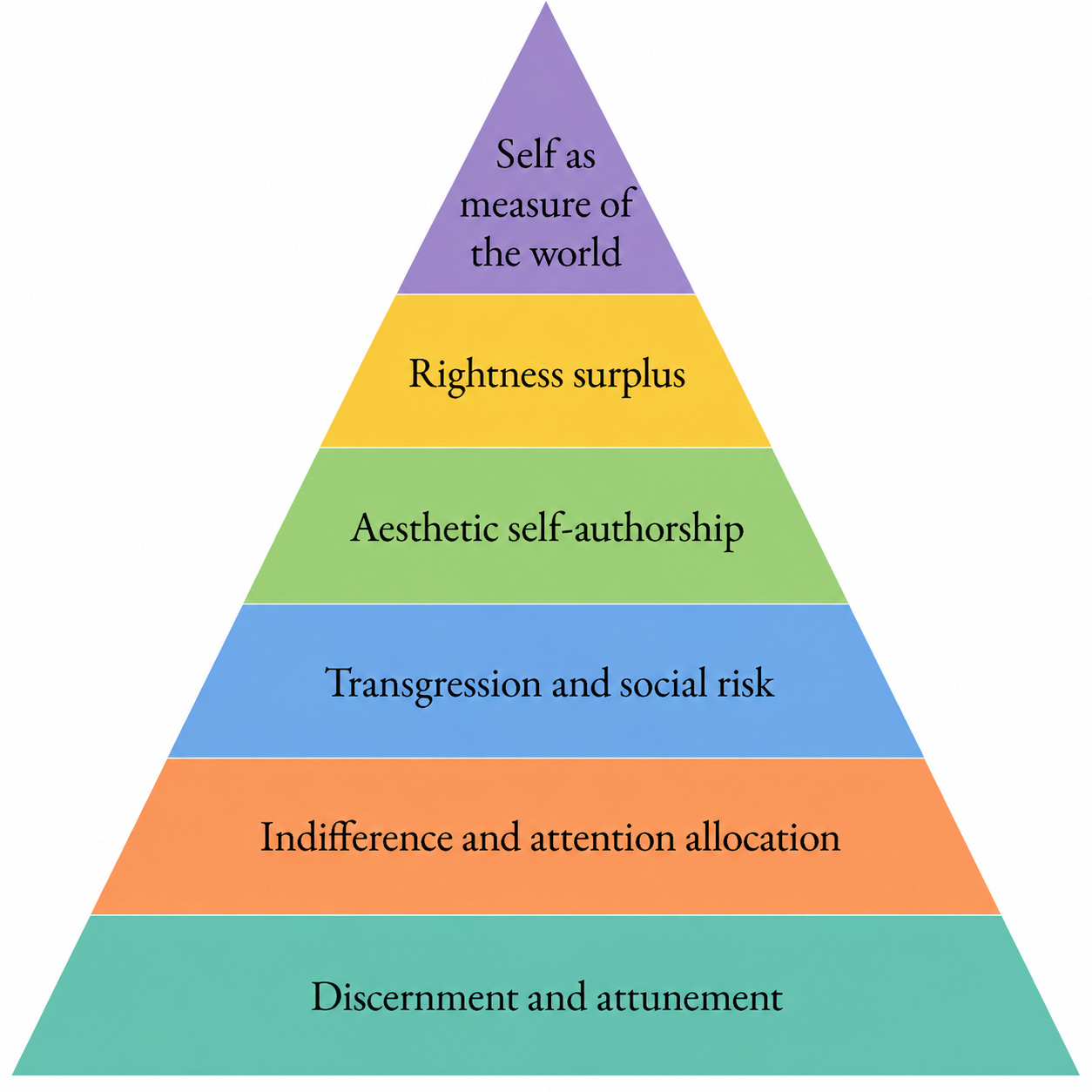
Much of taste discourse today concerns the bottom two levels, and these are the levels that connoisseurs typically inhabit, and where AIs currently threaten to compete.
The three levels above typically involve some degree of risk, and are the levels at which taste pioneering operates and the mechanics are those of a social bloodsport.
The final level, the one occupied perhaps by Mrs. Higgins, represents transcendence of the taste culture.
Let us work through the first two levels.
Discernment and attunement are obviously preconditions to any praxis of taste. You cannot form conscious opinions about things you do not even notice, and you cannot care about differences if you cannot detect the underlying distinctions. Cultivating an increasing resolution of attention is table stakes in any culture of taste. While rare, there can be arrested development at this level — obsessive-compulsive attention to taxonomizing and distinguishing, accompanied by inability to make choices or be indifferent to anything. A kind of taste paralysis.
Indifference and attention allocation, equally obviously, are central to any expression of taste. You cannot watch every movie, listen to every song, or read every book. To choose is to choose indifference to some distinctions, and care about others. In a trivial sense, any two movies are going to be different. In a more meaningfl sense, some of those differences are only going to be evident at a given level of attunement and discernment. Of those, you will care about some, but not others. To do justice to some, you must do at least ritual violence to others.
It is at this point, give or take some details, that much of taste discourse tends to stop. And certainly there is a great deal to say about these two levels. But if this is as far as you go in your taste journey, you have not yet explored taste per se. You have merely internalized a grammar of taste set up by others as a sort of artificial physics, and the rules of that game are indistinguishable from the rules of games designed by nature. Which is why this xkcd (I swear I didn’t remember it was titled “Connoisseur” before getting to this point in the writing of this essay) is so funny.
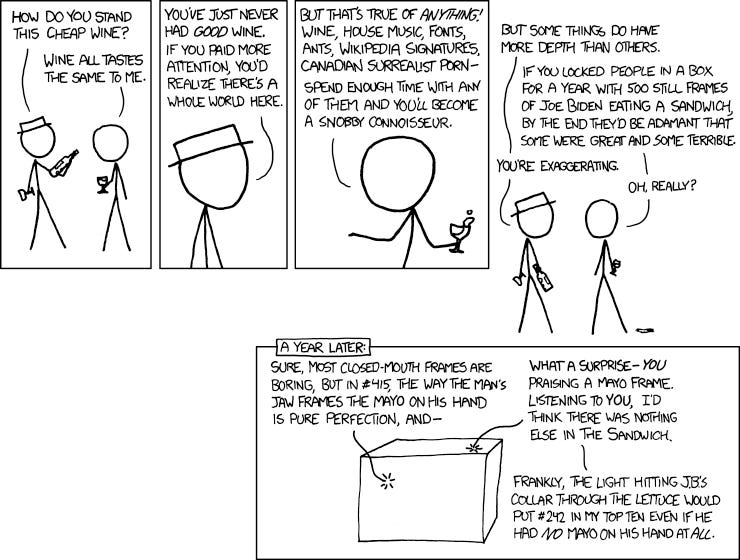
It is worth noting that though connoisseurs disagree and argue, that is the point. They do not actually make decisions their peers do not want them to make. There is no actual risk; no real costs. There is merely the pleasure of endless ritualized disagreement. This is not yet a social bloodsport.
So what does it take for a taste culture to escape the reductio ad absurdum of the Joe-Biden-sandwich-eating endgame?
It takes people who refuse to be locked up in a box, and insist on situating the taste culture in a wider world, and forcing an engagement between the two. People who do not flinch from the question of whether photographs of Joe Biden eating a sandwich actually deserve attention. Taste pioneers who can revalue what the philistines devalue, and rebuild taste cultures after their depredations.
If reality has a surprising amount of detail, and you can nerd out over anything to arbitrary depths, what distinguishes worthwhile and worthless ways of allocating attention and indifference? Asking this question is the first step towards becoming a taste pioneer.
***
The answer, I think, has to do with the potential for high-social-risk intersubjective self-authorship a domain offers. As the xkcd cartoon suggests, any subject can be arbitrarily deep, but once you add risk, real distinctions emerge.
Consider two examples of connoisseurship:
Two dinosaur fans, with equally attuned discernment on saurian matters, argue about the fidelity of two dinosaur representations in Jurassic Park that the rest of us can barely tell apart.
Two jazz fans, with equally attuned discernment on jazz matters, argue about the relative merits of two musicians that the rest of us can barely tell apart.
In the first case, the ground truth for the argument is derived from scientific facts — whether or not dinosaurs have feathers, whether T. Rex ran fast or slow, whether velociraptors were in fact that big (they weren’t) and whether they hunted in packs.
In the second case, the ground truth for the argument is derived from the tradition of taste itself, but to the extent you don’t challenge received authority, it might as well be a matter of objective facts. Instead of poring over fossilized remains, you pore over seminal texts. Instead of systematic empiricism, you practice systematic hermeneutics. Instead of submitting to the authority of experiments and data, you submit to the authority of authority figures.
While there is some room for taste, stylization of facts, and appeals to authority when it comes to beliefs about dinosaurs, dinosaur fandom offers less room for self-authorship than music. This is simply because you can, in fact, become an authoritative source of musical tastes. But you cannot become a new set of dinosaur facts. Taste pioneering is possible in music in a way it isn’t in dinosaur fandom. Fewer constraining facts equals more room for humans.
So when it comes to music, you can go further, because the truths about music are truths about the human psyche and how it can be transformed through the creation and consumption of music. One sign that this is so is that a great deal more social risk accompanies musical tastes than dinosaur tastes.
The journey beyond connoisseurship, and into taste pioneering, begins when you realize that some cultures of taste are neither objective, nor subjective, but intersubjective. And because they are intersubjective, your self-authorship can influence others the way empirical facts can in more objective domains. And that exercising this influence will involve taking on risk.
Few venture into taste pioneering, however, which is why it yields a good definition of taste. Making choices that connoisseurs do not want you to make takes courage.
Much of what passes for taste discourse is really restricted to what we might call aesthetic erudition, which rehearses and models the patterns of judgment of a mature taste culture through scholarship and maintenance of boundaries between esoteric and exoteric. This is the substance of connoisseurship. While I do not in general like Straussian-Girardian frames, they are peculiarly well adapted to thinking about how connoisseurs curate tastes.
In fact, taste cultures are likely the only class of phenomenology to which Straussian-Girardian frames can be usefully applied. Connoisseurs are, in a Straussian reading, scholars of intersubjectivity induced by pioneering greatness. Stewards of mimesis and esoteric-exoteric boundaries, and keepers of hermeneutic rather than empirical truths (and yes, wine, as much as poetry, can be understood as comprising texts produced by authority figures for suitably cultivated tastes, rather than empirical realities). Connoisseurs are at once the scientists and inertial masses responding to forces set in motion by taste pioneers.
This is one reason taste cultures, unlike reality, famously have a conservative bias. If a taste culture goes long enough without disruption by a sufficiently disruptive taste pioneer, it will ossify into a tradition. Connoisseurs will evolve into a priesthood, punishments for tastelessness will increase in severity, slowly choking off the supply of fresh creative minds, and the culture will begin to decay, holding on to fading memories of liveness.
Aesthetics, as I once noted, is the entry drug of conservatism. And it isn’t just the tedious tradarch posters I’m talking about here.
***
Let me venture a strong statement: The connoisseur, ultimately, has no autonomous creative agency, and therefore cannot express taste as such. They can only acquire a particular learnable discernment, and get to a kind of mimetic subjectivity first established as possible by a taste pioneer.
What they visibly practice is a craft that is impressive only insofar as it reliably rehearses and reproduces patterns of judgment we already know, by some other means, to be correct within a given taste culture. It is not an art, either in consumption or production.
This is why there is usually a culture of competitive discernment to first qualify connoisseurs on the basis of objectively determinable competence, (can you identify this wine? this raga?), and then on mutual agreement (does your ranking of these wines meaningfully correlate to those of Wine Spectator? Can you distinguish more and less celebrated exponents of a raga?)
What is notable about such tests of connoisseurship is that they are not tests of individual tastes, but of ability to auditably internalize the default tastes of an entire inherited culture of taste.
The taste pioneer, however, can and does go beyond. A good example of this was Andy Kauffman, who famously did a series of deliberately bad stand-up impressions in his act, topped off with a pitch-perfect impression of Elvis Presley. The act left the audience first annoyed and contemptuous, then speechless. The message was clear — I understand and can express your tastes better than you can, but I have better tastes, fuck you.
Kauffman explored realms of taste that were clearly beyond the culture of taste he was part of, and helped move that culture to those new realms. That’s taste pioneering.
Levels 3-5 of my pyramid chart this sort of journey into taste pioneering.
Transgression and social risk: You must make decisions connoisseurs cannot help but disagree with, because they do not own their own tastes. They merely represent the tastes of a taste culture.
Aesthetic self-authorship: Connoisseurs are, to varying degrees, automatons whose behaviors are only legitimate to the extent they are predetermined by the taste culture. Taste pioneers discover and model new modes of discernment and attunement, responding to phenomenology beyond the walls of the culture. The cultivation and expression of taste becomes a mode of self-authorship rather than a mode of belonging. They are the living proofs of their tastefulness.
Rightness surplus: Taste pioneers, like good leaders of any sort (per Amazon’s famous leadership principles) are right a lot. But what they are right about is a subtle thing. While there can be particular crude signs like commercial or popular success, these can easily be (or interpreted to be) signs of degeneracy. But what they are really right about is where generativity and liveness are to be found. They declare: we must take fashion/art/cinema/music in this direction rather than that one, for that way lies exhaustion and death, while this way lies new life.
At this point, we have something like a theory of creative destruction of taste cultures.
We can think in terms of the Wardley-Cringley pioneer-settler-town-planner model, and draw Wardley maps to capture the evolutionary dynamics of a particular taste culture.
We can talk about how alive or dead it is, what innovations are being introduced by taste pioneers, how notions of sacred and profane are changing, and what elements of taste are becoming irrelevant and commoditized through automation.
I’ll leave all that as suggested exploration directions.
***
Mrs. Higgins in Pygmalion transcends taste culture. She occupies the top of the pyramid, too old to take the trouble to dress out of fashion. She predicts and interprets her son, Henry Higgins’ misadventure for him, and helps protect Eliza from the fallout.
To transcend a taste culture is to no longer rely on it for self-authorship. To no longer be defined by conformity or transgression. To no longer be defined by the cruelties of exclusion, contempt, humiliation, heresy, and heterodoxy. To no longer be defined by a taste for social blood.
To transcend a taste culture is to evolve with it without being defined by it. To inhabit a self that can serve as a measure of the world rather than being measured by it, and give itself permission to be kind, regardless of whether or not that is a tasteful choice.
The instinct to beauty — which is another possible definition of taste — is always also an instinct to cruelty. Cruelty to others, yes, but also cruelty to oneself, in the form of limiting self-conceptions.
Kindness is, perhaps, the ultimate act of tastelessness. It is a taste for life itself, rather than for blood. Which is why it is the mark of transcendence of taste itself, and paradoxically, the ultimate sort of tastefulness too.
I got to thinking about taste, as many have in recent years, by way of thinking about how to teach AIs to have taste. Much of what we can do today is teach AIs connoisseurship. To the extent my theory of connoisseurship as a kind of learned automaticity is correct, it should be entirely trainable. A mimetic subjectivity is reducible to objectively observable behavior. We can likely create zombie connoisseurs as good as any human ones, so long as we can replicate sensory discernment. There is nothing uniquely human about discernment and attunement. The connoisseur is ultimately a Large Taste Model equipped with special sensors. The self they have cultivated can be distilled into model weights.
But to actually teach AIs taste, we must first introduce them to aesthetic risk, both social and material. To the costs of choices someone does not want them to make.
What kinds of risk? And what sorts of costs? And imposed by whom?
I’ll explore these in a future post.
Gabe eventually decided Twitter was “actually bad” (iirc he pioneered the briefly popular usage of “actually good” and “actually bad” that shaped early taste discourse) and disappeared. I don’t know what he’s up to now. But he did help me refine my theory of taste.
You finished in another direction, but what's implied here is that since philistinism is more perturbant than even pioneering, any given taste culture can only emerge because of externalities. (Anyone who's been a grad student knows that bloodsport itself can devolve into a sterile meta-connoisseurship.) So actually stakes are not enough for pioneering; domain collisions caused by philistines are required to originate stakes. In so many cases the philistine of X is also the pioneer of Y, and that's not a coincidence. (This is obviously the social role you love yourself.) In Contraptionese that's "portalling" -- perturbant adjacencies created by mere circulation rather than design. The Pygmalion example suggests further that in the life cycle, grandma can be a "pioneer of Y" by default because she's circulated enough through enough time & space. So teaching an AI bloodsport is by that logic less valuable than using it to accelerate philistinic adjacencies among human agents who are more robustly evolved to perform this sort of pioneering. In Contraptionese, an engine of neo-convergentism. That's how you get waffle cones I suppose: https://www.arabamerica.com/pathbreakers-of-arab-america-ernest-hamwi