

I touched some literal grass today. I don’t think the phrase means what the young people think it does.
I was touching grass not because I particularly wanted to, but because my wife needed some help repotting her tomato plants. Neither of us is particularly interested in gardening. My wife is primarily on a mission to secure better tomatoes for the coming months than are generally available in Seattle. I’m free-riding on her efforts for a ready supply of fresh cilantro. Though to be honest, if she weren’t gardening, I’d just get my cilantro at the store like I used to. I’d probably just let the local forest take over our yard.
Little signal boost: I’m organizing the Protocol Symposium in September, on the theme of New Nature. One day left for talk and workshop proposals (deadline, Sunday 14th June, midnight).
I don’t mind light gardening chores like watering the lawn or a spot of digging around, but it’s not my idea of relaxing fun. The wife though, has been drawn into the ceaseless global war of backyard gardeners against weeds and various critters that try to eat your produce. In our case, local wild bunnies, which she initially thought were cute but has now declared her sworn enemies. She is wishing death-by-coyote on them, but the local coyotes have so far not obliged. It’s nature red green in tooth and root in our backyard.
This essay is not about whatever “touching grass” is a metaphor for. I don’t know, probably some touchingly vulnerable thing like curing loneliness and alienation by seeking more non-parasocial IRL friendships and romance, with maybe a bit of actual outdoor time to regulate sleep better and mitigate the fatigue of too much screen time. Worthwhile life-hygiene things perhaps, but not particularly interesting to me. These are not problems I personally suffer, though I sympathize with those who do.
This essay is a little bit about literally touching grass, but it’s mainly about a complementary activity I’ll call touching time.
***
To literally touch grass in most parts of the world, especially in the sort of somatic-meditative mode the meme-phrase suggests, somebody probably needs to be fighting a deadly war against not-grass. Grass in a pure, monocultural form is not a natural thing.
I grew up mostly in single-family homes with lawns-equipped gardens and regular gardeners. My mom was an avid gardener, and remains one in her 80s (though now limited to a bunch of balcony plants in my parents retirement apartment). I enjoyed helping out with the lawn watering mainly because you could have fun playing games with the water.
Grass anywhere, in the sense suburbanites everywhere encounter it, is an extraordinarily unnatural thing, but it is particularly so in India. The tropics are not a natural habitat of temperate European lawn grasses, and it’s an uphill struggle against blazing sun alternating with torrential rain to keep lawns going. Tropical monsoon ecologies alternate between dry and dusty and lush and overgrown. Neither mode is lawn-friendly. The natural sort of curated domestic plant ecology is a fruit orchard plus herb garden full of small gods.
Grass is not natural in the Seattle area either, where I live now. The latitude is right, but it’s too wet. The natural ecology here is dense temperate rainforest full of sparkly vampires and werewolves.
But even in the form you might typically encounter it in its native habitat, grass in the sense of a lawn monoculture is a highly unnatural, authoritarian high-modernist Veblen good. The stylized expression of Euro-heritage billionaire atavism, not starving poet soul-salve that heals through touch. What is natural is the meadow, a wild multi-species ecology. And meadows are not that fun to touch, as you’d know if you’ve tried. The one time I tried was when I misguidedly tried to do a spot of orienteering in 2005, with a survey map in hand, on the outskirts of Ithaca. It was not fun.
Meadows harbor many itchy-scratchy-sneezy-creepy-crawly things. Hostility animal, vegetable, and mineral. The mix of grasses and other plants typically grows taller than a lawn (between knee and waist-high). And much of it is not the soft kind.
Laying on your back on a well-manicured suburban lawn, running your fingers through the cool grass, is fun. On a wild meadow, not so much. You’ll probably touch something unpleasantly pokey or bitey.
Between the wild meadow and the authoritarian high-modernist lawn, we have the heavily grazed pasture. That probably has horse and cow manure all over it.
***
Here is a picture of the grass I touched this morning. We just reseeded it a few weeks ago, and it’s already enduring an assault from some sort of weed species, probably buttercup, according to ChatGPT.
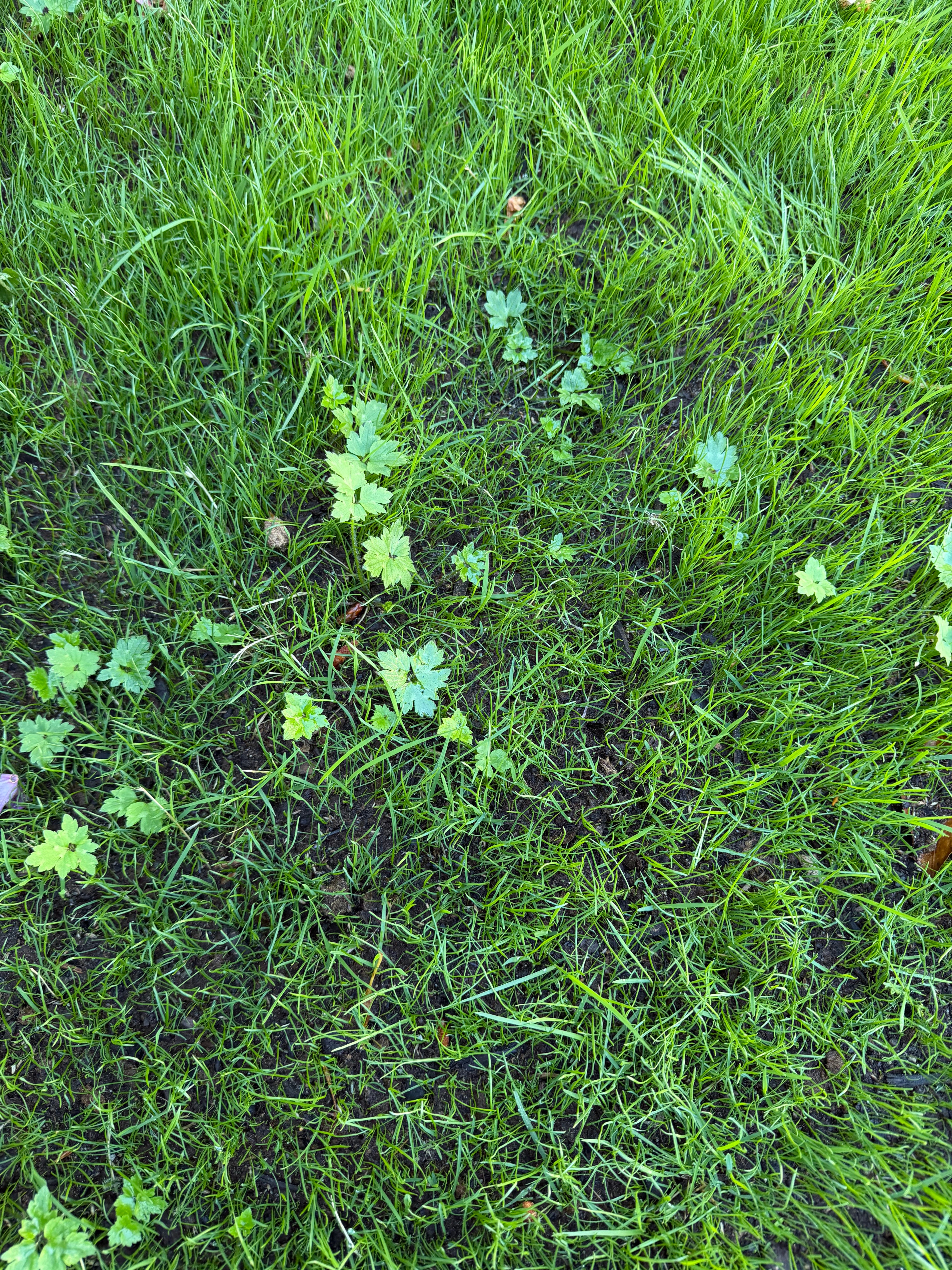
The very idea of a weed, of course, is an authoritarian high-modernist one, but my wife, an authoritarian high-modernist to the core, is planning a battle against it. Our lawn is going to be monoculturally legibilized in war mode whether it likes it or not. Darwin’s tangled bank is not permitted to enter. Wildflower meadow patches are for the weak-minded.
See, that’s the thing about actually, literally touching grass. Unless it’s someone else’s grass you’re free-riding on, you’re actually signing up to participate in a silent, never-ending war against meadowfication or forestification. Tangled-bankification. It is ceaseless, tiring hard work; a specialized kind of farming. If you want five minutes of grass-touching a day, you’ll probably need to spend an hour a day fighting the war to keep it available (or paying someone to fight it for you).
People meditatively posting about “agency” aren’t well-suited to doing it. In the US, this war is mostly waged by immigrant Mexican workers on behalf of people posting online about touching grass.
Grass of the sort that shapes the Western narrative imagination, whether of the naturalistic English garden variety, the formal French garden variety, or the golf-course variety, is fragile monocultural life maintained with grim determination against the encroaching pressures of wilder, more pluralist ecologies.
Yes, it’s pleasant to touch. No, it’s no more a natural experience than touching astroturf. Which actually isn’t bad. I enjoy astroturfed outdoor malls.
Touching meadows would probably be a better prescription for the times, but I doubt it will catch on.
***
My prefered form of interaction with nature is not ceaseless war-mode agentic striving to maintain authoritarian high-modernist gardens but walking and mild hiking through mildly challenging wilderness areas. Well, “wilderness” in the sense of human-adjacent zones of preservation with some well-maintained easy hiking trails through them. Actual wilderness (as in the deep interiors of national parks, far from well-maintained trails and campsites), which I’ve experienced a few times when I was younger and actively “seeking meaning” myself, is stressful in a whole different you-could-die way. I exhausted what little desire I had to test my wilderness survival instincts by age 22.
The thing about both gardening/farming and being in extreme wilderness is that they’re necessarily zones of inescapable high-intensity agency that you either have to take on yourself or pay someone else to. They are not spectator sports. Light hiking trails, on the other hand, enable more passive experiences. Somebody (preferably not me) still has to labor a bit, but it’s not as intense as farming, gardening, or cutting your way through deep wildernesses with a machete, keeping an eye open for jaguars. It’s not a warzone. It’s a sort of neighborly detente zone of engagement with minimally domesticated wilderness.
Over the past few decades, I’ve been fortunate enough to have nearly always lived near pleasant light-hiking trails. The one exception was a year in Austin, 2000-01. There, I lived in an unpleasant neighborhood next to big-box stores and highways. I don’t know whether there are any areas in Texas I could enjoy living in.
My favorite lightly domesticated wilderness was Ithaca, where my commute from downtown to my office on the Cornell campus was a hike up a trail next to a cascading waterfall.
What was nice about it was not touching grass, but touching time. Deep time. The gorges of Ithaca (the town’s slogan is Ithaca is Gorges) were carved out in the last ice age. Hiking around near Ithaca, you hike through deep time. Tens of thousands of years evident in the landscape. Millennia visible to the literate eye in the strata exposed by the retreating glaciers.
Mine is not a literate eye. I’m no geologist. But I can feel it in my gut when there is in-your-face deep time geology stuff going on, and I like it.
***
As a kid, my fondest memories of our backyard lawn is not of touching the grass, but of looking up at the stars. In high school, I’d regularly lug my cheap telescope out to the lawn to do a spot of star-gazing.
Now there’s an activity that’s almost entirely about touching time. The skies above offer zero room for human agency. Even trillionaire Musk, with his dreams of Mars colonies, has agency that amounts to a rounding error past zero relative to the cosmos. There’s basically nothing you can do with the heavens besides photograph them.
Not only is it all impossibly far away in space, largely beyond any sort of touching, the vast majority of it is also impossibly far away in time. The nearest star you see is 4.2 years in the past. The Vogons could have demolished it yesterday and we wouldn’t know.
The heavens are a sort of asymptotic zone of non-agency. You have only two choices in relation to them — ignore them entirely and refuse to learn about them (as the very practical Sherlock Holmes did), or treat them as a spectator sport (a very slow one; slower than cricket).
The only available attitude to the heavens demands not agency, but presence.
To a certain contemporary type, mere presence in the cosmos is an anxiety-provoking, even alarming state of being to contemplate. If they’re not aggressively making grand plans to construct Dyson spheres and generation ships headed to Alpha Centauri, they find the spatio-temporally distant read-only universe too distressing to even attend to.
***
Presence without agency is also the only way we can relate to the past. We can be present in memories, individual and collective. But we cannot alter the phenomenology that induced them. We can endlessly spin revisionist narratives, but we can’t alter the past itself.
This too, is anxiety provoking for the agency-anxious, and so they turn to notions of progress and predestination, trying to go beyond mere revisionist history to what we might call proofs of history: Authoring hoped-for futures in part to “prove” preferred pasts.
When I was younger, I enjoyed reading “Big Histories.” Now I no longer do. They’re all anxiously motivated revisionisms, simply by virtue of being Big. No story at that sort of scale can be told except in the form of a self-soothing fantasy.
Instead, I enjoy reading about specific periods and episodes. Little histories. I like my sense of the Big to emerge not through epic grand narratives, but as a sort of collage of deeper temporal dynamics revealed through many fragments coalescing into a sort of atomized encyclopedia of moments.
Little histories allow you to touch time in ways big histories don’t. That is their main advantage.
This doesn’t mean you have to immerse yourself in the sort of joyless grind of uninspired documentation that is much of scholarly history. There is plenty of little history that combines scholarly attention to detail with a sense of the poetry of time. Our book club is mostly about reading that sort of romantic little history. And if you harbor psychohistorical conceits as my world machines buddies and I do, I think the trick is to get at your Seldon Vault prophecies by touching time through little histories. Not self-indulgence in anxiously revisionist Big Histories.
You do need a certain amount of Big History reading as preparatory orientation for understanding little histories. If you survive the many perils of that kind of reading — historicism, progressology, ideology, theology, exceptionalism — what you end up with is a rough map on which to start placing the little histories you can begin collecting. My idea of Big History now is like an empty stamp album. Stamps are actually ideal motifs of little history. Every stamp usually tells some specific story (though not always the one it is trying to tell). The Big History is implicit in the organization of the collection, rather than explicated in an epic grand narrative.
Touching stamps is a good example of touching time. Touching time is about the physics of stamp collecting.
What I mean by touching time is this: A cognitive-sensory experience that has temporal depth in the frequency domain, with time constants ranging from seconds to millennia available to the attuned awareness to attend to. “Infinity in an hour” as William Blake put it.
Many experiences are temporally shallow. A well-manicured lawn, for example, is largely a war of short time constants between fast-growing grasses and roughly equally fast-growing weeds. Deeper, slower dynamics, as well as faster, shallower ones are present, but harder to become aware of and attend to. Hiking through a gorge with exposed strata, on the other hand, the depth of time is in your face. Time is thick enough to cut with a knife.
***
I think one undertheorized reason people feel the urge to touch grass is a sense of helplessness in relation to events at larger scales, in an era which urges us to cultivate agency in relation to everything.
To be is to do apparently. The only way our age knows of to merely be is to be somebody, which is a degenerate sort of doing, in the form of personhood performance in theaters of agency.
To merely be, in the sense of existing anonymously and idly in a universe over much of which you have zero agency, without either studiously ignoring it, or striving intensely to try and make it take special notice of you, is widely regarded as a disease.
Touching time is about rejecting that pathologization of banal, non-special presence, and choosing to exist in the cosmos without being somebody or doing something. Not because it’s some enlightened state of being (it just takes some laziness and mediocrity of disposition), but because it’s actually a very pleasant way of being.
I came up with an allegory for this.
Imagine you’re on a vast spaceship traveling in hyperdimensional space. You’re a normal human, so you can only intelligibly sense the regular four: three spatial dimensions plus time. But the ship itself is weaving in and out of many more curled-up dungeon dimensions, as Terry Pratchett dubbed them. Sometimes maneuvering aggressively, at other times cruising along.
You do, however, unintelligibly sense the other dimensions, all of them, in your gut. You are present in all dimensions as a full-dimensioned dungeon-dimensions creature rather than a four-dimensional limited one.
Your experience of the dungeon dimensions of the spaceship’s journey is the familiar one of nausea.
And you can regulate this nausea. Turns out, if you let your mind wander to abstract thoughts and intangible ideas, graspable only through words, the nausea increases. But if you retreat from abstraction and intangibility, the nausea goes down.
So naturally, a division appears between two groups of people on the ship.
The first group, unable to tolerate the nausea, retreats from it. And is so successful at retreating, it begins to doubt that the spaceship is in fact maneuvering in hyperdimensional space. It begins to believe the dungeon dimensions do not exist at all. That the ship in fact merely exists in 4d space and chugging along placidly in it. That the sensible thing to do is to stay grounded in things you can see and touch, such as the astroturf (heh!) covering much of the ship’s built environment.
The second group, with greater tolerance for the nausea, heads deeper into it, to try and experience the dungeon dimensions as fully as possible. To get past mere visceral feelings and vibes to consciously regulated intelligible experience. This group immerses itself in abstractions and intangibles as far as it can tolerate, and begins to make for itself dungeon-dimensional maps, with the spaceship’s estimated trajectories marked on it. Slowly, it begins to convince itself that not only are the dungeon dimensions real, but that its maps are accurate, and that it can reliably orient in and navigate them.
And naturally, a war begins to unfold between the two groups.
The spaceship, of course, is just Buckminster Fuller’s Spaceship Earth. And the two groups of course, are the grass-touchers and the abstract map-makers.
Touching time is how you bridge the divide between the two.
We are living through times when Spaceship Earth is maneuvering extraordinarily aggressively through the dungeon dimensions of hyperdimensional spacetime, even though in the three dimensions we can see, it is continuing its age-old orbit around the Sun, marking time at one year per orbit.
We all feel it in our guts. To retreat to touching grass is to surrender to a sense of the maneuverings of history being unsteerable. To retreat in the other direction to make endless maps is to mistake your comforting fictions for vast and limitless steering authority.
But to touch time is to feel your way into whatever steering authority you do have, without needing to retreat from everywhere you have none.
Damn, son. <--Took 20 minutes to edit left of the arrow.
This is wonderful. Been using the metaphors of lawns vs the wild quite often in my writing.
Touching time is such a great way to frame the middle-ground here. Another way I've been treating it, is the embodied world (grass touchers) vs the world of symbols (map makers). Been doing a lot more recently to "feel" time by tapping into the world around me. Things like, opening windows more regularly (even if it's mega humid in the summer), more walks, etc. It's about feeling like I'm a part of the world around me, not just the one in my phone.
Great food for thought.