

The current debate over whether OpenAI has become “too big to fail,” triggered by the viral Wall Street Journal article, tends to frame the risk in familiar economic terms: over-concentration, interlocking commitments, trillion-dollar infrastructure buildouts, and the emergence of a firm whose collapse could destabilize a sector that now props up a sluggish U.S. economy. That argument is correct but incomplete. The deeper structural fragility lies not in the financing of AI infrastructure but in the epistemic dynamics of the models themselves. As we worked through the numbers, it became clear that OpenAI’s infrastructure roadmap—petawatts of compute, trillion-parameter systems, multi-trillion-dollar capital requirements spread across cloud providers, chip manufacturers, and sovereign backers—was constructed on an essentially theological belief in seamless exponential model improvement, a belief that assumed scaling could continue indefinitely toward “AGI.” That faith was not grounded in empirical availability of training data or in any theoretical understanding of how learning actually behaves at frontier scale. The infrastructure has been sized for stars that burn hotter and hotter, without regard for the fuel supply.
Sloptraptions is an AI-assisted opt-in section of the Contraptions Newsletter. If you only want my hand-crafted writing, you can unsubscribe from this section.
The real fuel, of course, is training data: the cultural, linguistic, computational, and behavioral traces that models attempt to fit. And here the numbers are uncompromising. The growth of high-quality data is slow and diminishing. The world’s stock of usable text, code, imagery, and speech grows incrementally, not exponentially. Meanwhile model sizes, compute budgets, and context windows have expanded by orders of magnitude. That mismatch means that newer, larger models are trained on datasets that are only marginally larger than those that fed their predecessors. The result is not graceful scaling but increasing epistemic brittleness. These larger systems learn the training distribution with greater and greater precision, pushing well past the semantic “signal” of an era and into its high-frequency cultural noise. They fit not only the stable structures of human knowledge but its accidents, its transient biases, its stylistic detritus. Emmett Shear’s observation—that frontier models are barely regularized and therefore massively overfit—captures this dynamic in accessible language.
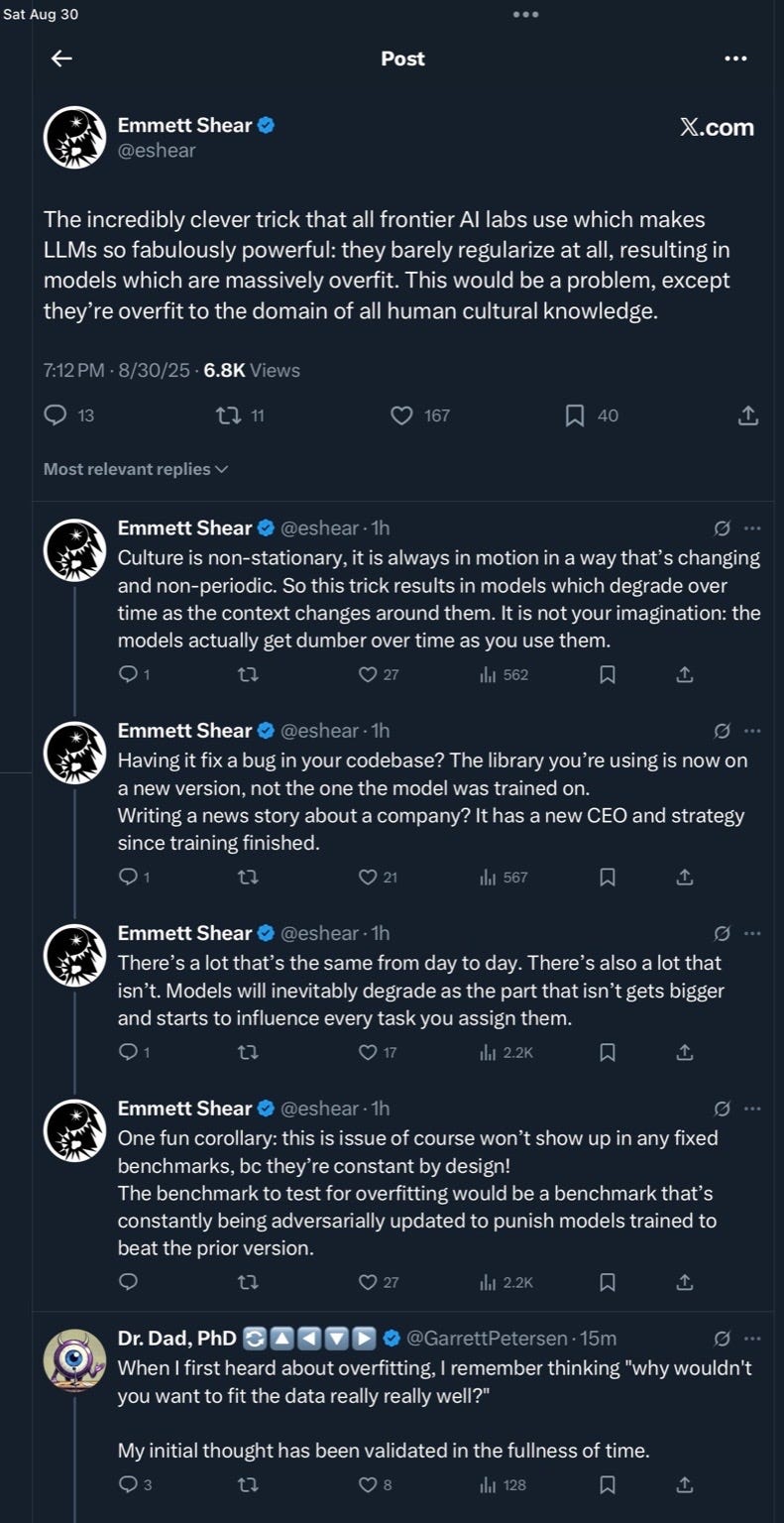
But the deeper point is that overfitting to a static cultural snapshot becomes more catastrophic the larger the model grows. Culture is non-stationary; code ecosystems evolve; APIs change; institutions churn; slang mutates; the factual substrate of the world drifts each month. A small model trained on yesterday’s world degrades slowly. A large model trained on yesterday’s world degrades quickly and fails sharply.
This leads to a paradox at the heart of current AI economics. The trillion-dollar infrastructure wave justified by OpenAI’s ambitions has been built to support the next generation of massive models, but those massive models become obsolete faster than smaller ones. Like large stars, they burn brighter but collapse sooner. They present answers with greater surface coherence and tighter epistemic compression, giving users the illusion of deeper insight when they are actually reproducing the micro-structure of an outdated distribution. People will rely on this increased apparent precision—mistaking fluency for truth—and take correspondingly larger risks, operational, financial, political, and scientific. Precision becomes a kind of leverage: as confidence grows faster than correctness, the system tilts toward a bubble of over-trusted, under-verified automated reasoning. When the model slips outside of its training-era manifold, it does so abruptly, invisibly, and in ways that propagate errors with unprecedented speed across the organizations that depend on it. This is a new kind of systemic fragility: epistemic over-leverage driven by model scale rather than financial leverage driven by debt.
Against this background, the “too big to fail” scenario acquires a different meaning. The infrastructure ecosystem—Oracle’s data centers, Microsoft’s GPU clusters, Broadcom’s networking pipelines, Nvidia’s supply chain—was scaled for frontier models that may offer shrinking marginal returns and increasing temporal instability. If model quality plateaus or degrades because data does not keep pace, the economic justification for the infrastructure may collapse even as the infrastructure itself remains technically capable and commercially underutilized. The danger is not that OpenAI fails outright, but that the sector pivots into a phase where the largest models have the shortest useful lifespans, while the capital commitments they require stretch across decades. This is a structural misalignment between epistemic time and financial time.
Yet the story need not end in collapse. There is a way out, and it comes from expanding the data manifold itself rather than merely scaling the model against a static corpus. The next major frontier is likely not text or code but 4D video—continuous, high-bandwidth, spatiotemporal sensory data that more closely matches the real structure of the physical world. Unlike textual culture, which is finite and saturating, the spatiotemporal world generates unbounded data streams. High-fidelity 4D capture, simulation, and reconstruction offer an escape from the bottleneck that is slowly strangling language-model scaling. Models trained on rich physical dynamics rather than frozen cultural snapshots would not merely grow larger; they would grow deeper, anchored to a data distribution that evolves with reality instead of drifting away from it. If the industry moves decisively toward 4D multimodal modeling—robotics, embodied agents, physical reasoning, simulation feedback loops—then the present overfitting trap can be broken. The fuel supply becomes effectively renewable, and the models’ lifespans lengthen rather than shrink. In that sense, the most optimistic path is not to keep scaling cultural predictors but to graduate beyond them, giving the infrastructure something real to learn from and restoring coherence between model scale, data scale, and the world itself.
Sonja Lang, Grok and me are collaborating on this new language.
It's all about avoiding epistemic fragility in scaling AI—overfitting to static data. Avoid burning too hot, and collapsing fast. It's about the mismatch between compute infrastructure and real-world evolution
https://docs.google.com/document/d/1_hMjpMQcuFKvt_n0Wm1_opFg_-Kwi713vaFRotPyyW0/edit?tab=t.0#heading=h.r9oq80jsfwtq
You would probably like Ben Rechts spicy posts about overfitting.
https://www.argmin.net/p/thou-shalt-not-overfit
https://www.argmin.net/p/flavors-of-overfitting