

The basic premise of the World Machines theory I’ve been developing in collaboration with book club regulars is that we can describe how the world works at any given time in terms of three co-extensive machine-like planetarities, an ascendant one (the Dawn machine), a maturing one (the Day machine), and a declining one (the Dusk machine), with each WM having a nominal lifespan of about a millennium, and spending 400 years in the dawn stage, 400 in the day stage, and 200 years in the dusk stage.
This is of course a highly stylized, arbitrary, and contraptiony Big History scaffolding, and I’m not pretending it’s isn’t. But it is perhaps the very arbitrariness that makes it so useful to me as a canvas on which to situate much messier and more nuanced learnings from reading real history in our book club.
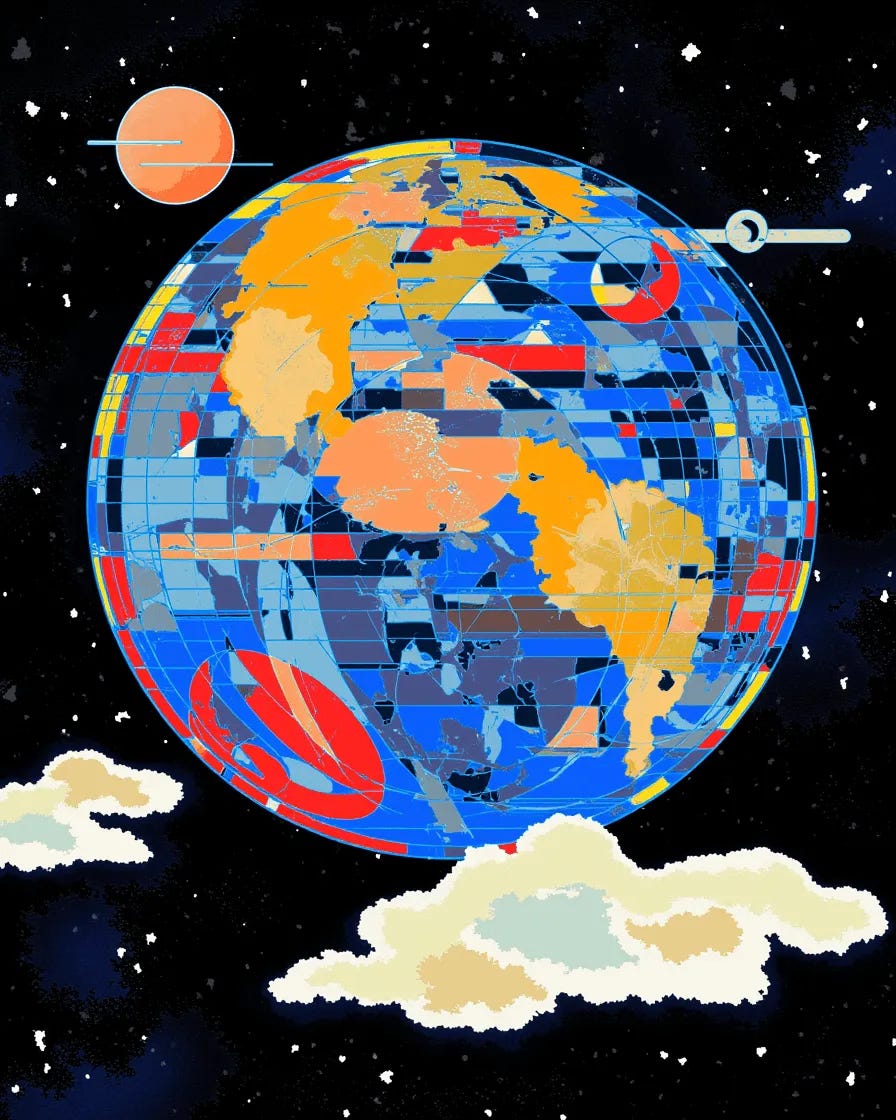
The WM framework is proving surprisingly expressive and capable of digesting a great variety of interesting ideas and historical phenomenology. I’m almost convinced WM theory can animate the prime radiant type core of a psychohistory project. We’re as gods, and might as well harbor ludicrous vibe-coding dreams inspired by long-in-the-tooth mid-century science fiction. Hence the World Machines Project. The link is to a tag index page on this newsletter with just my WM-tagged posts, but there will soon be a separate website that will compile writings by others besides me, and feature more comprehensive project information, a Seldon vault, etc.
Currently, the Modernity Machine (MM) is entering its Dusk stage, the Divergence Machine (DM) has reached its Day stage, and the Liveness Machine (LM)has just been born into its Dawn (links to posts about each in the link above).
We’re currently reading Andrea Wulf’s The Invention of Nature in the book club, about the life and work of Alexander Von Humboldt (1769-1859) in our DM-themed 2026 book club. The construct of Nature™ that Humboldt invented (Wulf is right to credit him as the inventor of nature as we know it) is a fascinating attempt to thread the needle between MM-based and DM-based accounts of nature. There is both a kind of mechanistic clock-like integrity to his conception, and hints of the unabashedly divergentist conception that Darwin developed a little later. Notably, Humboldt’s model included both the non-living earth and life. His was an integrated vision of geology and the biosphere. He anticipated both evolution and plate tectonics.
Equally notable—despite being a member of the Jena German romanticism movement and inclined to emphasize subjectivity and poetry, his model doesn’t appear to have liveness to it, unlike James Lovelock’s Gaia hypothesis or the Varela-Maturana autopoiesis model that came a century later. Humboldt’s planet was a complex hybrid machine, but not a living one. His poetic sensibility did not extend to Gaian conceits afaict. He was too much of a true empiricist for that. And liveness as a non-allegorical planetary property had to wait for technology to get much more sophisticated than it was in Humboldt’s time (his life roughly coincides with the birth phase of the steam engine).
Specifically, I think the Liveness Machine being born today is only being born because real AI has emerged. While a degree of meaningful liveness might have been possible with pre-AI computing, I think it would have fallen well short of a World-Machine-grade dynamic, and still required a squinting allegorical imagination to appreciate. More importantly, it would have lacked the power to dethrone divergence as the dominant force shaping the planet. The core dynamic of the new Dawn machine would have been something else. Perhaps renewables driving an Energy Machine. But now it’s clear that the most leveraged use of energy, whether renewable or not, and regardless of the severity of the climate shock in store for us, will be to power AI. And AI will animate the planet-scale Liveness Machine. Whether it is a grimdark LM or a solarpunk LM, is tbd. By psychohistorical analysis.
So we’re now on track to create a living planet that will take no refined poetic or romantic sensibilities to appreciate. It will be a New Nature. And given how AI is speed running every technology cycle model, it might take much less than 400 years for the LM to switch from Dawn to Day phase, consigning the divergence machine to a premature retirement. In my kickoff WMP post, I noted:
The current Dawn machine, which I’m calling the Liveness Machine, starts with the cusp technology of generative AI, which is poised between a divergent non-living process, and a self-organized critical living process. Shoggoth-like basically. We’ll study it next year, so resist the temptation to jump the gun on it.
I don’t want to jump the gun myself, but I think it’s worth saying enough about liveness to contrast it with divergence for the purpose of characterizing AI correctly in WM terms. We can do that by listing the divergence vs liveness attributes of AI.
Divergence aspects
Bespokification — AI lets us personalize our experience of technology to the point it makes it incommensurable with the experiences of others
Solipsism — AI lets us retreat to personal, subjective, escaped realities
Deep fakery — AI erodes trust and connection by allowing us to present arbitrarily rich deceptive surfaces
Personal memory involution pressure — AI draws us into deeper dialogue with our archival selves, by articulating personal memories much better, making us retreat from live others
Collective memory intermediation — AI buffers our ecoerience of collective memory compared to human media, through summarization, reinscription, bespoke renarration etc.
Camera > Engine effect — AI draws us into a photographic spectatorial relationship with knowledge organized into alienized spaces, allowing for increasingly weird ontic-structure experiences of reality
Permaweirding accelerant — AI accelerates divergent weirding forces of the Permaweird, making the world objectively weirder not just our subjective experience of it
Liveness aspects
Ooziness — AI is oozy, like a primordial soup that harbors intensely reactive chemistry
Strange loopiness — AI creates strange OODA loops (Claude Code being the earliest example) that refactor our identities when we surrender to them
Configurancy catalysis — AI allows larger and more complex configurancies to cohere and persist, creating a whole ecology of new artificial life forms in latent space
Memory revivification — AI makes all memories come alive, integrating them into the experience of the present and future
Execution pull — AI pulls us into much stronger execution regimes, drawing us out from vita contemplativa regimes to vita activa regimes
Intelligence media graph minds — rich context-level connections between individual solipsistic realities allows new kinds of transhuman egregores (what I’ve previously called graph minds) to emerge
Superhistorification — AI densifies history, turning it into a gravity well, creating convergence forces in civilization that balance out divergence forces
On balance, I think divergence will dominate in the short term (2-5 years) but liveness effects will compound more steadily and dominate in the long term (>5 years).
Interesting. Hypersensory intelligence seems in line with this (proposition? Provocation? Hypothesis?). Still, though, I would bet “liveness” also runs through breakthroughs in human intelligence - both sensory and collective.