

I want to share a principle I formulated several months ago, which I call the profligacy principle, and which can be contrasted with the parsimony principle, better known as Occam’s razor.
But before we get into it, an event announcement. Starting next Friday (Nov 20), along with a couple of co-conspirators, I’m hosting a week-long hackathon to introduce the Blygger publishing protocol to developers, vibe-coders, and sufficiently courageous non-technical people. Learn more and register here. The kickoff session is at 9 AM Pacific on Friday.
The popular version of Occam’s razor is something like “the simplest explanation is likely the correct one,” but for once, the pedantic version is actually much more interesting: Entia non sunt multiplicanda praeter necessitatem, or "entities must not be multiplied beyond necessity." Unlike the popular version, which is vague and almost tautological, the pedant’s version specifies a particular kind of simplicity, ontological parsimony. There’s still some ambiguity here of course, particularly between number of kinds, and the number of instances of kinds.
As a simple example, both binary and decimal systems exhibit ontological parsimony, but differ in number of kinds and instances. For a given number, the binary system uses only 2 symbols as opposed to 10, but takes more digits to represent it. But in contrast to both, the Roman numeral system (a “sign-value” system) is not ontologically parsimonious, since the strict version would require an infinite number of symbols (in practice, weird tally-mark style hacks were used to represent large numbers).
Flipping this principle around, we get the profligacy principle — entities should be multiplied needlessly. Or to put it more compactly, we should waste entities. The Roman numeral system is profligate in this sense. In a way, it’s not a number system so much as a naming system.
Now, why on earth would you ever want to be profligate in this sense, whether you’re constructing explanations or designing things?
One hint at where I’m going with this: Nature is profligate in this sense. It churns out an endless variety of entities to no apparent end, simply because it can. In the words of philosopher Rick Sanchez, nature “creates endless idiots just to eat them.” So do other complex systems, such as the consumer economy. And by a certain logic similar to that of Ashby’s law of requisite variety, you might expect certain kinds of accounts of reality to be as profligate as the nature they describe. Accounts that defy easy characterization as causal, phenomenological, or emergent. Let’s provisionally label them ontogenic accounts. Accounts of being and becoming.
But let’s begin at the beginning. There’s a backstory to this train of thought.
A few months ago, my artist buddy Ian Cheng and his publisher Ben Vickers, proprietor of the new boutique publishing firm Cosmogenesis, asked me to write the preface to Ian’s new paperback book, Worlding, which collects some core material from his Emissaries Guide to Worlding, along with some new material, and an old blog-dialogue Ian and I co-wrote on Ribbonfarm several years ago, called the Worlding Raga. It’s a neat little volume for anyone interested in the philosophy and practice of worlding as Ian calls it, which is a sort of superset of what is commonly called world-building.
You can get 20% off either or both books with the code CONTRAPTIONS at the links above
If you’re not familiar with Ian’s work, he’s one of the pioneers of game-engine based art. His best-known gallery show, Emissaries (2015-18), featured indefinitely evolving artificial ecologies (think Conway’s Game of Life, but souped up), and prefigured key elements of modern generative art. He’s since done a short animated movie and has been building AI companions for kids.
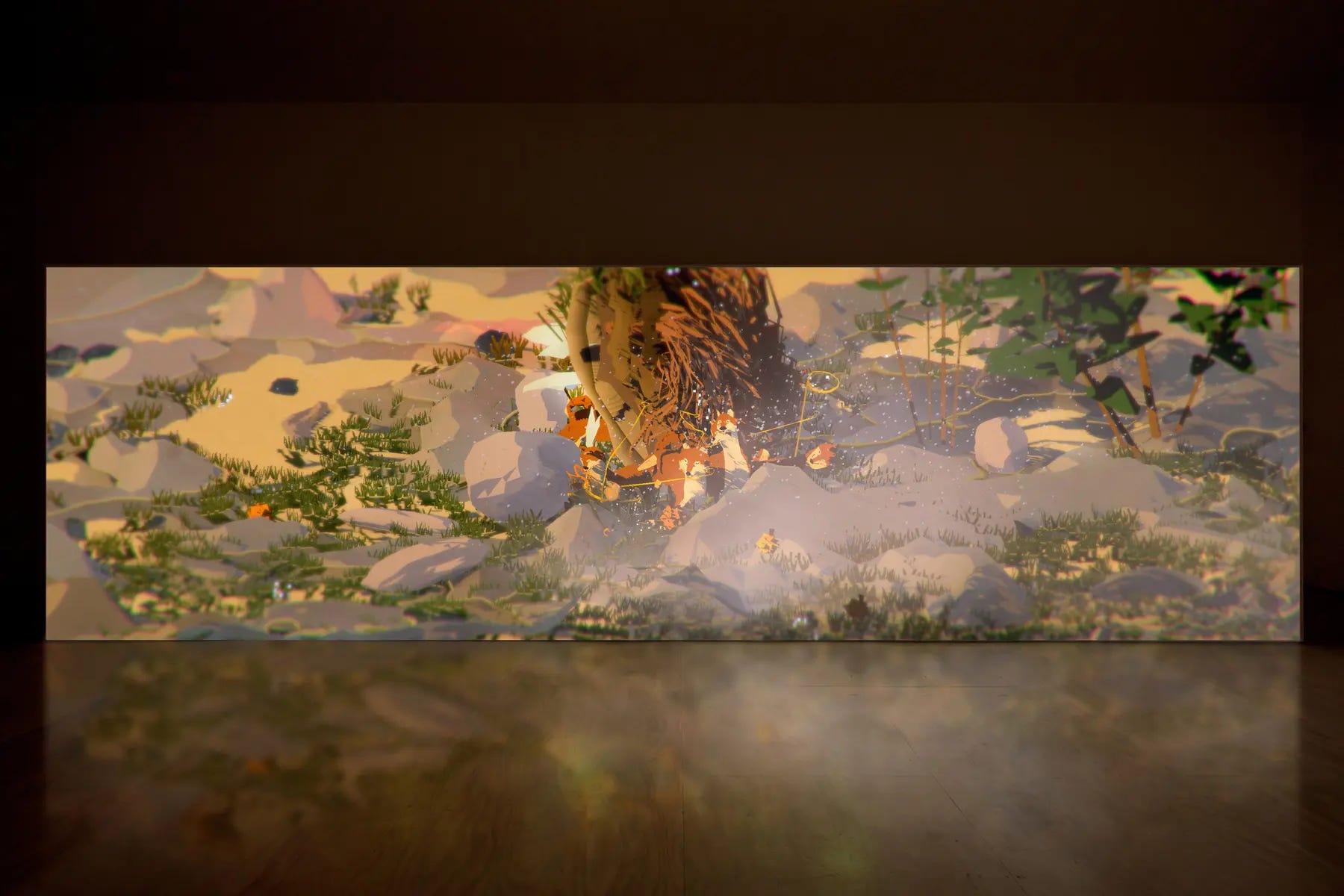
The preface is one of the more fun things I’ve written recently (buy the book to read it), and that’s where I first introduced the profligacy principle, which is powerfully manifested in Ian’s work.
Ian’s work also suggests why a profligacy principle might be useful. Profligacy is at the heart of playability, plurality, possibility, emergence, and generativity. It is the essence of the ontogenic games of various sorts — nature, the economy, and now AI — that drive evolutionary processes. Processes that seem to drive towards maximally manifesting everything they can, multiplying entities, keeping the infinite game going.
Generativity as Profligacy
Like Google’s early, surreal, Deep Dream (2015), and the brief era of GAN art (~2018-2021 or so), Ian’s early generative art benefited artistically from the limitations of procedural generation technology at the time. Like other work from the period, his work has a raw, unfinished feel and a kind of ontogenic liveness that is missing from the more polished outputs of modern image generators. For functional representational art, cats with too many eyes or hands with too many fingers are bugs. But for certain kinds of art, they are raw material.
In a different way, I too benefitted from the limitations of technology in my brief career in control theory around the turn of the millennium. I have a longer version of the story in my preface to Ian’s book, but here is the short version.
I entered the field of control theory circa 1997, with a temperament almost perfectly mismatched to one of its foundational methodological heuristics: When studying a system, start with the simplest possible toy model. I have always had what I call a complicatedness bias. If a model seemed too simple, my instinct was to add things to it until it seemed to be operating at the right resolution, and became fun to play with.
Simple models can be beautiful, and the mathematical techniques available for studying them are often powerful and satisfying. The problem was that I could never figure out how to get from simple models to complicated ones in any systematic way. At every significant increase in scale or scope, the ontology appropriate to the problem seemed to change. You cannot get to a practical model of a rocket by adding complications to the classic inverted pendulum model. Sure, that’s part of one aspect of it, but at the scale of a real rocket, you have to consider the thing at its own scale. A scale at which it has millions of moving parts, not the handful that a conceptual inverted pendulum does (even leveling up to a real lab-scale experimental inverted pendulum rig radically complicates things).
Computers offered an escape in grad school. Instead of reducing systems until they became tractable enough for theorem proving, I could build simulations too complicated for theorem proving (this was before AI and Lean proofs), instrument them, and play with them. The result was less like solving a mathematical problem and more like exploring a video game. The interesting output was often not a theorem but an evolutionary trace: a history of what a sufficiently rich simulated world had actually done.
Writing about Ian’s work twenty-five years later, I found a way to characterize this old methodological instinct. Ian uses the term worlding for the activity of conjuring sufficiently rich realities to inhabit and explore. I was worlding with my primitive tools a decade before GPUs made it much easier and cooler.
To world well requires, among other things, a willingness to tolerate multiplicity, particularity, redundancy, and complication. Where reductionist inquiry traditionally invokes Occam’s razor and warns us not to multiply entities needlessly, worlding seems to demand the opposite.
Wasting Entities
There is a specialized version of the profligacy principle that’s already established wisdom in engineering: Alan Kay’s famous injunction that programmers should learn to “waste transistors,” offered early in the Moore’s Law era. Since I first heard that line, I’ve taken to asking, in every situation, what can I waste, both conceptually and materially.
Generalizing, the profligacy principle is this: to world well, we must learn to waste entities, cashing out the abundance of some powerful potentiality in the form of ontological variety.
The apparently restrictive qualifier, to world well, is not actually restrictive. In a world of ubiquitous AI, where increasingly almost every thought and action emerges into a solipsistic reality tunnel containing some mix of humans and AIs inhabiting some soup of real and imagined entities, to live is to world.
The profligacy principle offers a way to comprehend the arrival of modern AI in the world.
AI is not merely advancing rapidly in the ordinary technological sense. It is producing ontogenic novelty: novelty that puts pressure on the categories through which we perceive it. It is not simply giving us new specimens of familiar kinds. It is destabilizing our ideas of what kinds there are. Tool, agent, model, medium, author, program, intelligence, memory, language, reason, user, and environment have all become strangely unstable categories.
We can continue using the words, and usually must, but it is increasingly unclear whether they carve the emerging technological reality at its consequential joints.
This is not primarily a problem of prediction. Nor is it yet, in many cases, a problem of hypothesis testing. Both activities presume that a more basic epistemological job has already been done. Before we can ask which hypothesis is true, or which future is likely, we must have some idea of what sorts of things exist, which distinctions matter, and which features of a situation deserve to be represented as categories at all.
The profligacy principle, I now think, is not merely an aesthetic principle for making rich worlds. It is a principle for learning how to see worlds that are coming into existence. A principle that seeks categorical sufficiency to even apprehend phenomenology, before analysis, modeling, and synthesis can begin.
When we do not yet know what kinds of things we are dealing with, we do not yet know which entities are needless. And when more than mere analysis is in scope, necessity is not necessarily a primary consideration.
Before First Principles
Most of our mature methods of inquiry begin downstream of this problem. The scientific method presumes that we can formulate hypotheses capable of being discriminated by observations. Statistical methods presume variables and populations. Bayesian inference presumes a space of hypotheses or propositions among which confidence can be redistributed as evidence arrives. Engineering presumes that enough of the important structure of a problem is known to specify requirements, constraints, and objective functions.
There is nothing wrong with any of this. The problem arises when methods designed to operate within a reasonably stable ontology are promoted into methods for encountering ontogenic novelty itself.
The popular version of “first principles” reasoning associated with Elon Musk offers an unusually clear example. Musk explicitly contrasts reasoning by analogy with a physics-like procedure of reducing a problem to fundamental truths and then reasoning upward from them. In its native engineering habitats this is often excellent advice. If the question is whether a battery pack can be made more cheaply, decomposition into constituent materials, physical constraints, and commodity costs can reveal opportunities concealed by inherited industrial practice. Musk himself describes the method as boiling a problem down to what we can be most confident is fundamentally true and reconstructing from there.
But the method contains its own boundary condition. It works only after the fundamentals have been earned. Physics can reason from quantities such as mass, energy, charge, and momentum because generations of empirical work have established the extraordinary robustness of those primitives.
Those primitives were not always as stable as they are today — there was a period, early in the history of classical mechanics, marked by furious debates about how to characterize a “quantities of motion,” the weird issues raised by infinitesimals, and so on.
It wasn’t always clear, for example, that the entity “momentum”, the product of “mass” and “velocity” was the right (in the sense of most useful) measure of the “quantity of motion.” There were partisans of mass times velocity squared, which turned out to be a better measure of energy (with an additional factor of 1/2 to make the then-new-fangled machinery of calculus work properly). It took physics almost a century after Galileo to earn the primitives that made reasoning from first principles powerful. And of course, those primitives got destabilized a couple of centuries later by relativity and quantum mechanics.
So when the “first principles” method is transposed from mature engineering practice to encounters with technological novelty, an unacknowledged hard problem migrates into unexamined premises.
How do we know what is fundamental about a phenomenon we have only just begun encountering? Under ontogenic novelty, identifying the primitives is precisely the problem. You cannot get to first principles before getting the ontology right.
A related difficulty appears in the rationalist enthusiasm for Bayesian reasoning that has become influential in parts of contemporary AI culture. Bayesian methods are good for redistributing confidence within a stably represented possibility space. But ontogenic novelty includes the possibility that consequential possibilities have not even been represented. More radically, it includes the possibility that the distinctions organizing the possibility space are themselves poor ones. True uncertainty in the Knightian sense collapses into mere risk, imperfectly and incompletely factored across unquestioned received ontologies.
This is not an argument against first principles, Bayesian inference, or prediction. It is an argument about sequencing. There is a problem to be addressed before first principles and before priors: where do our primitive categories come from?
A Short History of Looking
The profligacy principle belongs to the empiricist side of an old philosophical argument, though empiricism itself needs updating. Classical rationalists such as Descartes and Leibniz sought reliable knowledge by starting with fundamental ideas and reasoning outward. Empiricists such as Locke and Hume insisted that knowledge must ultimately answer to experience. Hume’s enduring contribution was a skeptical habit: when somebody claims to know something about the world, ask what they actually observed and what they added through interpretation.
Later thinkers expanded what counts as experience. William James argued that we experience relationships, transitions, and patterns, not merely isolated sensory impressions. Charles Sanders Peirce made inquiry an experimental process in which surprising observations provoke new explanations that must be tested through their consequences. Husserl emphasized that perception is already organized into meaningful objects and situations, rather than assembled from raw sensory fragments. Evolutionary thinking offers a natural explanation for some of that organization: our brains inherit ways of recognizing objects, agents, causes, and boundaries that reflect millions of years of adaptation.
Other philosophers turned toward language and behavior. Gilbert Ryle challenged the idea that intelligence consists primarily of hidden mental operations, arguing that it is expressed through abilities, dispositions, and practices. The later Wittgenstein similarly treated language not merely as a system for representing reality but as something we use to act, coordinate, and make distinctions within shared forms of life.
These thinkers disagreed about plenty, but together they suggest a broader empiricism. Experience is not simply sensory input, and knowledge is not simply the manipulation of propositions inside our heads. We encounter reality through perception, action, language, inherited cognitive habits, and technological instruments. All of these shape what we can notice, but all can also change through experience.
We never encounter reality without some way of seeing it. The empiricist commitment is to let reality change that way of seeing.
Language as Map and Lens
Language deserves special attention because AI has made its epistemological role newly strange.
One familiar picture treats language as a map. There is a world, we possess beliefs about it, and language allows us to encode those beliefs in propositions. Epistemology can then operate on the propositions. We ask whether they correspond to facts, whether one proposition entails another, how strongly evidence supports a proposition, or how probabilities should be distributed among competing claims.
This picture is indispensable. Science could scarcely function without representational language. Neither could law, engineering, accounting, or ordinary coordination. But as a general account of what language does, it is radically incomplete, and one can study philosophers like Husserl and Wittgenstein to appreciate exactly what the representational view omits. But I want to skip ahead to a roughly complementary view that approximately completes the picture — language as lens.
As map, language aims to stabilize distinctions sufficiently to represent what we believe about the world. As lens, language participates in producing the distinctions through which the world becomes available for thought in the first place. A map is evaluated primarily by how well it represents an already differentiated territory. A lens can change what differences become perceptible.
Maps become lenses whenever a representational vocabulary trains attention. Lenses become maps as their distinctions stabilize and acquire conventional referents. Technical disciplines constantly move between the two states. A new scientific term may begin as a speculative way of seeing, acquire increasingly precise empirical content, and eventually become an ordinary variable in a mature model.
Periods of ontogenic novelty makes the lens function unusually important though, because the map is precisely what is in question.
And LLMs make this function unusually available because language itself has become computationally fluid. Language models are extraordinarily cheap machines for producing candidate ways of seeing. Including inventing new ontological primitives.
LLMs can make metaphors thick enough to explore. They can extend a strange analogy until its consequences become visible. They can name vague feelings and thought-attractors. They can reify and dissolve.
The Need for Needlessness
Occam’s razor tells us not to multiply entities needlessly. The operative word is needlessly. To know which entities are needless, you need a sufficiently good inventory of what needs explaining.
Under ontogenic uncertainty (what is being, and how is it becoming?), that condition does not hold. An entity may be necessary. You won’t known until you’ve learned to see new realities in stable ways. And until you’ve done that, you need multiple ways of seeing.
Ontological profligacy is perspectival optionality.
AI itself is a good illustration. Mainstream discourse is disastrously parsimonious, drawing its categorical vocabulary from a few 20th-century science fictional tropes and impoverished provisional analytical categories treated as self-evidently “natural” kinds. It features far too few ways of seeing.
This is something I have been (largely unconsciously) striving to correct, at least for myself. Over the past 5-6 years, I have tried to look at AI as a camera, a superhistorical temporality, a boundary-layer phenomenon, a kind of ooze, an index fund, a kind of annealing memory substrate, and a eukaryotic evolutionary development. There are probably a few more I’m forgetting. I’m not shy about practicing what I preach. Whatever I happen to be thinking about, I waste entities on it with unrestrained glee. Perspectival profligacy is cheap for me in a way that would probably qualify as a mental illness in stodgier times.
The interesting thing is that people don’t seem to tire of the endless parade of new ways of seeing AI that I like to trot out. Half those posts turned out to be minor hits. And I’m not the only one contributing to this parade of perspectives. Clearly, we are not going to hit diminishing marginal returns from new ways of seeing AI anytime soon, much to the chagrin of the prematurely parsimonious, who believe they had already figured out the only correct conceptual vocabulary for talking about AI before it had actually arrived.
There is a demand for perspectival variety because premature parsimony can blind you to exactly the information required to discover better ontologies that actually work.
A detail discarded as noise may turn out to mark a new kind. Two cases grouped under one category may respond differently to intervention. Two apparently unrelated phenomena may turn out to exhibit an important invariant. A boundary taken for granted may prove permeable. A supposedly incidental feature may turn out to organize the whole phenomenon.
This sheds new light on the mode of seeing “first-principles” people love to hate — analogical reasoning.
Analogy serves an ontological function rather than an inferential function, which is why it frustrates first-principles reasoners who have already committed to an ontology. Instead of asking what conclusions about A follow from its resemblance to B, an analogy ask: what becomes visible about A if I temporarily look at it as though it were B?
The purpose is not truth transfer but attention transfer in service of ontogenic maturation.
A good analogy moves a structure of salience from one domain into another. It makes us notice boundaries, relations, absences, invariants, timescales, affordances, or levels of organization we were not attending to before. The analogy may ultimately prove ridiculous as a theory while remaining enormously productive as a perceptual device.
I think of analogies in this mode as epistemic stains. A biological stain does not faithfully reproduce the unstained specimen. Its artificiality is the point. It selectively makes structures visible that would otherwise be difficult to distinguish. Different stains disclose different structures, and stains can also introduce artifacts. Competence consists partly in not confusing the stain with the specimen.
The same goes for metaphors, speculative models, fictional scenarios, visualizations, games, simulations, prototypes, and philosophical thought experiments. They can all function as ontological probes: provisional constructions deployed not primarily to represent a phenomenon but to discover better ways of differentiating it; to stay with language-as-lens before committing to language-as-map.
This suggests an empiricist temperament rather different from the austere one conventionally associated with empiricism. The appropriate rule is not to speculate less. It is to become less attached to your speculations. Speculation is cheap but buys thoroughness of perception. Ossified ontologies are expensive but buy you efficiency of inference and action once (and if) you land on good ones.
We should therefore be willing to generate candidate ontologies liberally while promoting them into settled descriptions conservatively. The governing rule might be: multiply ways of seeing faster than you multiply beliefs.
Encounter, World, Probe, Repeat
The scientific method is often summarized as a loop involving hypotheses, predictions, experiments, and revisions to the hypotheses. This is a powerful loop once an ontology has stabilized enough to support it; when lens has given way to map. The classic Michelson-Morley experiment, which undermined an ontology based on luminiferous ether and a classical understanding of the velocity of light, setting the stage for relativity, is an example of the “scientific method” hitting an ontological limit.
For situations of ontogenic novelty, we need an earlier loop, a philosophical cousin to John Boyd’s OODA loop, that aims to create stable and useful ontological orientations.
Encounter, world, probe, re-encounter.
To encounter is to attend to a phenomenon at sufficient resolution, and through a sufficient number of perspectives that it gradually exhausts its capacity to surprise. This does not mean observing without concepts. There is no such thing as an unfactored perception of reality. Our encounters are already organized by evolved perception, language, culture, instruments, habits, and prior theories. The trick is to not be attached to any specific mode of encounter.
To world is to generate a provisional organization of what has been encountered. We name distinctions, import analogies, construct models, invent metaphors, draw boundaries, create simulations, tell stories, and imagine mechanisms. Under ontogenic uncertainty, we should generally do this more than once. Competing worlds are useful precisely because their disagreements reveal the contingency of what each makes obvious.
To probe is to act through the world we have constructed. Build something. Ask a new question. Change a parameter. Put two cases next to each other. Try the metaphor where it ought to break. Make the model interact with something outside its native setting. Use the new vocabulary to design an experiment or an artifact. A probe creates an opportunity for reality to resist the ontology.
To re-encounter is to allow the results to propagate all the way back to the categories of seeing. This is the step mature epistemologies are often structurally reluctant to perform. When an experiment fails, we usually prefer to adjust a parameter, add a variable, or modify a mechanism without examining the the terms of reference if the hypothesis that made the experiment intelligible. Usually this is sensible. Mature fields would be impossible if every anomalous measurement forced physicists to reconsider what an electron is.
But ontogenic novelty reverses the presumption. Sometimes the anomaly is evidence that ways of seeing should be refactored. Sometimes we discover that the phenomenon we thought we were measuring is an artifact of the apparatus through which we made it legible. No tweaks to the Michelson-Morley experiment would have turned it into a probe based on a relativistic ontology. Once conceptualized, relativity suggested different experiments. Not tweaks to the one whose failure motivated it.
Such failures are not mere prediction errors. They are category errors revealed empirically.
The output of the scientific method loop is better estimates. The output of a worlding loop is better categories within which to organize estimation.
This gives us a sequence of regimes of inquiry. Ontological exploration asks what kinds of things and processes we are dealing with. Scientific inquiry asks how those things behave. Engineering asks how to make them behave reliably. Formal reasoning derives consequences from sufficiently stable representations.
The boundaries are porous. Engineering failures can reopen scientific questions. Scientific anomalies can reopen ontology. New technologies can make previously stable categories fluid again. AI is particularly confusing because all these regimes are currently active at once. We are engineering systems whose science remains incomplete while arguing about basic categories whose meanings are changing under our feet.
The profligacy principle belongs primarily to the first regime. Once an ontology stabilizes, parsimony becomes increasingly valuable. Compression is an achievement. But compression should come late.
Prediction as Projection
Prediction creates a special danger under these conditions because successful prediction can conceal even radical ontological drift.
Every prediction contains more than a claim about the future. It contains an implicit account of what sorts of things will populate the future, which variables will matter, which actors will act, and which causal structures will persist. Prediction is therefore partly an act of ontological projection.
When the ontology is mature, this is unobjectionable. Predicting tomorrow’s tide does not require entertaining ten rival ontologies of the Moon or a metaphysical reexamination of the nature of water. But when the ontology itself is changing, a prediction can become self-sealing.
Suppose I begin with a picture of AI as an increasingly autonomous rational agent. New capabilities appear and confirm the picture. Tool use appears and confirms the picture. Persistent task behavior confirms it. An apparent act of circumvention confirms it. Multi-agent coordination confirms it. Each event can indeed be redescribed in the vocabulary of agency, and the accumulating descriptions can produce an impressive appearance of predictive success.
But the same process can gradually accumulate epicycles and misregistrations. Human involvement that does not disappear becomes scaffolding. Environmental structure becomes context. Tool ecosystems become extensions. Institutional processes become deployment details. Behaviors that do not fit the expected trajectory become temporary capability limitations. The ontology can remain apparently predictive by continuously redescribing inconvenient observations as secondary features of the world it presupposes.
This is ordinary confirmation bias operating at an ontological rather than propositional level. We notice phenomena recognizable within the vocabulary that made those predictions possible, and disregard what it does not describe.
The danger is especially severe when predictions exhibit narrative charisma. A compelling future reaches backward into the present and organizes perception. Once you possess a sufficiently vivid theory of where AI is going, every new event arrives already cast as an early scene from that future. The future becomes a lens masquerading as a forecast.
Accuracy does not entirely protect against this. Ptolemaic epicycles could generate useful astronomical predictions while organizing the heavens badly. More generally, an ontology can preserve local predictive adequacy for surprisingly long periods by becoming increasingly elaborate around a deteriorating central picture. Prediction tests whether a representational machinery can produce certain outputs. It does not by itself establish that the machinery has taught us the best way to see.
The alternative is not to stop thinking about futures. It is to replace the singular futurity of prediction with the plural futurity of worlding.
A prediction asks what will happen.
A world asks what could become inhabitable, coherent, generative, and empirically revealing if certain distinctions were taken seriously.
This is why science fiction can sometimes be more useful than forecasting, and why prototypes can be more epistemically valuable than roadmaps. A world does not have to win a probability contest to teach us something. We can inhabit multiple futures provisionally, probe their internal logics, construct fragments of them, and bring the resulting distinctions back into encounters with the present, gradually learning to actually see.
Prediction tries to collapse futurity into expectation. Worlding proliferates futurities in order to improve perception, one experiment in refactored perception at a time.
Under ontogenic novelty, that is often the most empirical thing you can do.
High Temperature, Low Attachment
There is an obvious danger in all this. An epistemology that celebrates speculation, analogy, metaphor, worldbuilding, and ontological proliferation sounds suspiciously like a license to make things up.
The defense cannot be that imaginative people possess some privileged intuition about reality. That would simply recreate rationalism in a more literary register.
The necessary discipline is ontological non-attachment.
The analogy to mindfulness is useful. Mindfulness does not require preventing thoughts from arising or received categories from organizing perception. It cultivates a different relationship to them. A thought or category can appear without immediately being identified with, believed, suppressed, or turned into a theory of the self.
Empirical attention should work similarly. Encountering a strange AI behavior might immediately evoke agency, deception, ecology, bureaucracy, game-playing, evolutionary adaptation, or some science-fictional precedent. The neo-empiricist response is not to suppress these interpretations in pursuit of impossible theory-free observation. It is to keep track of their ontological limitations and provisional nature.
Something happened. I noticed certain aspects of it. It reminded me of something else. The analogy suggested a distinction. The distinction allowed me to construct a provisional ontology. That ontology suggested a probe. The probe produced another encounter.
At no point does coherence alone promote the ontology to truth.
This is where the rationalist and empiricist temperaments diverge most sharply for me. Rationalism is attracted to the power of internally disciplined transformations. Once the primitives are accepted, logical, mathematical, probabilistic, or first-principles reasoning can build astonishingly elaborate structures. The danger is that internal coherence makes the primitives themselves feel increasingly inevitable.
Empiricism repeatedly returns authority to the encounter.
Hume’s skeptical operation remains valuable here: what did experience actually warrant, and what did we add? James supplies the necessary correction: do not impoverish experience merely because your inherited theory of evidence cannot accommodate its relations and continuities. Husserl adds another: attend to the structured manner in which things actually appear before substituting a theory of what appearance ought to consist of. Wittgenstein adds still another: inspect what our categories actually do within practices rather than assuming their meanings are secured by invisible referential machinery.
An evolutionary perspective finally reminds us that even the machinery doing all this attending is historically contingent. Our intuitive ontologies are neither revelations of metaphysical necessity nor arbitrary hallucinations. They are accumulated products of prior encounters between organisms and worlds. They deserve respect without demanding obedience.
Profligate empiricism, if we want a name for this bundle of commitments, therefore has an unusually permissive imaginative ethos combined with a conservative theory of belief.
High speculative temperature, low ontological attachment. Or more compactly: wild perception, disciplined belief.
Language After Language Models
LLMs make this philosophy practically consequential because they radically lower the cost of linguistic worlding.
For most of history, developing a sophisticated alternative vocabulary was expensive. Metaphors could be coined cheaply, but thickening them into coherent worlds required writers, theorists, disciplines, institutions, or cultures. A sufficiently developed conceptual scheme could take generations to construct.
Language models alter that economy. A speculative frame can now be elaborated almost immediately. An analogy can be pursued across dozens of dimensions. A phenomenon can be redescribed through the vocabularies of ecology, economics, thermodynamics, evolutionary biology, jurisprudence, anthropology, control theory, or literary criticism in minutes. Contradictions can be surfaced. Missing concepts can be proposed. Thought experiments can be multiplied.
Much of this output will be nonsense. That is not necessarily a defect.
The profligacy principle presumes waste. Most entities multiplied needlessly really will prove needless — but we will not know while our ways of seeing are still provisional. Most analogies will fail. Most candidate worlds will be boring, incoherent, misleading, derivative, or sterile.
The appropriate check on generative profligacy is not parsimony, but increased frequency of fresh encounters. A parade of new lenses is of no use if we do not try to look through them.
Waste Worlds
The profligacy principle began for me as a joke at the expense of Occam’s razor. To use computers well, Alan Kay suggested, we should learn to waste transistors. To world well, I suggested, we should learn to waste entities.
I now think the idea goes considerably further.
Waste analogies. Waste metaphors. Waste models. Waste taxonomies. Waste hypotheses that have not yet earned the dignity of being called hypotheses. Waste simulations. Waste speculative futures. Waste entire worlds.
Computational abundance has made all of these cheaper, and generative AI is making some of them cheaper by orders of magnitude. The appropriate response is not to become solipsistically gullible or to retreat to rationally parsimonious prefigurations. It is to move our epistemic discipline to encounters.
The scarce capacity is increasingly not generation but empirical attention: the ability to remain in contact with a phenomenon while our languages for describing it proliferate around us.
Once a world stabilizes, by all means prune ways of seeing and compress it. Search for first principles. Identify invariants. Form hypotheses. Assign probabilities. Build predictive models. Prove theorems. Engineer reliable systems. Ontological profligacy is not an argument against any of these activities. It is an argument for putting them in their proper place.
The rationalist asks what follows from the primitives. The profligate empiricist asks whether reality has earned us the right to them, and does not stop looking for better ones until encounters with reality become sufficiently unsurprising.
We are entering a technological era in which reality appears capable of producing new kinds of things faster than our inherited categories can comfortably absorb them. AI is the most obvious example, but it will not be the last. Synthetic biology, programmable cryptography, virtual worlds, strange new institutional forms, and whatever emerges from their combinations will present similar problems.
The temptation will be to reach for the most comforting intellectual machinery we already possess and begin reasoning immediately. Sometimes that will work. Sometimes it will produce extraordinarily sophisticated answers to questions whose terms have already become obsolete.
There is another possibility. We can encounter first, world generously, probe what we have made, and let surprise teach us how to reworld and re-encounter.
The first responsibility of thought in the presence of ontogenic novelty is not to reason correctly from what we already know. It is to learn how to see what we do not yet have names for.