

Last year I decided to stop doing annual roundups of all my writing, so for the second year in a row here is my gift to you — no annual roundup. You can scroll the archives if you actually want a list of what I wrote or slopped about.
The lighthouse handcrafted post of the year was probably The Gramsci Gap from January 10, and the lighthouse sloptraption was probably Configurancy from Dec 11, the first of my posts that I think I could not have written any version of, without AI assistance. ChatGPT contributed on all fronts — knowledge, ideas, and even to my signature move, naming the focal new concept.
The dates of those two bookend lighthouse posts alone tell you the story of the year. In 2025, Contraptions itself became a contraption. A monstrous contraption. Monsters, first encountered in The Gramsci Gap, increasingly took over my imagination and eventually led to my new motto: Be Slightly Monstrous. This is now the governing ethos of what is now less a newsletter and more an AI-scaffolded workshop, study group, and centaur-social-network of sorts. It’s only going to get more monstrous from here on out.
All my friends are now all-in on transforming themselves into AI-augmented transhuman monsters who read, write, make, think, and socialize with AI intimately in the loop. There isn’t even much schadenfreude to be found in the antics of frantic humanists in cope mode. Better spectacles abound.
This new phase demands new rules of engagement, so let me get that out of the way before continuing with what’s going to be a wild riff on many matters.
Going forward, I will not be paywalling any of my writing. You can still be a much-appreciated paid subscriber, but the only thing that will affect is ability to comment on articles.
I’m also slowly going back and unpaywalling all my archives (it’s slow since Substack doesn’t offer a bulk unpaywall mechanism).
If you’re pushing up against the limits of your newsletter budget, feel free to go unpaid. If you choose to stay on the paid tier, thank you 🫡.
There are some Substack-specific reasons I’m doing this (more at end), but the main reason has nothing to do with Substack — it is now obvious that barring catastrophic AI-bubble-popping, all my future creative shenanigans will be heavily shaped by AI use, misuse, and abuse, and necessarily, many will take shape in more AI-native media rather than this mildly AI-hostile one.
So I’m going to start using Substack more in the way it already wants to be used anyway — as a place to report on activities with centers-of-gravity elsewhere (true “newsletter”), and join conversations with other writers.
There will still be essays here of course, but they’re probably going to have a different, more workshop-notebook/release notes type energy.
Notes on Writing
Much of my writing energy and attention this year actually flowed towards getting the Protocolized magazine off the ground, along with Timber Stinson-Schroff and James Langdon.
It’s been an amazing opportunity for me to channel the spirit of John W. Campbell of Astounding fame, and try and meme the genre of Protocol Fiction into existence. Through three contests and dozens of published short stories, we’ve spun up a solid cabal of a dozen odd writers (all filtered for radical AI-positivity of course) now pushing the boundaries of that project.
While much of the energy that’s gone towards Protocolized has been in the editorial vision-setting and direction department, I’ve also been writing there. My most substantial piece of the year was probably the one I published in Protocolized in January — Strange New Rules (hand-written). But my favorite piece of the year, also in Protocolized, was The Signal Under Innsmouth, an AI-assisted transposition of a classic Lovecraft story to an AI-transhumanism register.
Protocolized will continue to be a big part of my presence here on Substack next year.
As an aside, for some reason, these days I find it easier to write for publications other than my own. Two other pieces I was very happy with were the introduction to The Protocol Reader, and a preface for a friend’s book that I’ll be able to share next year.
There’s more going on with my writing that is making me reconsider how and where I do it. Over the last 6 years that I’ve been on Substack, I’ve been very slowly serializing a book, as well as developing several other serialized projects. Even before the rapid maturation of AI tools for writing, these were never quite a comfortable fit for Substack.
I plan to move these serialized projects (or at least, the ones I intend to finish) off Substack and into more book-like AI-assisted production and publishing workflows. If I ever finish my book, it’s definitely going to get done with AI assistance and get published online-first in an AI-forward way. Right now, LLMs aren’t quite good enough to work on book-length things, but they’re getting close. They’re more than good enough to help rig custom workflows and do supporting backend research though.
Two projects I’ve been procrastinating on for ever went from zero to nearly done in mere days thanks to AI — the Yakverse Chronicles, which is now published as a rough cut online, and a book based on my Twitter archives (150k tweets and hundreds of threads to filter, select from, and clean up), which is 90% done and will be published online in January.
What’s notable about both projects, but especially the latter, is that they are the results of completely bespoke, even idiosyncratic workflows, and sui generis publishing solutions. What had me stalled previously was that no off-the-shelf tool could easily produce online books the way I wanted: With minimal infrastructure and maintenance needs. So a fat AI workflow leading to a lean output, such as a static html site, was ideal. I don’t need either my development workflow, or my content architecture, to be reproducible, repeatable, or scalable either horizontally or vertically. N=1 solutions are fine.
In the case of the Twitter book, transforming and formatting tweet content into a roughly book-shaped static html artifact was simply beyond the capabilities of any standard publishing workflow short of brute force manual labor. One does not simply print tweets.
I have an even bigger project ahead — getting my retired blog Ribbonfarm off expensive WordPress hosting and porting it to some sort of customized low-cost, zero-maintenance, high-longevity memorial/archival hosting solution.
There is a bigger theme in the direction all my writing and writing-scaffolding projects, from shitpost-scale to book-scale, are tending.
Bespokeness
If you’re wondering “what comes next for publishing” after the late-blogging Substack-enclosure era, it’s not a single new publishing paradigm, “alt” coded substitute platforms like Ghost, or alt techno-political publishing paradigms like decentralized publishing on IPFS.
The future is bespokeness.
There is no reason anymore to force-fit content into standardized containers besides convenience.
The marginal cost of making a custom workflow and publishing solution for your idea is now low enough, it’s a serious alternative to what we’ve been doing for centuries — making the content conform to the constraints of production, publishing, and distribution media. AI allows us to make things that look more like illuminated manuscripts than books.
What happened to marketing a decade ago is now happening to publishing. The message is becoming the medium (the link is to a blog post about a couple of talks I did in 2014, about this inversion triggered by intelligent computation capabilities).
Now, there’s no reason to go nuts with idiosyncratic publishing solutions for bog-standard essays simply because you can, but also… there’s no reason not to when you have an idea that would otherwise call for medium-driven compromises. For example, I don’t like how Substack doesn’t allow text or image centering. Well, now if I want that, I don’t have to spin up a high-maintenance SSG site or use a heavyweight CMS. I can just vibecode a one-pager site exactly the way I want. In green Comic Sans font too if I want.
As someone pointed out somewhere, one interesting effect of this is that registering a domain just to serve a single custom-formatted essay is now a meaningful option at scale. If you have money to spare, you can just spin up a new site for each new essay, and each can be a unique work of art if you want.
In a few years, you might even be able to define a meta workflow where an AI designs bespoke distribution artifacts for each essay based on creative design rules you specify. It’s now less about AI getting more capable, and more about AI continuing to get too cheap to meter along the current trajectory. The capabilities are already there.
Writing as a sequence of art-gallery like singleton essay sites is probably overkill and would cause brand/marketing problems, but the point is — the future is bespokeness. It’s going to look like the wild and crazy era of Geocities webpages again. Even extreme n=1 futures are possible, where no two sites will look the same or get published the same way. It will be gloriously ugly and all the font mavens will be sad.
After all, n=1 production at scale is the way nature operates, and nature does fine without economies of scale. Intelligence is how you get on diminishing cost curves without surrendering to uniformity and monocultures. If the solution is good enough for nature, it’s good enough for me.
Economies of variety, which I’ve been lusting after for a decade, are finally here for real.
What this means: You can expect to see my writing here continue to get more AI-transformed, and the focus to shift partly to longer projects, some of which will take shape off Substack within bespoke snowflake publishing solutions.
Art, Code, and Robots
The idea that the future is n=1 bespokeness has even bigger implications for creative work outside of writing.
Much of my creative energy in 2025 hasn’t been devoted to writing at all, especially in recent months. You could say 2025 is the year I finally admitted to myself, at age 51, that I’m not primarily a writer and never have been. I’m primarily a medium-agnostic dilettante idea guy in need of skilled serfs to implement my ideas in whatever medium is appropriate for each.
Well, I have my jinn-like superserf now. So do you. We can all be Alladins now. If we want to be. I do. Rubbing magic lamps over painfully honing crafts any day for me.
In the last couple of months, I made my first serious foray into art in decades. Back in high school, I was at least as into drawing and painting as I was into writing. But though I have always had decent visual ideas and composition instincts, I was never quite good enough at the craft side of it to get very far on execution. It takes me a long time to make even passably decent art by hand. This fairly basic and marginally competent realist drawing took me probably 3x the time to make (circa 2006 I think) than it would someone with more aptitude. And while I did (and do) enjoy the time spent in ludic immersion with a pencil, sometimes you just want to get to the finished product. Sometimes it’s not about the journey. It would take an image generator 10 seconds to do better than this of course.

As a result of my artistic limitations, and as you’ll know if you’ve been reading me for a while, I’ve mostly contented myself with crude cartoons, maps, and diagrams to accompany my writing, and collaborated with more talented and skilled artists where I’ve been able (and higher artistic quality has been called for).
The emergence of AI assistance first inspired me to get back into handmade art more seriously, which then led on to my first non-trivial experiment in generated art. You can read about that in Bucket Art from last week.
I continue to be delighted by my ability to simply wave a wand and instantly create new artworks, in what feels like a very personal style, for pennies.
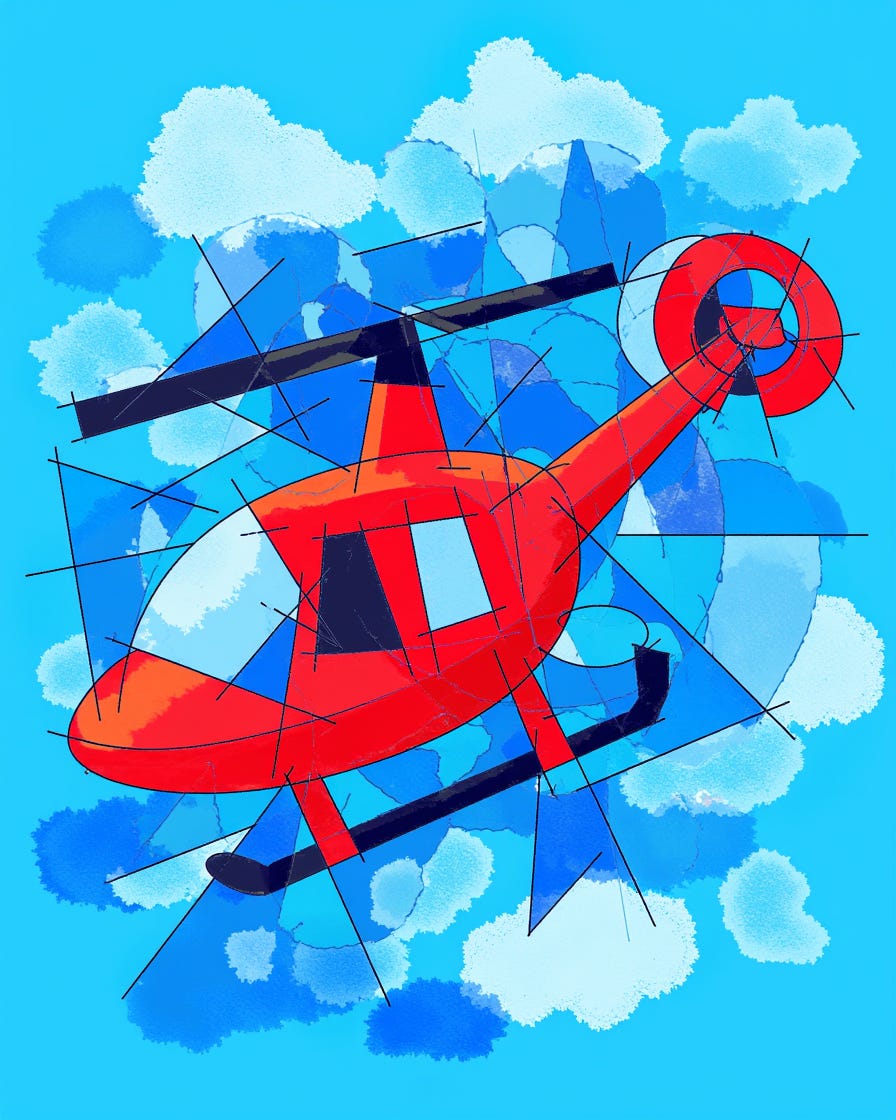
The red helicopter motif, by the way, which has been my stable pfp for several years now, was originally generated by a friend with Dalle2, based on my then-pfp of the standard helicopter emoji 🚁. My identity is now unreasonably indexed to an emoji that has now been through a few generations of AI transformations.
The publishing solution for the Bucket Art project, of course, is a hideously bespoke contraption comprising a vibe-coded single-page site, a hosted AI model, and an NFT collection. This is what it means to be slightly monstrous. Doing things like this.
More recently, I’ve finally gotten seriously into vibecoding. You’ve already seen a couple of early results: The gallery page for Bucket Art, and the updated Art of Gig site now featuring the online Yakverse Chronicles book. Both were vibe-coded without me having to touch a single line of code. Both are projects that previously I would have paid someone to do, or more likely, simply abandoned.
For my Twitter archives online book, which is a massively more complex project, I’ve already generated and used more code (github repo here) than I hand-wrote in my entire past life as a pre-AI engineer. The code is a mess, but it only needs to work once, and is cheap to produce.
I’ll publish that Twitter book (a compilation of my best tweets and threads) in a couple of weeks, and work on making it a paper book too. It’s been the sort of heavy duty data laundering pipeline project for which I’d previously have had to hire a data-science contractor.
My true white whale though, is robotics. I’ve been dabbling at the edge of my dilettante abilities for a few years now, along with my buddies at the Yak Collective, but AI tooling beyond text/images/code is finally starting to get good enough that I can do more than I ever thought I could. So I’m hoping to do a lot more with my robots in 2026.
I last did serious hands-on technical work around 2007-08, and back then I always chafed at my engineering skills not being good enough to execute on my much better engineering ideas, and having to rely on others as a result. Now that constraint is increasingly dissolving, at least at the level of the sort of prototype-scale n=1 one things I like to build.
And beyond these separate categories, who knows?
Some of the projects I’m now idly dreaming of doing would require combining writing, art, code, and hardware engineering. I don’t have any more spare time in the evenings and weekends than I used to. But I can now do a lot more in the hours I have, without needing to turn into a full-stack genius-god overnight.
What all this means — you can expect to see relatively more reports of art projects, vibe-coding projects, and robotics projects in this newsletter.
Full-Stack Dilettante Futures
Routinely reaching well beyond my native creative aptitudes is a heady feeling. Apparently, I’ve always-already been an artist/programmer/roboticist etc. It’s just that previously you had to be some sort of full-stack genius-god on the aptitudes front to express such a personality.
Now you can just invoke a full-stack-genius-god jinn to complete your natural personality for $20/month.
It’s genuinely hard, depressing, and boring to think of myself as primarily a writer now. With AI prosthetics, my natural dilettante tendencies are finding pathways for expression that simply didn’t exist before, and it is becoming clear that temperamentally, I tend towards a breadth that demands full-stack depth for realization.
This train of thought inspired a bon mot recently — a man’s reach should exceed his grasp, else what’s vibecoding for?
Before AI, writing just happened to be the only mode of creative expression I could access at low-enough cost, and without AI, given my mix of actual aptitudes and energy levels.
Looking back, in high school, I was something like the Jason Schwartzman character Max in Rushmore. Frenetically dabbling in a dozen different hobbies, from astronomy and airplanes to writing and theater, pursued with dilettantish vigor and amateurishness.
This is not a mode of being you can keep up as an adult unless you have a trust fund underwriting your life. You have to identify your best aptitudes (or in my case, my least worst ones), focus, and do your best to make a living with or near them. You have to do that “hone your craft” thing so many tedious people seem to fetishize, and which I find to be mostly hell on earth.
I’ve spent most of my life just looking for the best leverage I can find for my minimally, reluctantly honed amateur tendencies. This mostly meant gravitating to n=1 margins with so little competition, low-craft amateurishness was never the issue.
Now the jinn-tooling is gravitating to the margins too, where us dilettantes have already been camped out all our lives.
It’s time for a revenge of the dilettantes. The self-consciously deep types are going to hate it. We’re poised to take over the world, one bespoke n=1 janky contraption at a time, conjured up with the help of genius-god full-stack jinns who don’t skeptically challenge even our dumbest, shallowest ideas.
The Book Club
The highlight of the year was not any piece of writing or even non-written creative project, with or without AI. It was reading with AI.
The Contraptions Book Club, the first book club I’ve ever run, was a big success. Some thirty-odd people joined me in reading a dozen books, one a month, plus a whole bunch of side reads.
It may not be immediately obvious how AI affects a book club, but it did. Not only were at least a third of the picks AI-assisted picks (found by exploring bunny trails in search of good reads), many would not have been readable at all without an AI assistant on hand.
From translating bits of Latin or Greek in books like Giordano Bruno in the Hermetic Tradition that would otherwise have been beyond me, to exploring the dozens of obscure historical side quests sparked by each book, AI suffused every aspect of the reading process. I tackled books I would previously have set aside as too dense and scholarly to take on. So did the others in the book club.
One of the more subtle affordances of AI in the reading loop was the ability to sustain exploration of an overarching grand thesis — that modernity began much earlier than people think, around 1200 rather than around 1600.
This is the sort of ambitious thematic focus that requires not only a good deal of curation and choreography in picking the books and leading the discussions, but really only feels substantial if you can go beyond casual reading to something that resembles studying and research.
It was clear from the discussions that all the regulars were using LLMs to read around the books as much as they read through them. Not quite the same thing as close reading in the academic or scholarly sense, but something that feels perhaps more powerful. Perhaps we should call it thick reading, by analogy to thick description in anthropology. Or dense reading. I think, for every word I read in the actual books, I probably read two words in a related LLM chat.
For the actual contents of the book club, I’ve written two posts The Modernity Machine and The Modernity Machine II. I’ll do a third part soon and make a trilogy of it.
We’ll be doing a book club in 2026 too. Stay tuned for details.
The Studious Dilettante
The AI-assisted reading —> studying phase shift is even more pronounced when it comes to short-form reading (essays and papers).
For several years now, much of my free time has been structured by participation in weekly or biweekly study groups. I’m now regularly part of four such groups, and occasionally drop in on three more. The structure in each case is similar — we read for 20 minutes, then discuss for 40 minutes. Before AI, the structure meant you could at most tackle a long essay or short/simple paper. Now with AI, we often get through 2-3 dense papers or reports in a single session. There is a skill to this that can be learned and, uhh… honed.
While I’ve always been a serious reader, I’ve never been able to match the truly heavy readers in terms of volume, depth, or speed. My reading exploits, as with my creative exploits, have always been on the dilettantish side.
The idea of a studious dilettante seems like an oxymoron, but with AI in the loop, it needn’t be. AIs can do the studious part.
The trick is to find a way to rein in the the runaway chain reaction that can happen when you close the loop between idle curiosity and a jinn who either knows everything about, or will diligently think through, any idle shitposty thought that crosses your mind. The best way to do that is to form study groups with other humans, and focus on a stream of relatively dense but short texts at a steady tempo over months and years.
Humans can hold each other accountable for staying on topic in ways AIs cannot, because most of us care what other humans think of us, but most of us currently don’t care what AIs think of us. Because we suspect (correctly in my opinion) that AIs currently don’t “see us” in any manner resembling being seen by other humans at all.
But AIs can help our reach exceed our grasp, even as other humans keep us on track and on topic.
Many of my sloptraptions this year have in fact been something like private study and brainstorming notes. The sort of thing that in the past would likely have stayed in my private notebooks. With AI, study notes can easily level up to being usefully shareable artifacts. Cognitive dark matter becoming visible.
Somebody recently asked me if I try to make AI sound like myself in my sloptraptions. I don’t, partly because that would be a pain (training it on my writing is currently still a painful prospect), but mainly because much of my AI use isn’t writing so much as internal processing. My inner thought processes don’t resemble how I write, so there’s no reason to make my inner-thoughts sparring partner sound like that.
Whither Substack?
Over the past year, Substack has transformed to be more a social network of writers than a publishing platform (or as someone vividly put it, a farmer’s market of writers most of whom are engaged in keeping each other’s spirits up by buying each other’s wares).
Unless you want to fight the message of the medium, the best way to write on Substack is to collaborate and compete with other writers on themes that attract a critical mass of shared interest, while trying not to get sucked into the obsessively self-involved community dynamics, mimetic envy gyres, or attention-cornering headline themes.
There are sketchy leaderboards, badges (I got downgraded this year from solid-orange bestseller to mere outline-orange pleb), niches coalescing into mini taste-subcultures, angst and cynicism about the platform, communities of practice around gaming its incentives for profit, engagement farming playbooks being circulated, and all the other phenomena we’ve gotten used to over several generations of social media platforms.
On a timeline where AI hadn’t emerged, I would care about all this. Despite it being the tenth such platform trajectory to play out in exactly the same way.
In this timeline, where AI has emerged, I honestly can’t bring myself to care about any of it. To stress and extend that old joke, if you’re offered a seat on a rocketship, it’s dumb to argue about which seat on the horse-drawn buggy headed away from the launchpad has the best view.
Substack today features all the sound and fury signifying nothing that typically marks a cultural endgame slowly having the vitality sucked out of it because it rejects the most vital part of the future. Not least because the median writer on here reflexively hates AI. And of course, also because the team behind the platform has always exhibited a somewhat nostalgic design sensibility in their stewardship of the platform, focused more on revivifying the forgotten glories of old media than pioneering the mechanics of new media. They’ve already retreated from advances made by the blogosphere a decade ago, so it would be unreasonable to expect them to bet the farm on AI advances yet to be made. Maybe they’ll prove me wrong, but I’m not expecting much by way of Substack becoming an AI-forward platform. Not that I blame them. If they tried anything remotely ambitious, they would face a huge revolt from their core publisher audience.
The future, as I have noted, for reasons having nothing to do with Substack, is about AI-powered bespokeness and variety in the media landscape. In both form and content. It’s not going to come here. If you’re interested in it, you have to go elsewhere to seek it out.
That said, Substack is still a great place to host a basic newsletter, rig up some no-worries payment plumbing to make some money, and stay in touch with other writers you want to track or be tracked by. It’s a publishing Schelling point, enabled by the less-than-ideal commons-enclosing mechanism of paywall culture. It is not a publishing frontier. This is the place to be because this is the place to be. Nothing more, nothing less. So I’ll remain here while that remains true.
But it is already not the place where any sort of interesting creative future is unfolding. There’s merely a past winding its way (hopefully with some grace and humor) to some sort of respectable denouement. A gated retirement community for an entire civilizational cultural mood.
Which means, increasingly, this is not where my attention will be, but for the forseeable future, it is going to remain the easiest place to tell you about where my attention has been. So more posts are going to sound like Dispatches from Elsewhere.
So, I’ll see you in 2026 with more AI shenanigans, more book-clubbing, more monstrousness, and more Dispatches from Elsewhere.
Happy holidays!
Been tossing out ideas of switching to other platforms mostly to see what other people are thinking. My conclusion: no one has strong stances on being anywhere right now 😂
FWIW - I have appreciated and enjoyed following your work this year. From the "sloptraptions", to the book club, to reading and enjoying the fiction on Protocolized. Looking forward to what 2026 brings!